
US Enforces Naval Blockade in Strait of Hormuz Amid Rising Tensions with Iran
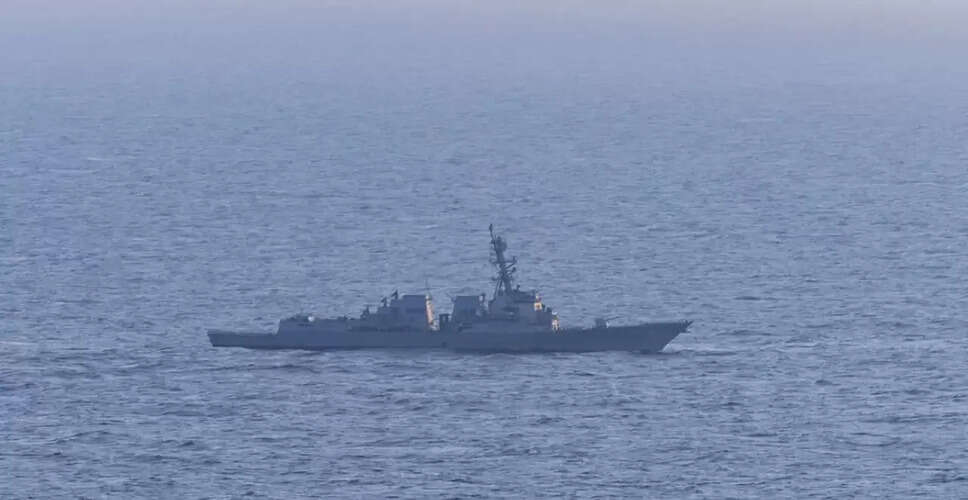

US Military Blocks Iranian Ships
Tehran: On Thursday, the United States military announced that no vessels departing from Iranian ports are permitted to navigate through the Strait of Hormuz. The Central Command of the US, which oversees military activities in the Middle East, reported that an Iranian cargo ship attempted to bypass the US blockade after leaving Bandar Abbas but was intercepted and redirected back. Since the blockade was implemented on Monday, the US military claims to have turned back ten vessels.
According to the US Central Command, "Yesterday, an Iranian-flagged cargo vessel attempted to evade the U.S. blockade after departing Bandar Abbas and was successfully redirected by the guided-missile destroyer USS Spruance (DDG 111) back to Iran." They further stated, "Ten vessels have now been turned around, and no ships have successfully passed through since the blockade began on Monday." However, maritime tracking data suggests otherwise, indicating that at least three ships left Iranian ports and traversed the critical waterway, as reported by The Times of India.
Iran's Response to US Actions
Iran's Warning to the US: Mojtaba Khamenei, a military advisor to Iran’s Supreme Leader, issued a stern warning on Wednesday (April 15), threatening to target US vessels if the naval blockade persists in the Strait of Hormuz. Speaking on state television, Mohsen Rezaei cautioned that Iran would retaliate against any US attempts to control the vital waterway. He questioned, "Is it really the role of a powerful army like the US to act as the police of the Strait of Hormuz?"
Rezaei, who previously led Iran’s Islamic Revolutionary Guard Corps (IRGC), asserted that Iran possesses the capability to sink US ships with missiles, stating, "These ships will be sunk by our first missiles, posing a significant threat to the US military. They are certainly vulnerable to our missiles, and we can destroy them," as reported by news agencies.
US Naval Operations in the Region
US Naval Blockade: The US has initiated a naval blockade in the Strait of Hormuz, deploying at least 15 warships, including the amphibious assault ship USS Tripoli (LHA 7), which is currently operating F-35B Lightning II stealth fighters and MV-22 Ospreys in the Arabian Sea. The Central Command confirmed that the blockade commenced at 1400 GMT on Monday.
The Strait of Hormuz is crucial, accounting for 20% of the global crude oil and liquefied natural gas (LNG) supply. Following US and Israeli airstrikes on Tehran on February 28, the IRGC has effectively blocked this vital passage, leading to an energy crisis affecting West Asia and Europe.