
US Deputy Secretary of State Emphasizes Caution in Economic Relations with India
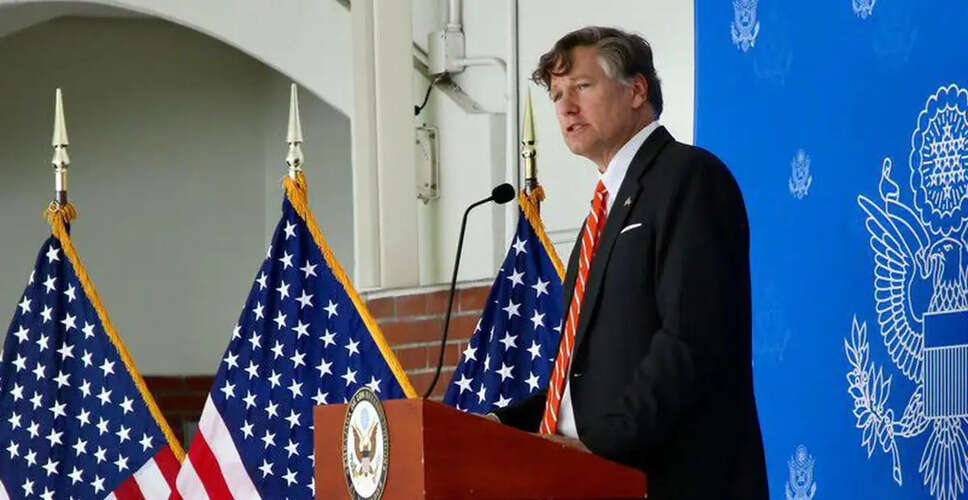
US Stance on Economic Relations with India
On Thursday, Christopher Landau, the Deputy Secretary of State for the United States, stated that the US will not extend the same economic privileges to India that it previously granted to China, which he believes contributed to China's rise as a significant competitor, according to reports.
During his address at the 2026 Raisina Dialogue, Landau expressed the US's desire to collaborate with India to harness its vast potential. He emphasized that the US aims to avoid repeating past mistakes made with China two decades ago.
The Raisina Dialogue is an annual event hosted in New Delhi, organized by a prominent think tank in collaboration with the Ministry of External Affairs.
Earlier in the week, Landau mentioned his visit to India was part of efforts to promote President Trump's 'America First' policy at the Raisina Dialogue.
The 'America First' initiative refers to the trade and foreign policies that prioritize US interests, which were implemented during Trump's administration. Tariffs imposed by the US in April 2025 affected numerous countries, including India, as part of these policies.
These tariffs were later reduced following the establishment of bilateral trade agreements with various nations.
Specifically regarding India, tariffs under the 'America First' policy were lowered after an interim trade agreement was reached on February 2, which aimed to decrease US tariffs on Indian goods from a combined rate of 50% to 18%. This initial rate included a punitive 25% tariff imposed in August due to India's purchase of Russian oil.
However, discussions on finalizing the trade deal have been delayed after the US Supreme Court ruled on February 20 that Trump's global tariffs were unconstitutional, stating he had overstepped his authority.
The court determined that the 1977 International Emergency Economic Powers Act did not grant the president the power to impose tariffs.
Following this ruling, Trump enacted a temporary 10% tariff on imports into the US, citing his authority under the 1974 Trade Act.
This new tariff is set for a maximum duration of 150 days unless Congress approves an extension.
Additionally, on February 21, Trump announced an increase in tariffs to 15% from 10%, although the timeline for this increase remains uncertain.
This situation has created ambiguity regarding the status of trade agreements between the US and other countries, including India.
India and the US postponed a three-day meeting scheduled to start on February 23, which was intended to finalize the legal text of the trade agreement. On February 24, Union Commerce Minister Piyush Goyal indicated that negotiations would resume once there is more clarity on the tariff changes announced by the US.
Landau's visit to New Delhi occurs amidst ongoing uncertainty regarding trade negotiations with India and the situation in West Asia.
He reiterated that it is in both Washington's and India's interests to collaborate, stating, 'We have numerous win-win scenarios with India.'
Landau expressed enthusiasm about the impending trade deal, suggesting it is nearing completion, as reported by a local news outlet.
Energy Cooperation Amidst West Asia Conflict
Landau also addressed energy cooperation, indicating the US's readiness to assist India in meeting its energy requirements, especially in light of supply disruptions caused by the ongoing conflict in West Asia.
He stated, 'We will collaborate with you to ensure your energy needs are fulfilled both in the short and long term.'
When asked if the US would permit India to purchase Russian oil amid the conflict, Landau suggested that India should consider alternative sources, highlighting the US as a viable option due to its energy resources.
His remarks coincided with the US granting Indian refiners a 30-day waiver to acquire Russian oil that was stranded at sea due to the conflict.
US Treasury Secretary Scott Bessent noted that this decision is a temporary measure aimed at maintaining global oil supply amid disruptions caused by the conflict.
He clarified that this measure would not significantly benefit the Russian government, as it only allows for the trade of oil already stranded at sea.
India relies heavily on oil and gas imports, fulfilling approximately 80% to 85% of its energy needs through foreign sources.
As of Friday, the price of benchmark Brent crude had surged to $84 per barrel following a joint operation by Israel and the US aimed at undermining Iranian capabilities.
In retaliation, Iran launched strikes against Israel and US military installations in the region, targeting major cities in Gulf countries and various vessels.
Reactions to US Economic Strategy
In response to Landau's comments regarding the US's cautious approach to India's economic growth, former Indian diplomat Kanwal Sibal questioned the rationale behind delivering such a direct message.
Sibal remarked, 'He is preemptively indicating that the US will manage and regulate India's economic ascent. We must incorporate this understanding into our decision-making processes. The appropriate response is to minimize the leverage we provide to the US, diversify our economic partnerships, and focus intently on self-reliance.'
What is the point in giving such a blunt message?
— Kanwal Sibal (@KanwalSibal) March 5, 2026
In advance he is telling us that the US will control and calibrate India’s economic rise.
We should internalise this in our decision making.
The response to this is to avoid giving sufficient levers to the US to control us,… https://t.co/SrwMX2Rrwt