
US Deploys F-22 Raptors to Israel: A Shift in Military Strategy
Introduction to the Deployment
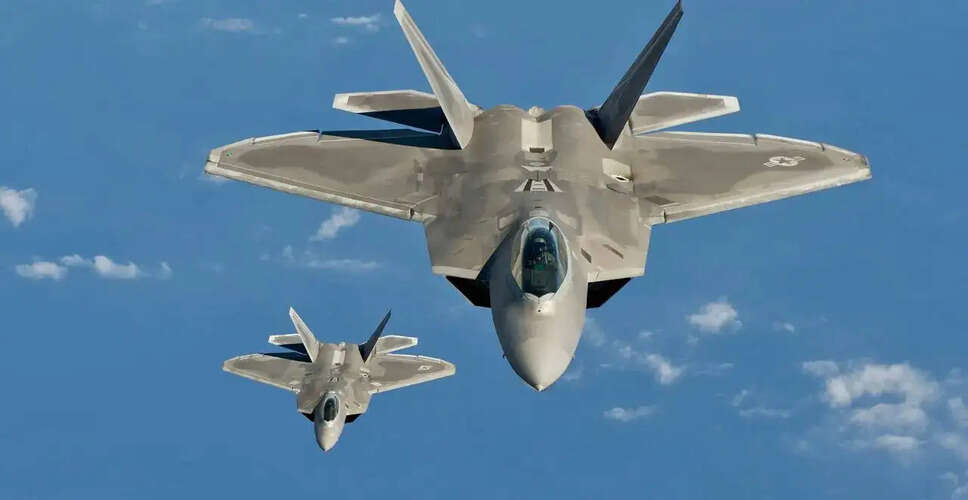
For many years, the United States refrained from permanently stationing offensive combat aircraft in Israel, primarily to maintain good relations with Arab nations in the region. However, this approach has changed recently. The US has now stationed F-22 Raptors at Israeli air bases, marking the first instance of these advanced stealth fighters being deployed there for potential wartime scenarios involving Iran.
This deployment occurs against a backdrop of escalating tensions with Iran and uncertainty regarding access to regional bases. Although US Central Command has not made any public statements and the Pentagon has not officially confirmed the deployment, videos of F-22 jets arriving in Israel have surfaced on social media platforms.
The F-22, utilized by the US Air Force, is recognized as one of the most sophisticated air superiority fighters available. It excels in air-to-air combat, precision strikes, and providing escort for bombers. Retired Major General Charles Corcoran, a former F-22 pilot, has previously noted that the aircraft can conduct strikes, escort bombers, and defend against cruise missiles and one-way attack drones.
Strategic Context: Iran and Basing Challenges
Strategic Context: Iran and Basing Challenges
The timing of this deployment is crucial. As President Trump intensifies pressure on Tehran regarding its nuclear and missile programs, Iranian leaders have warned that any military action would lead to retaliation across the region. The Islamic Revolutionary Guard Corps has stated that bases supporting US operations would be legitimate targets.
The U.S. has quietly moved an entire squadron of F-22 Raptors to an air base in southern Israel. This is an unprecedented deployment outside American borders. Over the past 24 hours, transport and refueling aircraft have arrived, along with a passenger jet carrying support… pic.twitter.com/zZK7CFVQ9p
— South Asia Watch (@MuhammadAli_PhD) February 26, 2026
Adding complexity to US military options, both Saudi Arabia and the United Arab Emirates have reportedly expressed their unwillingness to permit American forces to utilize their territories or airspace for any potential strikes against Iran. The concentration of US aircraft at bases like Muwaffaq Salti Air Base in Jordan raises concerns about vulnerability and reliance on limited locations. By relocating aircraft to Israel, the US enhances its operational flexibility. Israel's comprehensive air defense systems, including Iron Dome, David’s Sling, and Arrow, provide additional security for valuable assets like the F-22.
A Shift in US Policy
A Shift in US Policy
Traditionally, US military leaders maintained a distance from direct integration with Israel’s military to avoid straining relations with Arab coalition partners. Prior to 2021, Israel was categorized under US European Command rather than Central Command to mitigate diplomatic sensitivities. However, following the signing of the Abraham Accords, Israel was transitioned into Central Command’s area of responsibility, allowing for deeper operational collaboration.
Former US official Dennis Ross has characterized the operation of combat aircraft from Israeli bases as unprecedented, labeling it as a significant first. This deployment is part of a broader reassessment of US military posture in the Middle East. For over three decades, the US has avoided stationing offensive aircraft in Israel to prevent regional backlash. Nevertheless, the current deployment indicates a shift in strategic calculations, particularly in light of Iran’s actions.
It remains uncertain whether the presence of F-22 Raptors in Israel is intended solely for deterrence or if it is part of a more extensive operational strategy. What is clear is that a long-standing boundary in US-Israel military cooperation has been crossed, indicating a more integrated approach as tensions with Tehran escalate.