
US Aircraft Carriers Mobilize in Middle East Amid Rising Tensions
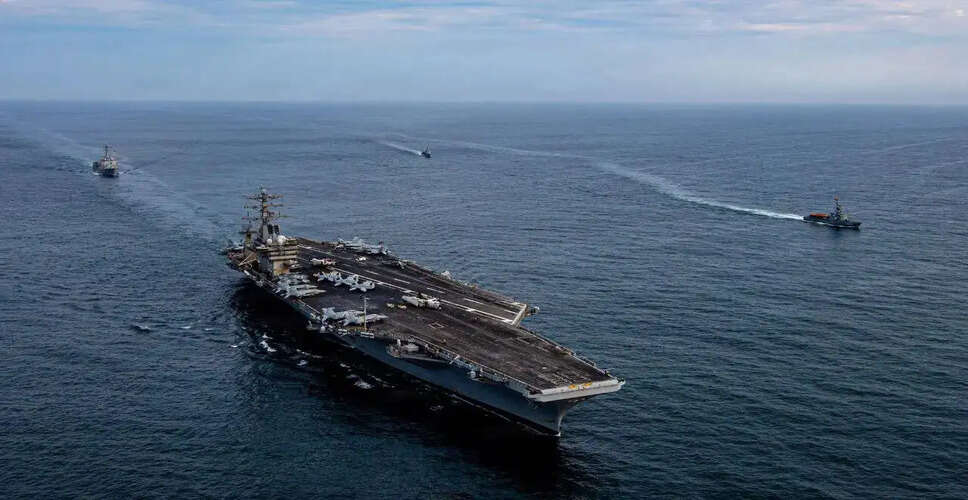

Significant Military Presence in the Middle East
Recent military movements have shifted from routine to suggestive of intent. The US Central Command announced on Friday that three American aircraft carriers are currently operating together in the Middle East, a scenario not witnessed since 2003. While this may appear as a standard deployment update, it carries deeper implications.
The three carriers — USS Abraham Lincoln, USS Gerald R. Ford, and USS George H.W. Bush — are not merely present; they are actively operating in unison, each accompanied by its complete strike group. This coordination brings over 15,000 personnel into a single operational area, supported by extensive naval and aerial capabilities. While numbers are significant, they do not fully convey the implications of this deployment.
For the first time in decades, three aircraft carriers are operating in the Middle East at the same time. Accompanied by their carrier air wings, the USS Abraham Lincoln (CVN 72), USS Gerald R. Ford (CVN 78) and USS George H.W. Bush (CVN 77) include over 200 aircraft and 15,000… pic.twitter.com/fbMdz1IYn8
— U.S. Central Command (@CENTCOM) April 24, 2026
Each carrier operates its own air force, and collectively, they deploy over 200 aircraft, including electronic warfare platforms like the Growler, stealth fighters such as the F-35C, and strike aircraft capable of launching without relying on regional bases. This effectively establishes a mobile air campaign that can maneuver across the Gulf at will. However, CENTCOM has remained largely silent regarding the reasons for this timing.
Strategic Positioning and Ambiguity
Not Just Deployment — Positioning
The lack of detailed information is intentional. Alongside the three carriers, at least twelve additional ships, including destroyers and cruisers, are part of the larger formation, yet there is no official clarity on operational timelines or goals. This ambiguity allows for various interpretations, which is where the real message lies.
This military buildup coincides with escalating tensions with Iran, particularly around the Strait of Hormuz. Disruptions in shipping, selective passage, and a US-imposed blockade have already changed traffic patterns in one of the world's most vital energy corridors. The presence of these carriers plays a crucial role in this dynamic, enhancing the credibility of enforcement efforts.
Navigating Risks and Pressures
Blockade, Pressure And The Risk Of Overreach
The naval buildup is occurring alongside an active US blockade aimed at Iranian ports. CENTCOM has reported that at least 34 vessels have been “redirected” since the operation commenced on April 13. The term “redirected” implies intervention in international shipping routes, and with three carrier strike groups in the region, this intervention is supported by formidable military force.
US Defence Secretary Pete Hegseth has indicated that there is no immediate endpoint to this operation, stating it will continue “as long as it takes.” This language suggests not only persistence but also a willingness to escalate if necessary.
However, it remains uncertain how far this military posture can advance without provoking a direct response. Iran has already indicated its view of the blockade as illegitimate. Regional players are observing closely, and global markets, especially in energy, are reacting in real-time. For Washington, this deployment signals control, but for others, it raises concerns about whether such a concentration of naval power stabilizes the situation or pushes it toward a more volatile state.