
Urgent Action Needed to Combat Vulture Poisoning Crisis in Assam
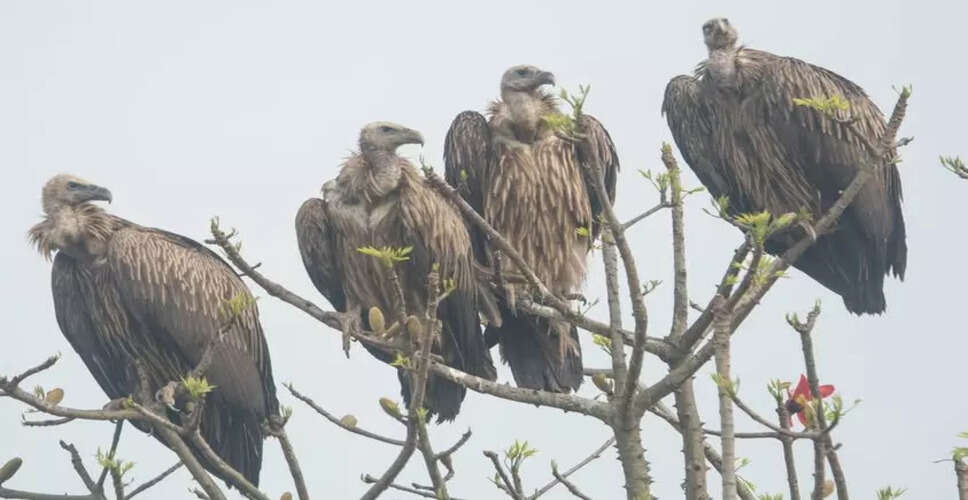
Critical Conservation Challenge
Amingaon, March 7: The issue of accidental vulture poisoning due to carbofuran, a highly toxic pesticide, has emerged as a significant conservation challenge in Assam, necessitating immediate intervention.
Experts have highlighted the urgent need for the registration of both sellers and buyers of this pesticide, which remains accessible in the market.
Dipankar Lahkar, assistant director and senior conservation biologist at Aaranyak, emphasized the detrimental impact of this chemical, stating, 'Commonly referred to as furadon, it is primarily responsible for the deaths of vultures in Assam. This pesticide, often used by farmers, poses a hidden threat to these birds.'
He further explained that livestock herders might unintentionally endanger vultures by poisoning cattle carcasses to deal with feral dogs that prey on their livestock, resulting in vulture fatalities as they scavenge on the tainted remains.
'This represents yet another blow to the already endangered species, warranting classification as an environmental crime,' remarked Dharani Dhar Boro, a forest officer and Assam Gourav awardee.
Lahkar advocated for stringent legal actions against such offenders, noting, 'Without records of buyers and sellers, authorities struggle to take action due to insufficient evidence during investigations. Implementing a mandatory registration system for carbofuran transactions is crucial to effectively address this pressing issue.'
He added that such a system would enhance accountability and facilitate the prosecution of wrongdoers, potentially reducing accidental poisoning incidents.
Since 2018, carbofuran has been identified as a key factor in vulture deaths, with approximately 700 vultures reported dead in Assam due to accidental poisoning.
Lahkar expressed deep concern regarding the situation in Kamrup, where the district has faced severe challenges. An official from the Kamrup West Forest Division reported that 13 vultures succumbed to poisoning in the division in 2025.
'Many people remain unaware of the pesticides banned by the Central government. Veterinary sub-centres should display posters listing these banned substances, along with their harmful effects on vultures, to prevent their use by the public,' Lahkar urged.
Boro stressed the importance of community involvement in addressing this issue, stating that local engagement is vital given the seriousness of the situation.
He emphasized the need to educate the community about the ecological significance of vultures and the consequences of their decline.
Regarding carbofuran, Boro called for closer monitoring of its sellers and buyers.
Boro has participated in numerous awareness meetings in the Kamrup West Forest Division, attended by village leaders and members of the Village Defence Party.
'Our extensive community-led awareness initiative, supported by the Assam Forest Department, Assam Forest School, Chhaygaon Police Station, and Chhaygaon Circle Office, has yielded significant results,' Lahkar noted, adding that this campaign has led to zero vulture deaths from November 2025 to February 2026 in Kamrup.
It is important to highlight that the period from November to March is critical for vultures, as resident species breed and migratory Himalayan Griffons join local populations, forming large mixed groups.
Lahkar also expressed alarm over the declining number of nests in lower Assam, pointing out that the significant reduction in nesting sites is concerning, given that vultures typically nest in large, tall trees like cotton trees.
Habitat destruction severely affects vulture nesting success and population stability.
Boro called for plantation drives to restore habitats by planting tall tree species, urging the state forest department to involve the public actively.