
Unveiling History: 14th-Century Inscription Reveals Military Triumph in Andhra Pradesh
Significant Discovery at Dharmalingeswar Temple
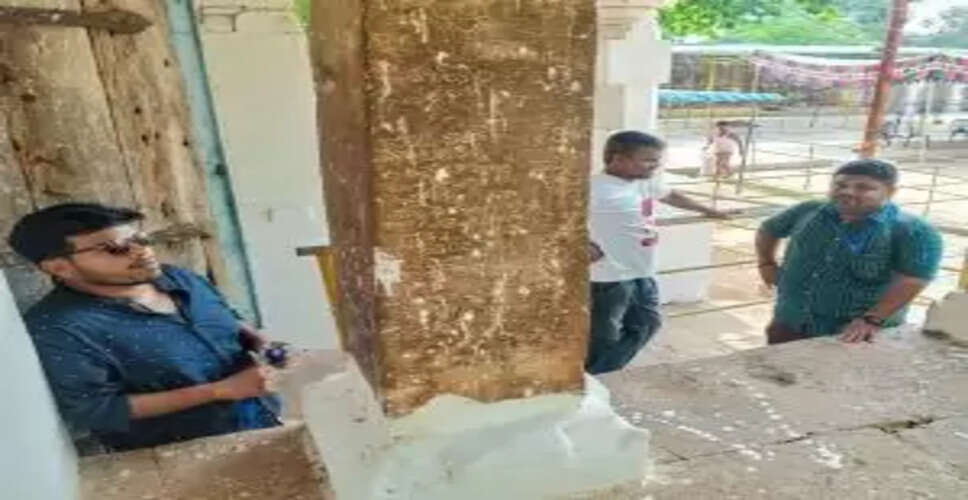
Bhubaneswar: A remarkable inscription dating back to the 14th century has been uncovered at the Dharmalingeswar Temple located in Panchadharla, Anakapalli district, Andhra Pradesh. This finding highlights a previously unrecorded military victory achieved by the Eastern Ganga dynasty of Utkala in alliance with the Haihaya rulers against the forces of Delhi's Tughlaq dynasty. The inscription is discussed in a newly published book titled 'Relics of Kalinga in South India, Part-I', released by the Indian National Trust for Art and Cultural Heritage (INTACH), Odisha Chapter. The inscription, etched on a three-faced black stone pillar at the temple's eastern entrance, was documented in November 2024 by a team from INTACH, which included project coordinator and author Deepak Kumar Nayak, epigraphist Bishnu Mohan Adhikari, and surveyor Suman Prakash Swain.
The inscription, composed in Sanskrit using the Telugu script, is dated to Saka Samvat 1325 (1403 CE) during the reign of King Choda III of the Haihaya dynasty. Notably, verse 16 of the 93-line inscription indicates that Choda III erected a gopura (gateway) and a grove at the temple's entrance to commemorate the victory over Firuz Shah Tughlaq of Delhi, achieved by Choda II, a predecessor and subordinate of Eastern Ganga king Bhanudeva III, who ruled Utkala (modern Odisha).
According to epigraphist Adhikari, following this victory, Choda II presented 22 elephants to Bhanudeva III and offered dancing girls to the Sultan of Pandua as 'Bijayashri'—symbols of victory. The inscription implies that the Sultan of Pandua may have been a vassal or allied commander under the Eastern Ganga ruler. The Haihayas of Panchadharla governed the southern Kalinga region, including Simhachalam and Panchadharla, from the 12th to the 14th centuries CE. This discovery reinforces the significant influence of the Eastern Ganga dynasty and the vital role of regional powers like the Haihayas in countering northern invasions during medieval India.