
Unraveling the 1979 'Double Flash' Incident: A Nuclear Mystery
The 1979 Incident Resurfaces Amid Current Tensions
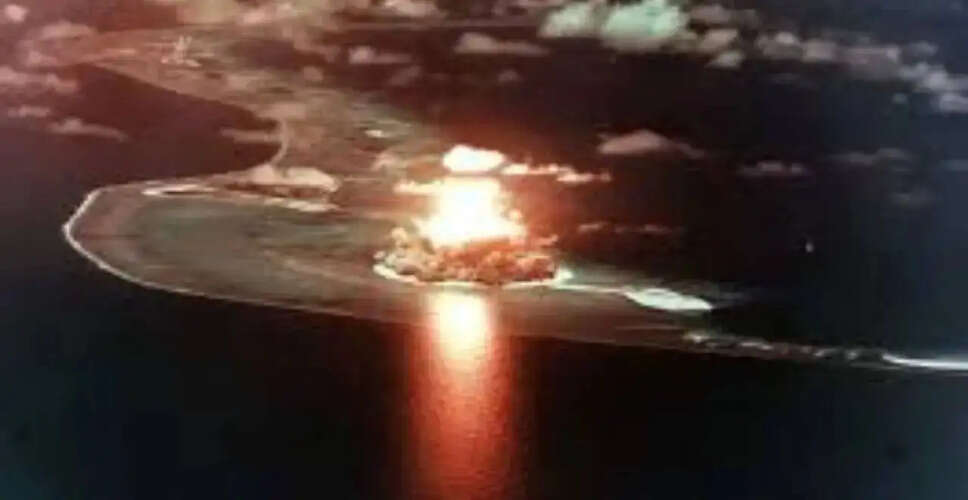
Recent tensions involving the United States, Israel, and Iran have reignited interest in the enigmatic 'Double Flash' event that occurred in 1979 over the Indian Ocean. On September 22, 1979, at approximately 3 AM, a US satellite detected an unusual signal characterized by a "double flash" of light, a phenomenon that scientists associate with a nuclear explosion. This satellite, part of the American Vela monitoring system, was orbiting near the Prince Edward Islands, located off the southern coast of Africa, when it captured the signal. The Vela satellites were specifically designed to monitor compliance with nuclear test bans, equipped with sensors to detect the unique light signatures produced by nuclear detonations.
'Double Flash' Ignites Controversy
'Double Flash' Sparks Debate
A report from the Wilson Centre in 2019 indicated that the initial response from the US government suggested the satellite might have recorded a covert nuclear test. Early intelligence assessments estimated a "90 percent plus" likelihood that the event was indeed a nuclear test. Some analysts speculated that the light signal resembled a low-yield nuclear explosion. The focus of suspicion narrowed to two nations: South Africa, which was in the process of developing nuclear capabilities, and Israel, or possibly a collaboration between the two. However, further investigations complicated the narrative. US intelligence agencies analyzed satellite data, atmospheric conditions, and oceanic factors, but no definitive explanation for the "double flash" emerged.
'Zoo Event' Hypothesis
'Zoo Event'
A panel led by MIT professor Jack Ruina concluded that the incident was likely a non-nuclear occurrence, potentially a "zoo event"—such as a meteoroid striking the satellite or another technical glitch. This interpretation became the unofficial stance of the US government, although skepticism lingered within certain intelligence circles. Some experts continued to suspect a clandestine nuclear test possibly involving Israel and South Africa, while others proposed that the satellite may have malfunctioned or recorded an unusual natural phenomenon. Over four decades later, the mystery remains unsolved. In November 2019, historians and former officials revisited the case, examining newly declassified documents and personal accounts, yet the consensus remained that while the satellite detected something unusual, its precise nature could not be clarified. This incident has evolved into one of the most enduring enigmas in nuclear history.
Suspicion Towards Israel
Why Suspicion Fell On Israel
US intelligence has long held the belief that Israel possesses nuclear weapons, despite Tel Aviv's lack of public acknowledgment. Internal assessments dating back to 1969 indicated that Israel had crossed the nuclear threshold. National security adviser Henry Kissinger prepared a memorandum for President Richard Nixon, suggesting that Israel had acquired missiles capable of delivering nuclear warheads and might already have several in its arsenal. Israel assured the US that it would not be the "first to introduce nuclear weapons into the Middle East." However, US policymakers later inferred that Israel might have interpreted "introduce" narrowly, meaning it would not openly test or declare its nuclear capabilities, even if it possessed them. This understanding underpinned Israel's long-standing policy of nuclear ambiguity. In September 1969, Nixon and Israeli Prime Minister Golda Meir reached an agreement: the US would refrain from publicly pressuring Israel regarding its nuclear capabilities, while Israel would keep its arsenal confidential. Against this backdrop, the signal detected in 1979—near waters where Israel was believed to have strategic ties with South Africa—naturally raised suspicions in Washington. Former President Jimmy Carter, in his 2010 memoir, expressed his belief that Israel was responsible for the incident. In February 1980, he noted that American scientists increasingly suspected that Israel had conducted a nuclear explosion in the ocean near the southern tip of Africa. His national security adviser, Zbigniew Brzezinski, echoed this sentiment in a 2016 interview, reinforcing the belief among some US officials that Israel may have executed a covert test.