
Understanding Palantir Technologies: The Company Behind Trump's Praise
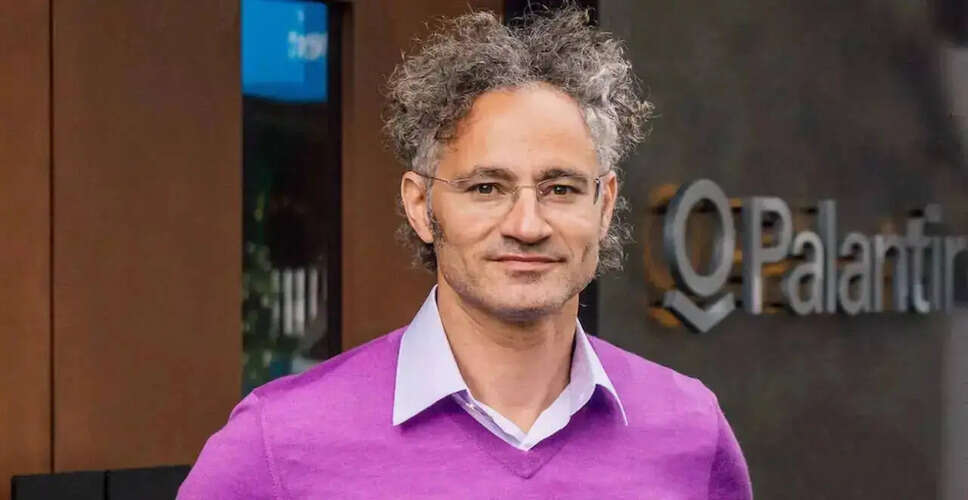

Introduction to Palantir Technologies
On Friday, Donald Trump took to Truth Social to commend Palantir Technologies, prompting many outside the defense and tech sectors to wonder about the company and the reason behind the president's endorsement of its stock. The inquiry leads to one of Silicon Valley's most distinctive personalities.
Trump's Endorsement Amid Stock Decline
Trump's Post and the Stock Slide
Trump's endorsement came at a challenging time for Palantir, as the company's stock experienced a 14% drop last week, marking its largest weekly decline in a year. Nevertheless, the president praised the firm, stating, "Palantir Technologies has proven to have great war fighting capabilities and equipment. Just ask our enemies!!!" This post quickly attracted attention, with the watchdog group Citizens for Responsibility and Ethics in Washington noting that Palantir had previously sponsored several events during the Trump administration and contributed to the White House ballroom project. They suggested that Trump's mention of the company's stock ticker might have been an effort to boost the price of a significant supporter struggling in recent months.
RapidResponse47
2042612218219352359
Reports indicate that the U.S. military is utilizing Palantir's AI-driven Maven Smart System for target identification in the Middle East, linked to operations against Iran that commenced in late February. Notably, the Pentagon, ICE, and other government entities account for over half of Palantir's revenue in the U.S.
Who is Alex Karp?
So Who Is Alex Karp?
Alex Karp, who practices Tai Chi before interviews and speaks fluent German, holds a doctorate in social theory from Goethe University in Frankfurt. He intentionally diverges from the typical Silicon Valley CEO mold. Raised in Philadelphia by a Jewish pediatrician and a Black artist, both involved in social activism, Karp faced challenges with dyslexia as a child, which influenced his abstract thinking. He studied philosophy at Haverford College before attending Stanford Law School, which he later described as a difficult experience.
Instead of following the conventional path after law school, Karp relocated to Germany, dedicating nearly a decade to a doctoral thesis on aggression, language, and culture, heavily influenced by German philosopher Jürgen Habermas. This unique journey shaped his approach to building and managing a company.
The Origins of Palantir
How Palantir Came to Be
Prior to co-founding Palantir, Karp managed investments from his grandfather's inheritance and led a London-based firm called Caedmon Group. This role kept him connected to Peter Thiel, whom he met at Stanford. In 2003, Karp, Thiel, and co-founders Joe Lonsdale, Stephen Cohen, and Nathan Gettings aimed to create software capable of analyzing vast, complex datasets, a need highlighted by post-9/11 intelligence agencies. Early funding came from the CIA's venture arm, In-Q-Tel, and the company's initial clients included the FBI, CIA, and Department of Defense, with its tools aiding in battlefield data analysis in Afghanistan and disrupting terror networks. For years, Palantir operated under the radar, but that has changed.
Today, Palantir's clientele includes the U.S. Department of Defense, CIA, FBI, the UK's National Health Service, and major corporations like Ferrari, Merck, Airbus, and BP. In 2024, the company reported nearly $2.9 billion in revenue, largely driven by new AI implementations.
Karp's Complex Identity
A Man Who Defies Easy Labels
Karp identifies as a socialist and progressive, yet he has long advocated for U.S. military strength and defended Palantir's collaborations with defense and law enforcement agencies. His rationale is straightforward, albeit contentious: it is preferable for democracies to control powerful technology rather than allowing authoritarian regimes to take the lead. This stance has not come without repercussions; Karp's outspoken support for Israel following the October 7 Hamas attack led to some employees leaving the company. He has also defended the use of Palantir's tools for monitoring immigrants and, in certain instances, American citizens.
His relationship with the Trump administration is complex. Despite having previously donated to Joe Biden's campaign and criticizing Trump, Karp has aligned with the current administration's priorities. This shift raised concerns within his company, with Palantir's communications chief Lisa Gordon describing it as "concerning" in an interview last October, although the video was quickly removed from social media.
Karp's Unique Position in Silicon Valley
An Outsider Who Built Something Inescapable
Karp has never fully fit into the Silicon Valley mold. He grew up in a far-left household, opted for German philosophy over an MBA, and created a company that contrasts sharply with the ad-driven platforms prevalent in the tech industry. While others focused on monetizing attention, he developed software aimed at safeguarding democratic values. Whether one finds this perspective convincing or troubling often depends on their viewpoint. With Trump now publicly endorsing the company during a week of stock decline, both Palantir and its unconventional CEO are firmly in the public eye.