
Understanding 5-Star Car Safety Ratings: What They Really Mean

The Importance of Safety Ratings in Car Purchases
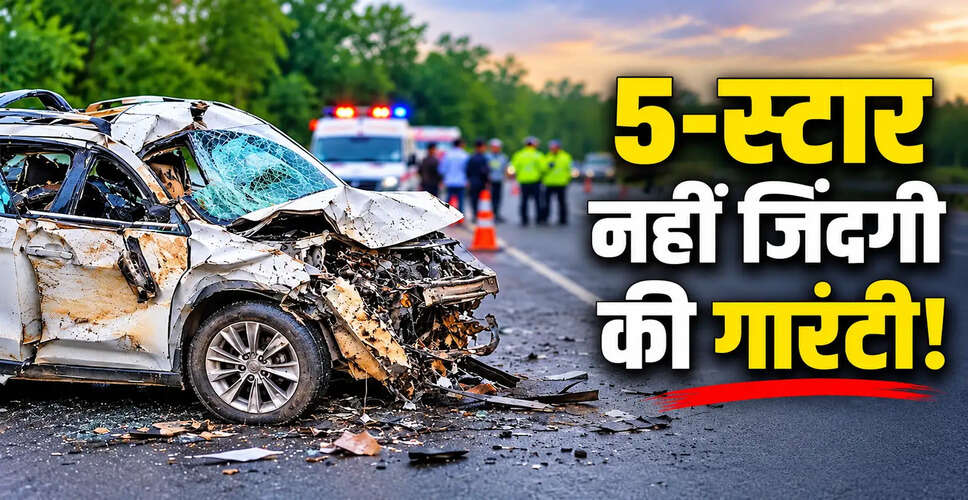
When purchasing a vehicle, buyers often consider its price, mileage, design, features, and safety ratings. Nowadays, cars with a 5-star safety rating are regarded as some of the safest options available. However, does a 5-star rating guarantee that passengers will be safe in all situations? The answer is no. In India, crash tests conducted by NCAP and Global NCAP are performed under controlled conditions and at specific speeds. Therefore, a car that passes a test at 64 kilometers per hour may not provide the same level of safety at 120 kilometers per hour.
Crash Tests Conducted at 64 Kilometers Per Hour
Under the India NCAP framework, various crash tests are performed to assess vehicle safety. These include frontal offset, side impact, and pole side impact tests.
- Frontal Offset Test: In this test, a car collides with a specific barrier at a speed of 64 kilometers per hour, impacting approximately 40% of the front section.
- Side Impact Test: A barrier traveling at 50 kilometers per hour strikes the side of the car.
- Pole Side Impact Test: This test involves the car colliding with a sturdy pole at a speed of 29 kilometers per hour.
During these tests, specialized crash test dummies equipped with sensors are placed inside the vehicle to measure the impact on the head, neck, chest, and legs during a collision.
Differences Between India NCAP and Global NCAP
Both India NCAP and Global NCAP evaluate vehicle safety, but their testing protocols and evaluation criteria differ.
India NCAP considers adult occupant protection (AOP), child occupant protection (COP), and safety assist technology (SAT). In contrast, Global NCAP has tightened its testing protocols since July 2022, emphasizing frontal crash tests, side impacts, child safety in rear seats, and seat belt reminders. Therefore, the star ratings from these two organizations should not be directly compared.
How Speed Affects Safety
As a vehicle's speed increases, the kinetic energy released during a collision also rises significantly. According to physics, the kinetic energy of a moving vehicle is proportional to the square of its speed.
For instance, if a car's speed is increased from 64 kilometers per hour to 128 kilometers per hour, its kinetic energy quadruples. This is why the severity of damage in an accident can escalate dramatically at higher speeds.
Consequently, a car that achieves a 5-star rating at 64 kilometers per hour may not be as safe at speeds of 100 or 120 kilometers per hour.
What Does a 5-Star Rating Indicate?
A 5-star safety rating signifies that a vehicle has performed well in designated crash tests and met safety standards. However, it does not guarantee that the car will protect passengers in every type of accident.
Key Factors in Vehicle Safety Include:
- A robust body structure
- Airbags and seatbelt systems
- Electronic stability control
- ISOFIX arrangements for child safety
- Crumple zones that manage energy during a crash
Additionally, it's crucial to consider not just the car model but also its variant and the safety features it includes.
Why Serious Accidents Can Occur Despite High Ratings
There are instances where vehicles with excellent safety ratings are involved in severe accidents. Various factors contribute to this, such as high speeds, collisions with heavy vehicles, impacts with trees or poles, failure to wear seatbelts, and vehicle rollovers.
Moreover, the lack of timely medical assistance post-accident can exacerbate the situation. Therefore, one cannot solely rely on the number of airbags or star ratings to gauge a car's overall safety.
Driving Safely: Key Considerations
While a car's safety rating is an essential criterion during the purchasing process, responsible driving is equally vital for road safety. Always adhere to speed limits, wear seatbelts, maintain a safe distance, and stay focused on the road.
Remember, a 5-star rating indicates a car's safety potential, but it does not guarantee complete protection in the event of an accident. Controlled speeds and adherence to traffic rules are paramount for ensuring safety on the road.