
UK Indians Rally in London to Support Delhi Protesters: What’s Behind the Solidarity?
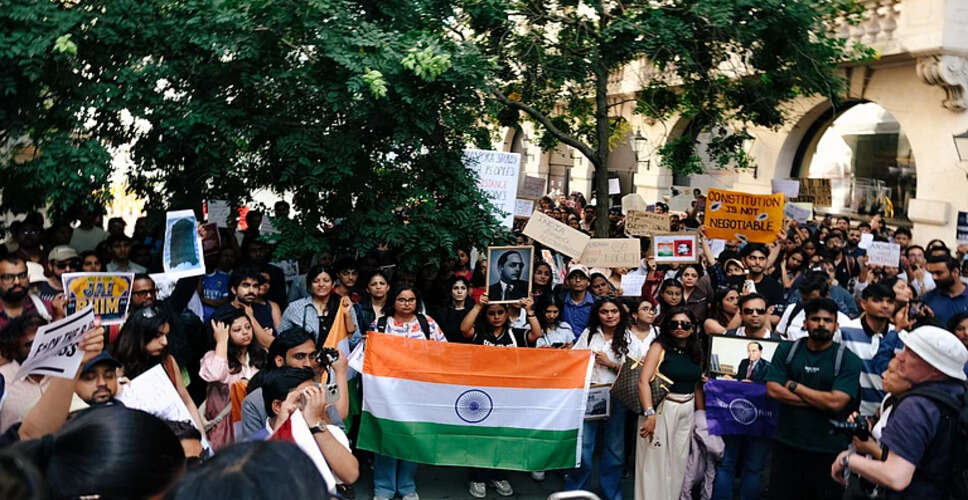

Protest in London Shows Support for Delhi Demonstrators
London: A group of diaspora organizations in the UK staged an "Emergency Protest" outside the Indian High Commission in London to express their support for the ongoing protests in New Delhi.
Organized by the South Asia Solidarity Group, Cambridge South Asian Forum Against Hindutva, Indian Workers' Association, and SOAS Ambedkar Society, the protest drew a significant number of students who voiced their backing for the "Jantar Mantar 2.0 protests" and the broader fight in India for voting rights and the right to protest.
The event aimed to "amplify" the demands of the Cockroach Janata Party (CJP), which included calls for the removal of Chief Election Commissioner (CEC) Gyanesh Kumar and the cancellation of the Special Intensive Revision (SIR) of electoral rolls in India.
"This is not merely about one corrupt official; it represents a mass uprising," stated Mukti Shah from the South Asia Solidarity Group. "For us in the UK, this is particularly significant as this regime plays a crucial role in the global far-right, which is becoming increasingly active here."
Leaders from student organizations addressed the crowd, urging attendees to unite in support of the protesters in India.
Demonstrators carried placards criticizing the CEC and denouncing what they termed as "police brutality and sexual violence against protesters, journalists, and lawyers."
This protest was part of a larger wave of solidarity, with the Students' Federation of India (SFI) UK also organizing events in Cardiff, Leeds, and Edinburgh throughout the week.
In New Delhi, protests have escalated, with the CJP, student organizations, and opposition parties calling for electoral reforms and the resignation of CEC Kumar due to alleged irregularities in the electoral roll revision process initiated last year under the SIR.
The Election Commission asserts that this exercise aims to update electoral rolls by identifying deceased, duplicate, and ineligible entries.
The unrest has also highlighted restrictions on public demonstrations.
The CJP, which began as a satirical social media initiative and has transformed into a pressure group advocating for political and public issues, had planned a protest at Jantar Mantar on October 10.
However, Delhi Police set up barricades to block access to the site and detained numerous individuals attempting to participate in the protest.
On October 11, the Delhi Police designated Ramlila Maidan, Burari Ground, and CBD Ground as approved protest locations, effectively removing Jantar Mantar from the list of designated protest sites.
The CJP has opposed this decision, arguing that moving protests away from central Delhi diminishes the visibility of public dissent.
Tensions escalated on Tuesday when CJP leaders Ashutosh Ranka, Saurav Das, and Ajinkya Shinde allegedly breached police barricades and entered Jantar Mantar without permission, chanting slogans demanding Kumar's resignation and raising a national flag, according to police reports.
The three were subsequently arrested. On Wednesday, Das and Ranka were remanded to five days of judicial custody in Tihar Jail for charges including trespassing and violating prohibitory orders, while Shinde was released after agreeing to maintain peace and good behavior for six months, as stated by police.
Congress leader Rahul Gandhi criticized the police actions, asserting that displaying the national flag during a peaceful protest is not a crime and emphasized that Jantar Mantar belongs to the people of India.