
Trump's China Visit: Navigating Trade, Technology, and Tensions
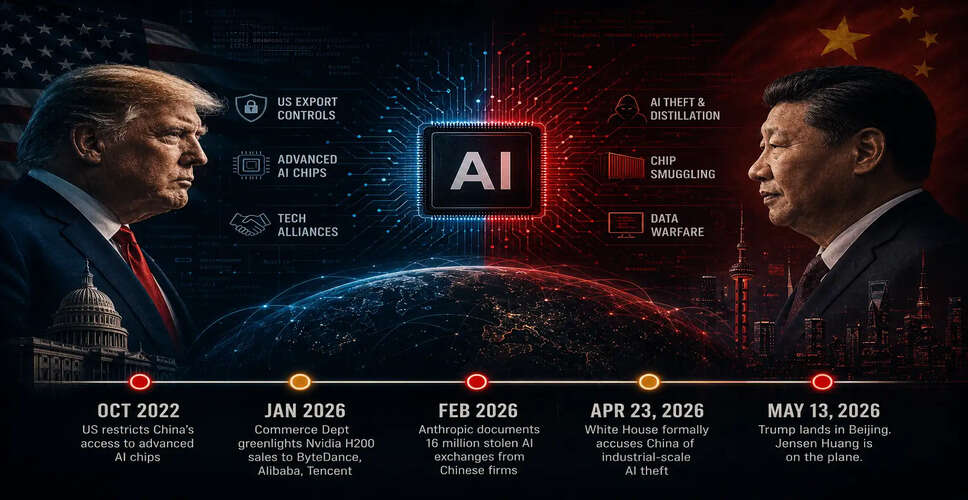

Trump's Arrival in China
On May 13, US President Donald Trump landed in China, marking the beginning of a highly anticipated two-day visit. This trip comes amid complex discussions surrounding technology, trade, Taiwan, and the situation in Iran. Accompanied by key officials and prominent business figures like Tim Cook and Elon Musk, Trump received a grand welcome upon his arrival in Beijing at approximately 5:20 PM IST. While both Trump and Chinese President Xi Jinping are expected to announce significant trade agreements, Xi may leverage the Iran situation to gain concessions on Taiwan, a critical issue for China.
The Underlying Technology War
As the two leaders engage in discussions, the focus will be on trade figures, Boeing contracts, and commitments regarding rare earth minerals. However, a more pressing concern looms in the background: an escalating technology conflict over artificial intelligence, which both nations cannot afford to lose. This is not a distant threat; it is already unfolding, as evidenced by a recent memo from the White House Office of Science and Technology Policy.
In this memo, OSTP Director Michael Kratsios accused foreign entities, primarily from China, of orchestrating large-scale campaigns to replicate US AI systems. These efforts involve using thousands of fake accounts to gather information without traditional hacking methods, leading to what the White House termed as systematic theft.
Understanding AI Distillation
The term 'distillation' may be unfamiliar to many. It refers to a method where advanced AI systems are inundated with millions of tailored questions through fake accounts, allowing the collection of responses to train a cheaper imitation model. This process does not involve direct theft of code but results in the quiet replication of powerful AI systems developed at great expense.
Reports indicate that Chinese firms like DeepSeek, Moonshot AI, and MiniMax have engaged in such practices, generating millions of interactions with AI models like Claude. OpenAI has also reported similar incidents involving its ChatGPT models. By April, major AI companies began collaborating to share intelligence on these attacks.
Contradictions in US Policy
While one segment of the Trump administration accused China of AI theft, another was facilitating chip sales to the country. In January 2026, the US Commerce Department revised its policy regarding Nvidia and AMD chips, allowing sales to China under certain conditions. Nvidia's CEO confirmed orders from Chinese clients, while China approved significant imports of these chips.
This contradiction raises questions about the US's stance on AI theft while simultaneously supplying the necessary hardware for its development.
Traditional Technology Theft
In addition to the distillation issue, traditional technology theft remains a concern. A $2.5 billion scheme to smuggle Nvidia AI chips to China has led to federal arrests. Prosecutors described how restricted chips were shipped to front companies in Southeast Asia before being rerouted to China. This operation, highlighted by a defendant's use of a hair dryer to alter labels, underscores the ongoing challenges in combating technology theft.
Congress is also taking action, with the introduction of the Deterring American AI Model Theft Act of 2026, aimed at identifying and sanctioning entities using improper techniques to replicate AI models.
China's Demands
China's requests are clear: ease restrictions on chip exports, remove numerous Chinese firms from US entity lists, and relax investment controls related to AI and semiconductors. In exchange, Beijing offers limited concessions, such as maintaining the trade truce and making symbolic purchases of American goods.
Discussions about establishing a formal AI security dialogue have taken place, but the US's focus on risk management contrasts with China's desire for chip access.
The Stakes for American Businesses
American companies are feeling the pressure, with a recent survey revealing that over half of US semiconductor and IT firms are experiencing delays of six months or more for export license reviews. This has resulted in lost contracts and customers turning to foreign competitors. As Trump meets with key figures in Beijing, the critical question remains: will the US defend its technological superiority or compromise it?