
Trump Questions Iran's New Supreme Leader's Existence Amid Ongoing Conflict
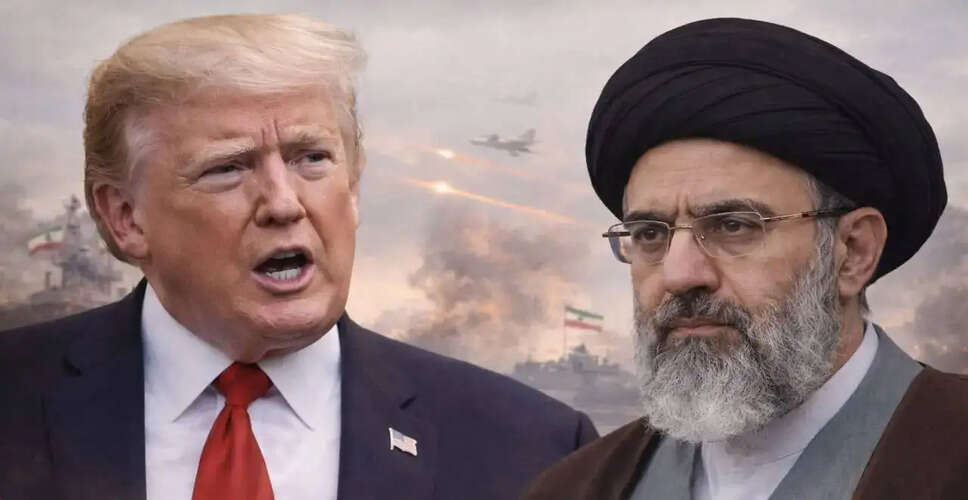
Trump's Doubts on Khamenei's Status
During a recent interview, US President Donald Trump expressed skepticism regarding the existence of Iran's newly appointed supreme leader, Mojtaba Khamenei. This statement came shortly after Tehran announced Khamenei's succession following the death of his father, Ali Khamenei, due to a series of strikes attributed to American and Israeli forces. Trump remarked, "I don't know if he's even alive. So far, nobody's been able to show him," during a nearly half-hour conversation with a news outlet. He further suggested that if Khamenei is alive, he should consider surrendering for the sake of his nation.
The US and Israel have been intensifying military actions against Iran, which has retaliated by targeting US interests and allies in the Middle East. Earlier this week, Iran confirmed Mojtaba Khamenei's rise to power and issued a statement promising to continue obstructing shipping in the Strait of Hormuz while escalating attacks against American allies. Trump noted the lack of public appearances by Khamenei as suspicious, questioning the reliance on a written statement instead of a live address.
Defense Secretary Pete Hegseth commented on Khamenei's condition, suggesting he has been injured and is likely disfigured, labeling his written communication as weak. Hegseth stated, "His father is dead; he's scared, he's injured, he's on the run, and he lacks legitimacy."
Stance on Negotiations
Iran War Timeline
In the same interview, Trump indicated he was not inclined to negotiate an end to the ongoing conflict, despite claims that Iran is open to discussions. He stated, "Iran wants to make a deal, and I don't want to make it because the terms aren't good enough yet," emphasizing that any agreement must be robust. When pressed for specifics, Trump refrained from detailing the terms but mentioned that Iran's commitment to abandon its nuclear ambitions would be essential.
Trump asserted that military operations would persist, claiming that the US has significantly diminished Iran's missile and drone capabilities. He predicted that Iran's remaining military assets would soon be "totally decimated."
Recent Military Actions
More Strikes on Kharg Island?
He confirmed that US forces executed strikes on Kharg Island, a vital center for Iran's oil exports, with the US Central Command reporting precision attacks on approximately 90 military targets while safeguarding energy infrastructure. Trump described the operation bluntly, stating, "We totally demolished Kharg Island, but we may hit it a few more times just for fun," while noting that oil facilities were intentionally spared to avoid lengthy reconstruction efforts.
Securing the Strait of Hormuz
Strait of Hormuz Update
Additionally, Trump mentioned ongoing collaboration with other nations to secure the Strait of Hormuz, a crucial passage for global oil shipments. He indicated that several countries had pledged naval support but did not disclose their identities, although he hinted at potential involvement from nations like China, France, Japan, South Korea, and Britain. "We're going to be sweeping the strait very strongly," he stated, suggesting that other nations affected by oil supply disruptions would likely join the initiative.
The conflict has already had a significant impact on US forces, with thirteen American service members reported dead since the war's onset two weeks ago, including six crew members from a US refueling aircraft that crashed in Iraq. Trump expressed surprise at Iran's decision to target other Middle Eastern nations in retaliation, commending US allies such as the United Arab Emirates, Qatar, and Saudi Arabia for their support, while noting they were unnecessarily attacked.
In the interview, Trump also criticized Ukrainian President Volodymyr Zelenskyy, claiming he has been more challenging to negotiate with than Russian President Vladimir Putin regarding the war in Ukraine. He suggested that Russia might be sharing intelligence with Iran about US forces, although he acknowledged the uncertainty of such reports, stating, "Russia is perhaps giving information, perhaps they're not." He concluded by mentioning that the US is providing limited information to Ukraine while striving for peace between the two nations.