
Trump Claims Credit for Resolving India-Pakistan Conflict at UNGA
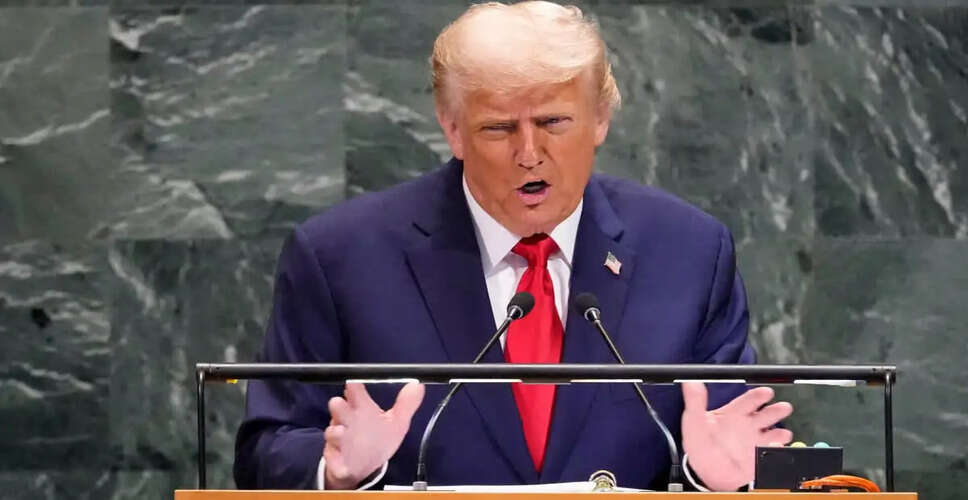

Trump's Bold Claims at the UN General Assembly
United Nations: During his address at the UN General Assembly, US President Donald Trump reiterated his assertion that he played a pivotal role in resolving the conflict between India and Pakistan last year.
In his speech to world leaders, Trump stated, "Since I assumed office, I have had the privilege of settling eight wars, fostering friendships with many leaders in the process. It has been a significant honor to achieve this, especially considering the longevity of these conflicts."
He attributed his success in these negotiations to his "unique relationships," trade strategies, and the strategic use of tariffs, among other factors.
Trump listed several conflicts he claimed to have influenced, including those involving Cambodia, Thailand, Kosovo, Serbia, the Democratic Republic of the Congo, Rwanda, Pakistan, India, Armenia, Azerbaijan, and the ongoing situation in Gaza, emphasizing the importance of returning all hostages.
He mentioned receiving letters of gratitude from leaders of these nations, highlighting a statement from the Prime Minister of Pakistan, who praised Trump for potentially saving millions of lives.
The President also recounted expressions of thanks from leaders in Azerbaijan, Armenia, and Cambodia for his role in ending their respective conflicts.
Trump has consistently taken credit for the ceasefire between India and Pakistan, a claim he first made public on social media on May 10 last year, stating that the two nations had agreed to a "full and immediate" ceasefire after discussions mediated by the US.
However, India has maintained that the ceasefire agreement was reached through direct communication between the military leaders of both countries, denying any involvement from a third party.
In a previous address to the UNGA, Trump criticized the organization for its inaction in resolving global conflicts, including the one between India and Pakistan.
Attending the UNGA session were First Lady Melania Trump, Secretary of State Marco Rubio, US Ambassador to the UN Mike Waltz, Treasury Secretary Scott Bessent, and Trade Representative Jamieson Greer, all listening to Trump's remarks.
Trump also mentioned his administration's close collaboration with Russian and Ukrainian leaders to resolve their ongoing conflict, expressing optimism about a swift resolution.
He revealed that he had recently signed a significant law passed by Congress, granting him enhanced tariff powers, which he indicated he would utilize if necessary.
The President criticized Iran, asserting that he would never allow the nation to develop nuclear weapons, and hinted at a major decision regarding Iran's future.
He posed a rhetorical question about whether to negotiate a deal that could lead to Iran's resurgence or to take decisive military action against the regime.
Trump concluded by suggesting that a deal with Iran might be possible after the upcoming elections, as he believes they are waiting to see the outcome of the midterms.
As Trump criticized the Iranian government, the Iranian delegation walked out of the assembly.