
Trump Administration Achieves Milestone in Golden Dome Missile Defense Program
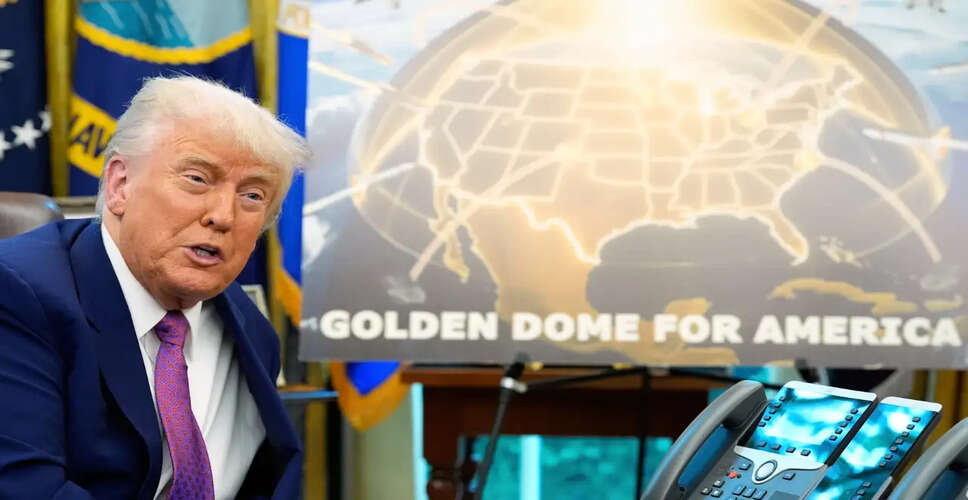

Successful Test Marks Progress for Golden Dome Initiative
The Golden Dome for America missile defense initiative, spearheaded by the Trump administration, reached a significant milestone on Monday. The Pentagon announced a successful full-scale test that involved advanced autonomous threat detection and interception technologies. Secretary of War Pete Hegseth, who observed the test firsthand, declared it a "full mission success," as the system autonomously identified, tracked, and neutralized multiple incoming threats during the exercise. This demonstration is viewed as a crucial step towards establishing what President Trump has termed the most sophisticated homeland missile defense system in U.S. history.
"Golden Dome is real, powerful, and on track," Hegseth shared on social media, highlighting that cutting-edge directed energy systems and the Dynamic Defense Autonomous Defeat (DDAD) platform effectively neutralized incoming drones and cruise missiles during the trial. This announcement represents the first major public achievement for a program that has become a cornerstone of Trump's national security strategy, drawing comparisons to President Ronald Reagan's Strategic Defense Initiative (SDI), famously dubbed "Star Wars" during the Cold War.
Today, the first milestone test of Golden Dome for America (GDA) was a full mission success — and I was honored to witness it firsthand.Cutting edge directed energy was harnessed and the Dynamic Defense Autonomous Defeat (DDAD) system flawlessly and autonomously cued, targeted,…
— Secretary of War Pete Hegseth (@SecWar) June 24, 2026
Pentagon Views Golden Dome as a Revolutionary Defense Strategy
Hegseth noted that the test illustrated the integration of next-generation autonomous defense systems with active military units. He mentioned that both established defense contractors and innovative tech companies contributed to the capabilities showcased during the trial. The Golden Dome initiative aims to shield the United States from a wide range of missile threats, including cruise missiles, ballistic missiles, and potentially hypersonic weapons. In contrast to Israel's Iron Dome, which primarily addresses short-range rocket threats, the American system is designed to protect an entire continent from more sophisticated dangers.
🚨 President Trump just dropped this EPIC post of the “Golden Dome” for the White House! Keep the President safe! pic.twitter.com/ViHIkLA21C
— Gunther Eagleman™ (@GuntherEagleman) May 30, 2026
Trump has consistently argued that the evolving missile capabilities of adversaries like Russia and China necessitate a comprehensive reevaluation of U.S. homeland defense strategies. The administration aims to have the Golden Dome operational by 2029, aligning with the conclusion of Trump's current term. Officials have indicated that the system could eventually intercept missiles launched from various platforms, including land, sea, air, and even space.
Challenges Ahead for Space-Based Defense System
Despite the successful test, significant uncertainties remain regarding the construction and funding of the complete Golden Dome architecture. Estimates from the Congressional Budget Office suggest that a fully developed missile defense network could cost up to $1.2 trillion over two decades, a figure that far surpasses the approximately $175 billion estimate previously mentioned by Trump when unveiling the concept. One of the most ambitious proposals involves deploying extensive satellite constellations capable of detecting and intercepting missiles shortly after launch. Analysts have indicated that as many as 16,000 space-based interceptors may be necessary for continuous global coverage.
Proponents argue that advancements in satellite technology, artificial intelligence, and autonomous targeting systems make such an initiative increasingly viable. However, critics caution that the engineering, financial, and operational hurdles remain substantial. Congress has already allocated around $24 billion in initial funding through Republican-backed spending legislation, which Hegseth credited as a catalyst for accelerating development.
For the Trump administration, the importance of Monday's test goes beyond the technology itself. The White House increasingly frames Golden Dome as the realization of Reagan's long-held vision of a layered missile defense system capable of safeguarding the American homeland from strategic threats. Whether this vision can be transformed into reality may hinge on the success of future tests in demonstrating that the concept can evolve from a successful trial to a comprehensive national defense architecture capable of countering the world's most advanced missile arsenals.