
Trilochan Pokhrel: The Unsung Hero of Sikkim's Freedom Movement

A Pioneer of Self-Reliance in Sikkim
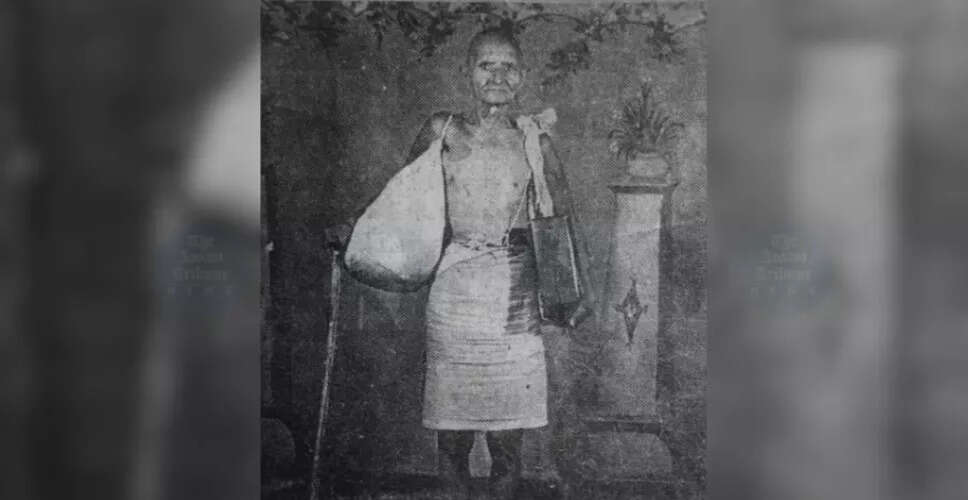
File image of freedom fighter from Sikkim, Trilochan Pokhrel (Photo: AT)
Long before Sikkim's freedom struggle gained recognition, Trilochan Pokhrel, often referred to as 'Gandhi Pokhrel' or 'Bande Pokhrel', was seen traversing the terraced hills of Tareythang. He carried a spinning wheel on his shoulder, embodying the spirit of self-reliance.
Pokhrel played a crucial role in connecting Mahatma Gandhi's freedom movement with the local farming communities, promoting the principles of Swadeshi throughout East Sikkim.
Born in Tareythang in the 1890s, he was inspired by the rising tide of national awareness in India.
He actively participated in significant movements such as the Non-Cooperation Movement, Civil Disobedience Movement, and Quit India Movement, spending time at the Sabarmati Ashram alongside Gandhi.
Later, he contributed to daily activities at the Sarvodaya Ashram in Bihar, where he spun cotton on the charkha.
“Motivated by the national consciousness, Pokhrel ventured into mainland India to engage directly in the freedom struggle,” noted Assistant Professor Rajen Upadhayay.
“He frequently returned to Tareythang, transformed, walking barefoot with his spinning wheel and greeting villagers with 'Vande Mataram',” he added.
For Pokhrel, the charkha symbolized more than just the freedom movement; it represented the philosophy of Swadeshi, which he integrated into his grassroots initiatives.
He visited market centers in Rhenock, Rangpo, Pakyong, and Rorathang, where he utilized weekly haats as platforms to advocate for self-reliance. On market days, he would spin yarn and instruct local farmers on producing their own thread.
Assistant Professor Binod Bhattarai emphasized that Pokhrel's legacy continues to impart lessons on self-sufficiency and the importance of promoting local products.
His efforts mirrored Gandhi's vision of involving ordinary citizens in the broader quest for social and economic independence. Rather than limiting the concept of Swadeshi to political rhetoric, Pokhrel brought it to village markets and farming communities.
However, much of his personal narrative remained undocumented for years.
Pokhrel's family eventually relocated to Assam, and many aspects of his life were preserved through oral histories shared within his family.
“Though I never met my grandfather, my childhood was filled with stories about his deep involvement with Mahatma Gandhi and his commitment to the freedom struggle,” shared his granddaughter Kabita Poudel.
Legacy and Recognition
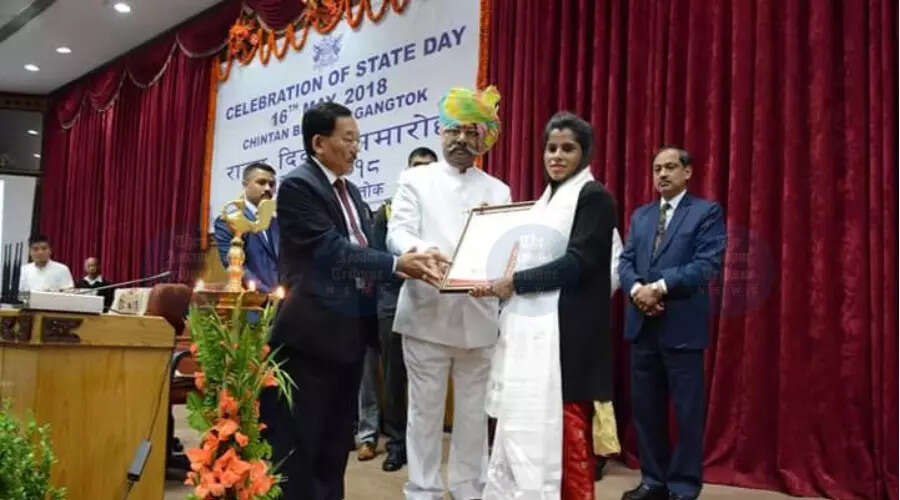
File image of Pokhrel's granddaughter Kabita Poudel receiving LD Kazi Award for Democratic Movement on his behalf in 2018 (Photo: AT)
Pokhrel's contributions to public life extended beyond grassroots activism. During Prime Minister Jawaharlal Nehru's visit to Sikkim in 1957, he had the opportunity to meet the Prime Minister and discuss the socio-economic challenges faced by the local populace.
This meeting marked one of his last public appearances in Sikkim before he returned to Bihar.
Trilochan Pokhrel passed away on January 27, 1969, at the Prakritik Chikitsalaya in Ranipatra, Bihar's Purnia district, yet remained largely unrecognized in mainstream narratives of India's freedom struggle for many years.
Formal acknowledgment of his contributions came much later. As the nation commemorates Gandhi Jayanti, Pokhrel's story illustrates how Gandhian principles transcended major urban centers and resonated in the daily lives of people in the hills.
In May 2018, the Sikkim government honored him posthumously with the LD Kazi Award for Democratic Movement, and India Post issued a special cover in his memory.
Today, his ancestral home in Tareythang, known as Pokhrel Bari, stands as a testament to a man who carried Gandhi's ideals from the ashrams to the Himalayan foothills.
On Gandhi Jayanti, as the nation reflects on the Mahatma's teachings of truth, non-violence, Swadeshi, and self-reliance, the narrative of Gandhi Pokhrel serves as a reminder of another facet of that legacy, quietly woven through mountain villages, weekly markets, and generations of oral history.