
Tribal Unity in Haflong: Protest Against ST Status Proposal
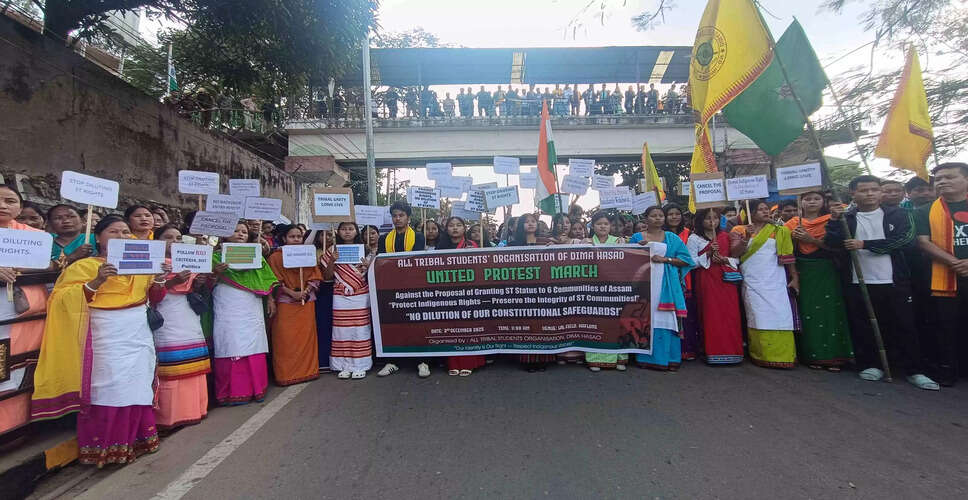
Mass Protest in Haflong Against Scheduled Tribe Status
Haflong, Dec 4: On Wednesday, a significant number of tribal students and community members rallied in Haflong under the banner of the ‘All Tribal Students’ Organisation of Dima Hasao’ to express their opposition to the Assam government's plan to confer scheduled tribe (ST) status on six communities: Chutia, Koch-Rajbongshi, Matak, Moran, Tai-Ahom, and the Tea Tribe (Adivasi).
This protest, one of the largest in recent times for the hill district, began at Lal Field and moved through key locations in the town, including Sambudhan Statue and Council Rotary, before concluding at the deputy commissioner's office in Haflong.
Demonstrators displayed banners and placards with slogans such as ‘No Dilution of ST Safeguards’, ‘Protect Indigenous Tribal Rights’, ‘Our Identity is Not Negotiable’, and ‘Reject ST (Valley) Category – Save Hill Tribes’.
Speakers at the event cautioned that granting ST status to these six communities, even under a new sub-category of ‘ST (Valley)’, would significantly weaken the constitutional protections and resources allocated for the existing scheduled tribes, particularly those in the hills.
Student leaders highlighted that the combined population of these six communities exceeds 80-90 lakh, which is substantially larger than the current ST population in Assam, estimated at around 38-40 lakh.
They expressed concerns that including these larger and more developed communities would severely limit educational opportunities, government job access, political representation, and welfare benefits for the already recognized tribal groups.
Uttam Langthasa, president of the All Dimasa Students’ Union (ADSU) district committee, stated, “This initiative threatens to undermine the essence of ST reservations, which were established to support historically marginalized indigenous tribes. These six communities are socially, educationally, and economically more advanced than the existing STs, particularly those in the hills. We will not permit our rights to be compromised for political motives.”
Mairing Johori, president of the ADSU central committee, remarked, “The establishment of a separate ‘ST (Valley)’ category is merely a covert strategy. It will ultimately result in the merging and sharing of quotas, leaving genuine tribal communities with minimal benefits.”
Liengoujao Singson, general secretary of the Kuki Students’ Organisation (KSO), Assam, pointed out, “The total population of these six communities is more than double that of the current ST population. Their inclusion in the ST list would allow them to dominate various sectors, from legislative seats to college admissions and government employment. This poses a direct threat to the survival and identity of smaller indigenous tribes.”
A memorandum was presented to Durga Das Uikey, Union Minister of State for Tribal Affairs, via the deputy commissioner, urging the Central government to dismiss the recommendations made by the group of ministers and uphold the integrity of the existing scheduled tribes in Assam.
The protesters warned of escalating demonstrations throughout the hill districts and beyond if the Centre moves forward with the proposal.
They also called upon all recognized tribal communities in Assam, both from the hills and plains, to unite against what they termed ‘a perilous dilution of indigenous rights’. The protest was conducted peacefully yet firmly, reflecting the increasing concerns among Assam’s existing scheduled tribes regarding the potential changes to ST status in the State.