
Tragic Fire at Oil India Facility Claims One Life and Injures Several Workers
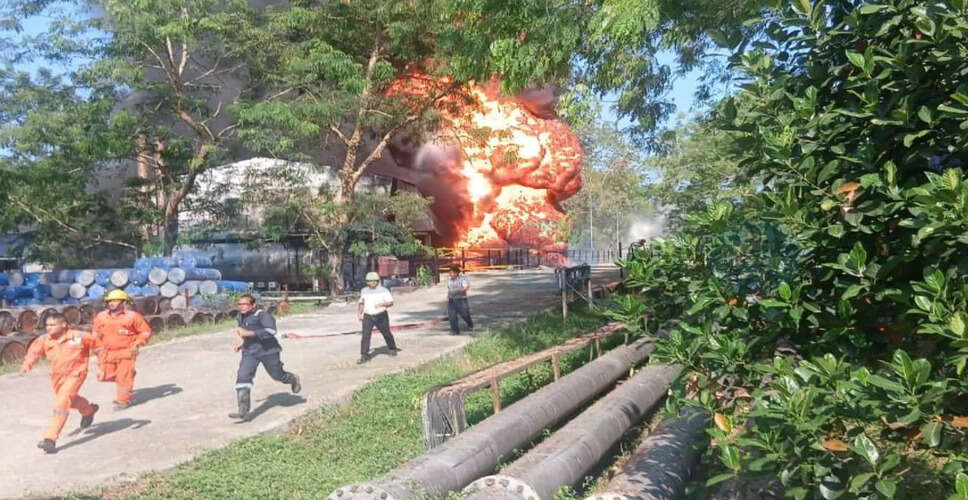

Fire Incident at Tengakhat
Fire breaks out at an intermediate tank farm in Tengakhat in Dibrugarh (Image)
Dibrugarh/Jorhat, Nov 6: A devastating fire erupted at the Intermediate Tank Farm (ITF) of Oil India Limited in Tengakhat, Dibrugarh district, resulting in the death of one worker and leaving at least seven others with serious injuries on Friday.
The victim has been identified as Raju Dutta, who tragically lost his life at the scene. Among the injured are Sailen Gogoi, Tapas Gogoi, Kumud Gogoi, Golap Dutta, and Indra Gogoi, all of whom were swiftly transported to Assam Medical College and Hospital (AMCH) in Dibrugarh for urgent medical care. Another injured individual, Rupam Gohain, was taken to a hospital in Duliajan.
The fire caused widespread panic in the vicinity, prompting multiple fire engines and emergency response teams to the site to control the flames. Over seven fire brigade vehicles from Oil India were dispatched to manage the situation.
While the precise cause of the fire and the extent of damage to the oil storage facility remain unknown, the incident has raised significant concerns regarding safety measures and emergency preparedness at Oil India's facilities, with speculation about potential safety oversights.
This incident has sparked strong reactions from local groups, particularly the All Assam Tai Ahom Students' Union, which criticized the company's safety protocols and accused it of negligence in safeguarding its workers and nearby residents.
With more than 100 individuals employed at the facility, the issues surrounding worker safety and emergency readiness are of paramount importance.
Drawing comparisons to previous industrial disasters, such as the Baghjan blowout and the Dikom oil incident, a representative from the All Assam Tai Ahom Students' Union stated that Oil India should have learned from past mistakes and improved its preventive and emergency response strategies.
"Oil India should have implemented sufficient safety measures to avert such incidents. Despite the lessons from Baghjan and Dikom, doubts persist about whether the company has truly learned from these events. In emergencies, external personnel are often called in to manage the crisis, indicating a lack of internal preparedness," the representative remarked.
The organization further accused the company of prioritizing profits over the safety and well-being of its employees, asserting that workers and local communities continue to suffer the repercussions of industrial mishaps.
"It is not the officials of Oil India who face the greatest losses in these situations. It is the ordinary workers and their families who pay the price. Many have sacrificed their lives while working for the company. We strongly denounce a profit-centric approach that neglects employee safety and the concerns of nearby communities," the representative added.
The students' union has called for a government and district administration investigation into the incident and demanded accountability for those responsible. They also urged for specialized medical care for the injured workers and appropriate compensation for the family of the deceased.
Highlighting broader issues regarding Oil India's operations in the region, the union claimed that activities at Intermediate Tank Farms, Oil Collection Stations (OCS), and other oil and gas facilities have led to environmental and noise pollution in the surrounding areas.
Additionally, the organization alleged that the company is increasingly relying on outsourced labor while expecting fewer employees to manage larger workloads, which could jeopardize operational safety.
"The company must focus on hiring employees directly instead of excessively depending on outsourced agencies. Direct recruitment would also provide job opportunities for local youth. The current system of managing manpower through external agencies has numerous flaws and requires reevaluation," the representative stated.
The union emphasized that employee safety, environmental conservation, and accountability should be prioritized at Oil India's facilities, especially in regions where industrial activities are in close proximity to residential areas.