
Tragic Collision: Seven Elephants Killed by Train in Assam
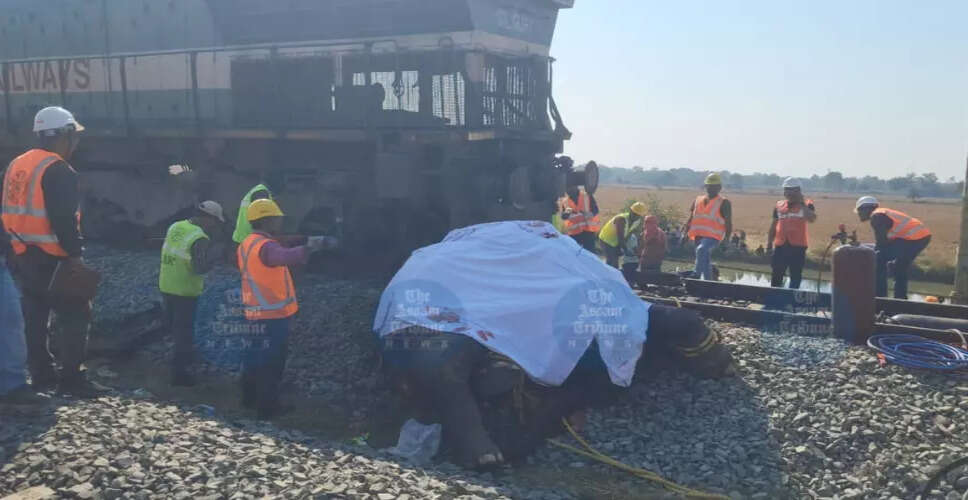
A Devastating Incident on Assam's Rail Tracks
Guwahati, Dec 20: In the early hours of Saturday, Assam's railway tracks became the site of a tragic event. The newly inaugurated Sairang–New Delhi Rajdhani Express collided with a herd of elephants near Changjurai village in Hojai district, resulting in the deaths of seven elephants, which included three adults and four calves, while one calf sustained injuries.
The train derailed, but fortunately, the passengers were unharmed. However, the elephants were not as lucky. This incident caused significant disruption to rail services across the Lumding division.
According to a spokesperson from Northeast Frontier Railway (NFR), nine trains were cancelled, 13 were regulated, and two were short-terminated due to the derailment of Train No. 20507. Although train services were eventually restored, the underlying issue remains unresolved.
Chief Minister Himanta Biswa Sarma has called for a thorough investigation, instructing the Forest Department to examine the circumstances surrounding the incident and propose measures to enhance the safety of wildlife corridors, especially in low-visibility conditions.
Suhash Kadam, the divisional forest officer for Nagaon, suggested that heavy fog may have contributed to the accident. This incident is not an isolated case but part of a troubling trend on Assam's railways.
Conservationists argue that fog is merely one aspect of a larger issue. Dr. Bibhab Kumar Talukdar, Secretary General of Aaranyak, emphasized that this tragedy highlights the inadequacy of focusing solely on designated corridors. He pointed out that the collision occurred outside an officially recognized elephant corridor, revealing how outdated planning does not align with the actual movement patterns of elephants.
Elephants do not adhere to administrative boundaries; they follow migratory paths developed over generations, which are now fragmented by railway lines cutting through their habitats.
Statistics paint a grim picture: conservationists report that Assam has seen 71 human fatalities and 41 elephant deaths this year due to conflicts between humans and elephants.
From 2000 to 2023, nearly 1,400 people and 1,209 elephants have lost their lives in such encounters. Among the elephant deaths in the past 23 years, electrocution has been the leading cause, claiming 209 lives, while train collisions have resulted in the deaths of 67 elephants, turning railways into silent threats.
The winter season exacerbates the situation. Dr. Talukdar noted that elephant fatalities on Assam's tracks are particularly prevalent during winter when elephants search for food, and fog significantly reduces visibility for train operators.
Railway and forest officials have proposed mitigation strategies, including warning signs, speed limits, patrolling, and sensor-based alert systems. While these measures exist on paper, elephants continue to face danger.
Conservationists argue that what is lacking is effective real-time coordination. Dr. Talukdar stressed the importance of timely information regarding elephant movements near tracks and immediate communication with railway authorities to issue cautionary notices and slow down trains.
He also highlighted the necessity of involving local communities, village leaders, eco-development committees, Forest Management Committees, and Village Defence Patrol groups in monitoring elephant movements and relaying alerts.
In a related note, the Supreme Court remarked that it would always favor animals, who suffer silently when their migration routes are obstructed by human activities and commercial developments.
A Bench consisting of Chief Justice Surya Kant and Justices Joymalya Bagchi and Vipul M. Pancholi made this observation while addressing petitions from hotel and resort owners in the Nilgiris, indicating that the matter requires thorough examination.
“You are all here for commercial purposes within an elephant corridor. These constructions disrupt elephant movement. The benefits must be directed towards these animals, who are the silent victims of such developments,” the Bench stated.
The fatalities in Hojai represent more than mere statistics; they signify calves lost alongside their mothers, a herd shattered in the dark, and a stark reminder that Assam's progress is outpacing its protective measures. Seven elephants perished in mere moments, and the warning they leave behind must not be overlooked again.