
Tragic Bus-Tanker Collision in Balochistan Claims Lives

Fatal Accident on Makran Coastal Highway
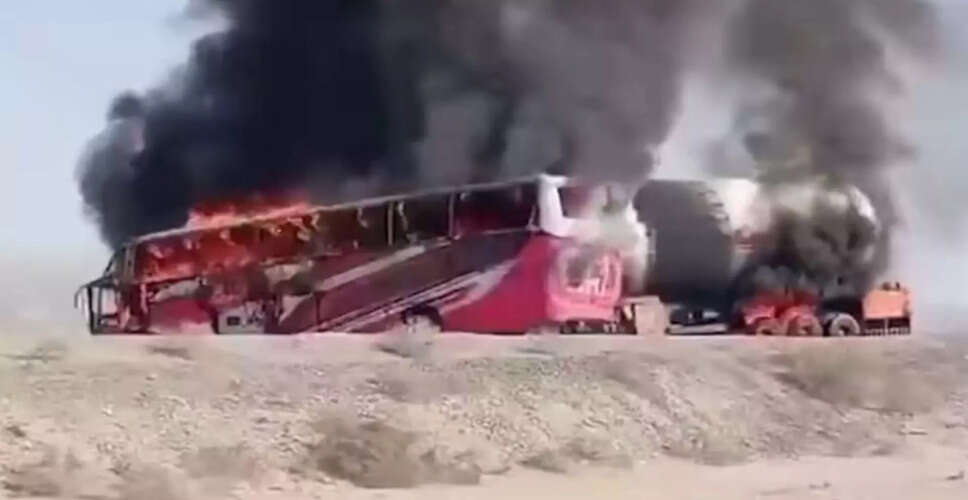
File image shows thick black smoke rising after a collision between a passenger bus and an LPG tanker in Pakistan(Photo: @RT_com/X)
Quetta, Nov 20: A tragic incident occurred on the Makran Coastal Highway in Balochistan, where a passenger coach traveling from Turbat to Karachi collided with a liquefied petroleum gas (LPG) tanker. Reports indicate that at least 10 individuals lost their lives, and 27 others sustained injuries.
The collision took place on Thursday near Basol, between Pasni and Ormara, resulting in a fire that engulfed both vehicles involved.
Emergency responders, including police, rescue teams, and firefighters from the Ormara Municipal Committee, quickly arrived at the scene to assist. The injured were transported to local hospitals for treatment.
Details regarding the total number of passengers and the precise cause of the accident remain unclear, as reported by local news outlets.
Sammi Deen Baloch, a representative of the Baloch Yakjehti Committee (BYC), expressed deep concern over the incident, attributing it to the government's negligence and lack of attention to public safety in Balochistan. She highlighted issues such as poor traffic management, inadequate road infrastructure, and the failure to modernize the province's aging single-lane highways.
“The ongoing fatalities on Balochistan’s perilous highways, whether on the Quetta–Karachi route or the Karachi–Turbat road, exemplify governmental negligence and disregard for public needs. Factors like poor traffic management, lack of law enforcement, unsafe travel conditions, and outdated single-lane highways contribute significantly to these accidents,” Sammi stated on X.
She further criticized the government for failing to improve the situation despite the province's rich resources, which have benefited other regions with infrastructure developments. “Despite the wealth generated from Rekodek, Saindak, and Sui gas, the government has not taken essential steps to enhance highway safety for the people of Balochistan,” she added.
Sammi noted that road accidents are a daily occurrence in Balochistan, with no highway deemed safe for travelers. “The tragedies on these roads have become a persistent human crisis,” she remarked.
While the Balochistan government claims to be advancing development, she argued that the reality is starkly different, with citizens lacking even basic travel safety and families mourning their loved ones regularly.
Naseem Baloch, Chairman of the Baloch National Movement (BNM), also expressed his dismay over the incident, suggesting that such tragedies reflect a broader pattern of suffering inflicted upon the people of Balochistan by the authorities.
“It is devastating that traveling on our own highways has turned into a life-threatening endeavor. These incidents are not just accidents; they reveal the state's intent to harm us on all fronts. The people of Balochistan deserve freedom, dignity, security, justice, and a safe existence, rather than a future marked by disappearances and preventable tragedies,” he posted on X.