
Tragic Ahmedabad Air India Crash: A Year Later, Memories of Heroism and Loss Persist

Remembrance of the Ahmedabad Air India Disaster
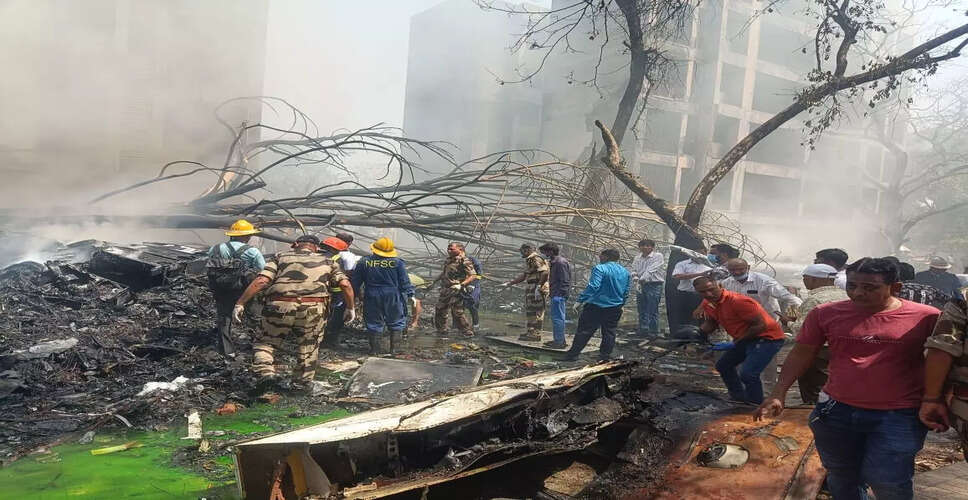
File image of rescuers at the crash site in Ahmedabad. (Photo:X)
Ahmedabad, June 11: A year has passed since the devastating Air India incident in Ahmedabad, yet the memories of first responders and witnesses remain vivid. The crash unleashed flames that soared above 1,000 degrees Celsius, causing boots, uniforms, and even parts of the aircraft to melt.
In the midst of the chaos, rescuers discovered the charred remains of a pregnant woman, a sight that profoundly impacted even the most seasoned disaster responders. By the end of the day, over 200 individuals, both deceased and injured, were transported to the Civil Hospital.
On June 12, 2025, the AI-171 flight, bound for London, tragically crashed into the BJ Medical College hostel in Meghaninagar, resulting in the loss of 241 lives on board and 19 on the ground, with only one passenger surviving.
"Initially, I was unaware it was a plane crash, but the first ambulance arrived within three minutes," recounted Jitendra Shahi, programme manager of 108 Emergency Services.
The emergency team was stationed near the Civil Hospital when supervisor Satinder Singh Sandhu heard the explosion while preparing for lunch. He quickly alerted Shahi and reached the site in just three minutes.
"Five ambulances were dispatched to the location. At 1:41 PM, Sandhu notified the state command center, prompting swift mobilization," Shahi explained.
Within a few minutes, numerous calls flooded the 108 helpline confirming the aircraft crash.
In total, 20 additional ambulances were deployed within 10 to 15 minutes, bringing the total to 25. By the end of the day, 35 ambulances had made multiple trips, with nearly 90 personnel involved in the rescue operations.
Shortly after, six teams from the State Disaster Response Force (SDRF), comprising 120 members, arrived at the scene, followed by six teams from the National Disaster Response Force (NDRF) with 180 personnel.
"The temperature soared beyond 1,000 degrees Celsius, making it nearly impossible to rescue those trapped and calling for help," stated Sheetal Gujar, SDRF Assistant Superintendent of Police.
Due to the main entrance being engulfed in flames, rescue teams had to scale a wall to enter. They assessed the wind direction and fire behavior, advancing from the rear to evacuate trapped students.
The heat was so extreme that boot soles melted, uniforms had to be replaced frequently, and communication devices malfunctioned, Gujar noted.
While 35 to 40 individuals were rescued immediately, an additional 70 were saved later. "Initially, we utilized sarees and wet blankets as makeshift ropes and stretchers, while fire brigade personnel sprayed water as we progressed deeper into the site," Gujar added.
Aircraft components had melted and shifted due to the intense heat. Every body or body part recovered was placed on a stretcher and sent to the Civil Hospital, he explained.
"Teamwork is essential during the critical golden hour," Gujar emphasized, noting that police, SDRF, civil defense, NGOs, ambulance crews, and firefighters operated as a cohesive unit.
Bhawani Singh Shekhawat, a 32-year-old resident of Kubernagar, Naroda, who lived just 1.5 km from the crash site, was at home when his uncle received news of the incident. "I stepped outside and saw thick smoke billowing into the sky," he recalled.
Using shortcuts through narrow lanes, Shekhawat reached the scene and climbed over a compound wall. Inside, he discovered a hostel canteen engulfed in flames, with the rear section of the aircraft embedded in the roof.
"Initially, I intended to record videos, but then I heard a woman crying for help, saying her daughter was trapped upstairs. I put my phone away and rushed inside," he recounted.
Despite being stopped by security personnel, he pushed through the thick smoke and climbed upstairs. The presence of gas cylinders in the burning kitchen posed an additional risk.
As commandos and firefighters arrived, Shekhawat assisted in carrying equipment, extinguishing flames, removing gas cylinders, and rescuing individuals trapped under debris.
"We kept bringing people out. There were students trapped inside. Everyone collaborated," he stated.
"I noticed a woman's leg beneath the debris, but when I attempted to lift it, an unidentified green chemical substance splashed into my eyes, causing severe irritation and blurred vision," he shared.
Despite the injury, he rinsed his eyes and continued to help until he was taken to the hospital.
Later, experiencing breathing difficulties from smoke inhalation, he walked to an ambulance himself but requested doctors to prioritize more critically injured victims.
Businessman Rajesh Patel, 57, and his associates also rushed to help, although the intense heat and smoke initially hindered their entry.
"We recovered nearly 70 tolas of gold ornaments, Rs 50,000 in cash, British passports, and some US dollars from the crash site and handed them over to the police," Patel recounted.
Handling the body of a pregnant woman was particularly challenging, he remembered.
"My hands trembled as I retrieved the body of the pregnant woman. Witnessing the fate of an unborn child was heart-wrenching," he said, his voice heavy with emotion.