
The Timeless Craft of Bamboo: Bidyadhar Bora's Legacy
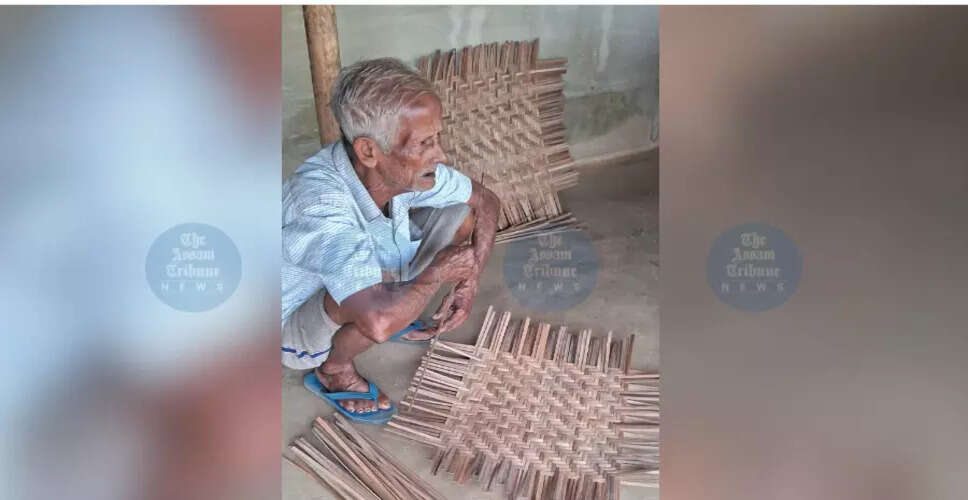
A Master Craftsman in Doomdooma
Doomdooma, Jan 3: As time passes, some hands grow weary, while others seem to transcend age.
In a serene area of Rupai Siding, 75-year-old Bidyadhar Bora continues to express himself through a craft learned in his youth—one that involves bamboo, shaped by patience and refined through years of dedication.
“Who can take away the skill of the hands, the knowledge of all ten fingers?” This old Assamese proverb is personified in Bora, a seasoned artisan who has devoted nearly sixty years to reviving Assam’s traditional bamboo and cane artistry.
In a world increasingly filled with plastic and mass-produced items, Bora's environment still resonates with the gentle sound of a dao gliding over bamboo, as the act of creation flows as naturally as breathing.
From his simple abode, he crafts everyday items—dala, chalani, kharahi, baskets, kula, jakoi, khalai, dhari, and many more bamboo essentials that once formed the core of Assamese domestic life.
Each creation embodies not just functionality but also nostalgia—of kitchens warmed by wood fires, rivers fished with handmade tools, and a community once deeply connected to nature's bounty.
Bora's journey with bamboo commenced at the young age of 16, learning from his grandfather Dalim Bora long before survival became a pressing issue.
While attending Chakalaghat High School in Nagaon, he had to leave his studies in Class IX due to severe financial difficulties. Ironically, despite his proficiency in English, fate guided him back to the age-old classroom of inherited skills and lived experiences.
What ensued was a lifetime of diligent work. Markets throughout Tinsukia district bore witness to his craftsmanship, where his handmade bamboo products provided him with modest yet honest earnings.
Through this traditional craft, he supported his family and subtly encouraged others to see cottage industries not as relics of the past but as viable sources of income.
Even now, whenever he finds a moment of leisure, Bora instinctively reaches for his knife and bamboo strips. At 75, his movements remain precise, and his focus unwavering.
The items crafted by his hands continue to receive admiration across the region, a testament to skills that have been refined over time rather than diminished.
However, despite nearly six decades of commitment to indigenous craftsmanship, Bidyadhar Bora remains largely unrecognized by the system. Apart from an old-age pension, no government initiative has acknowledged his contributions.
His life's work unfolds without accolades, driven solely by personal determination and cultural dedication.
In a time when unemployment looms over the State and many educated youths struggle to find work, Bora's life narrates a quieter, more profound story.
It speaks of self-sufficiency, the dignity of labor, and the lasting importance of traditional skills. In his humble bamboo creations lies a powerful reminder—that development need not obliterate tradition, and that hope can still be crafted, piece by piece, by hands that refuse to yield.
In Bidyadhar Bora’s realm, bamboo is not just a material; it represents memory, livelihood, and legacy. As long as his hands continue their gentle interaction with cane and fiber, Assam’s cottage industry will continue to thrive.