
The Rise of the Cockroach Janta Party: A Youth Movement in India

Introduction to the Cockroach Janta Party
Munish Sood
Mandi
A unique internet initiative, stemming from political satire, has quickly transformed into a prominent social media phenomenon in India. The 'Cockroach Janta Party' (CJP) has emerged as an unexpected emblem of youthful discontent, online activism, and meme-driven political discourse.
Controversy Surrounding the Movement
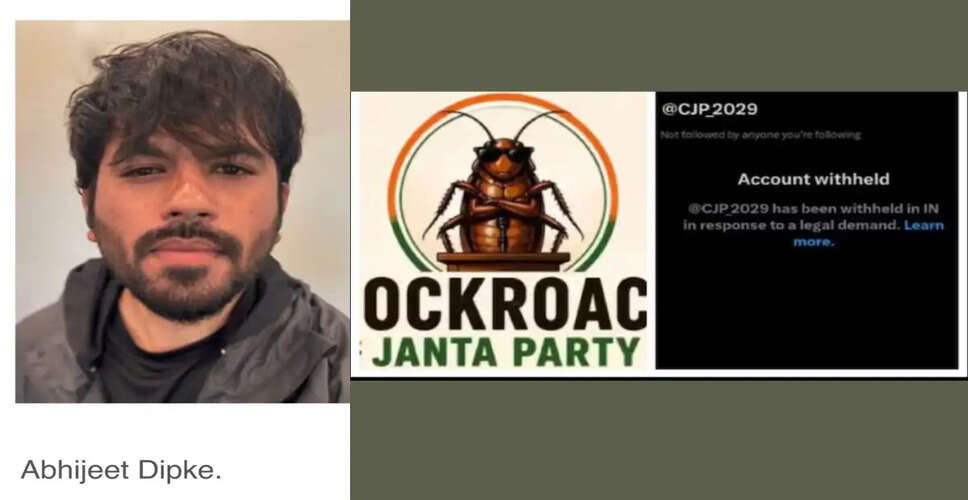
The situation escalated on Thursday when the movement's account on X was reportedly restricted in India following a legal request. This action occurred just hours after the group's Instagram followers surpassed those of the official Bharatiya Janata Party account, igniting fresh discussions across various digital platforms.
Youth Engagement and Political Discontent
The satirical group, which brands itself as a youth-centric political entity with the motto 'Secular, Socialist, Democratic, Lazy,' has garnered millions of followers shortly after its inception. What began as a light-hearted online joke has morphed into a broader expression of dissatisfaction among young Indians regarding unemployment, exam leaks, dwindling opportunities, political fatigue, and concerns about institutional accountability.
The Origin of the 'Cockroach' Symbol
The peculiar name originates from comments made by Surya Kant during a recent court session. Remarks that likened certain unemployed youth and online activists to 'cockroaches' and 'parasites' sparked outrage on social media, particularly among younger demographics.
Although the Chief Justice later clarified that his comments were aimed solely at individuals misrepresenting their educational qualifications, the backlash had already gained momentum online.
Reclaiming the Cockroach Identity
In a matter of hours, the cockroach—often seen as resilient and hard to eradicate—was embraced by users as a sarcastic symbol of identity. Memes, hashtags, and parody content flooded social media, ultimately leading to the creation of the Cockroach Janta Party.
The Visionary Behind the Movement
Abhijeet Dipke, a former social media campaigner for the Aam Aadmi Party and a current student at Boston University, spearheaded the campaign. He noted that while the movement started as satire, it quickly evolved into a significant platform after receiving overwhelming support from the youth online.
Dipke explained that the Chief Justice's remarks resonated with many, as they were perceived as dismissive of an entire generation grappling with economic challenges and limited opportunities.
A Viral Political Experiment
In less than a week, the movement reportedly attracted hundreds of thousands of supporters through online sign-up forms and established a substantial social media presence.
Its Instagram account surpassed 10 million followers, overtaking the BJP's official account, which has around 8.7 million followers. Meanwhile, the Indian National Congress maintains a larger presence, while the Aam Aadmi Party lags behind.
Legal Challenges and Public Reaction
However, the movement's X account became inaccessible to users in India on Thursday, displaying a message that it had been withheld 'in response to a legal demand.'
In response to this development, Dipke stated that they had anticipated such actions and argued that attempts to limit the account would only heighten public interest in the campaign.
Support from Prominent Figures
The online movement has garnered attention from various notable public figures. Senior advocate Prashant Bhushan, activist Anjali Bhardwaj, and Mahua Moitra have all engaged with the campaign online. Kirti Azad humorously expressed his willingness to 'join' the satirical group.
A Reflection of Youth Frustration
Beyond the humor and memes, analysts suggest that the movement encapsulates the growing discontent among India's youth. Despite having one of the youngest populations globally, many young individuals feel increasingly alienated from traditional political frameworks.
Economic growth has not alleviated concerns about unemployment, rising living costs, inequality, and uncertain career paths. For numerous students and young professionals, academic credentials no longer ensure financial security or upward mobility.
Conclusion: A New Political Discourse
The Cockroach Janta Party seems to have tapped into this frustration through an unconventional approach that utilizes satire and internet culture rather than standard political rhetoric.
Its website combines absurd humor with serious political messages, advocating for accountability, electoral transparency, media reform, and increased representation, while simultaneously poking fun at doomscrolling, political fatigue, and unemployment.
What started as a sarcastic online reaction has now blossomed into a broader digital dialogue about how India's younger generation perceives politics, power, and representation in the social media era.