
The Inspiring Journey of Remo: A Brave Combat Dog of ITBP
From Innocence to Valor: Remo's Transformation
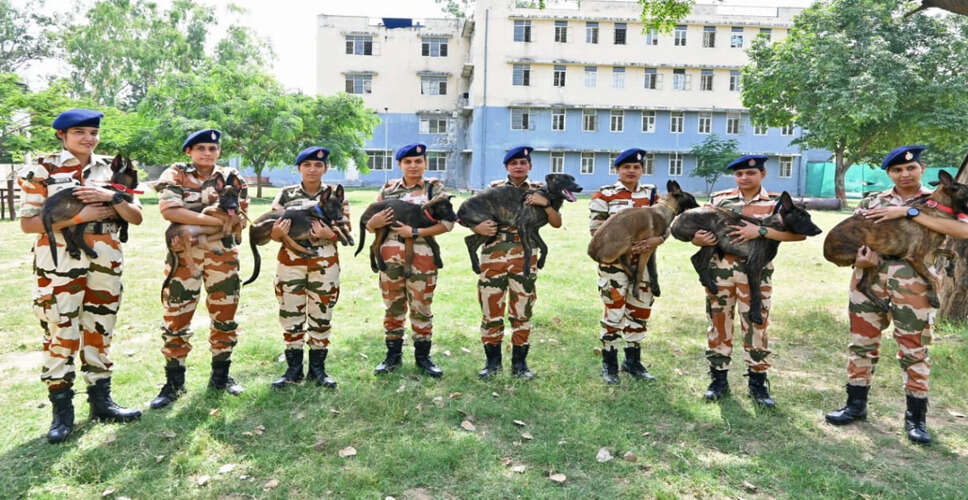
When Remo first arrived among the personnel in khaki, he was just a three-month-old puppy, unaware of borders or battlefields. Today, he stands as a courageous warrior of the Indo-Tibetan Border Police (ITBP), proving effective against Naxalite IEDs and explosives. Remo's tale reflects the bravery of countless combat dogs trained to outsmart death through play.
Note -This news has been published by a news agency, with minor grammatical corrections made by the author.
Remo's story offers a glimpse into the lives of many combat dogs trained to face death with courage. His handler, a soldier stationed with the ITBP, shared that Remo's initial deployment was in the Naxal-affected regions of Chhattisgarh.
In this area, IEDs buried by Naxalites pose the greatest threat to soldiers. According to his handler, Remo has cleared paths for security forces multiple times using his keen sense of smell. It took nine months to train Remo as an expert explosive detection dog. The soldier recalled that Remo was brought to the training center at just three months old, and he was entrusted with his training.
He was quite playful and mischievous. At times, his disobedience would frustrate me, but I learned to teach him with love and incentives (favorite food, toys). We sometimes spent 24 hours together during training, and then came the day he became my most loyal companion.” Dogs older than three months are not inducted into the military.
The Three Stages of Training: How a Combat Dog is Made
The handler explains that to enlist a dog in the military or paramilitary forces, it must be no older than three months. Following this, a rigorous training program lasting from nine to eighteen months is divided into three phases:
Basic Commands (Coordination): In the first phase, a bond is established between the dog and its handler. Commands such as sit, stand, and follow instructions are taught.
Behavior Test: Based on the dog's capabilities, it is determined whether it will be trained to detect explosives, narcotics, or track criminals.
Specialization: Here, dogs are rewarded (with favorite food or toys) for sniffing the ground and identifying specific scents (like explosives).
Dogs undergo training for a minimum of nine to eighteen months, completed in three stages. According to the soldier, the initial phase involves teaching dogs 'basic commands,' which include sitting, standing, walking, and following the handler's instructions. This is when the bond between the dog and handler is formed. Each dog is assigned a handler who works with them from training through to duty.
The soldier emphasized that the bond between the dog and handler is crucial. If the handler changes, the dog takes time to adjust to the new person, which can affect its performance. After basic training, the dog undergoes a 'behavior test' to assess its capabilities, determining whether it will be trained for explosive detection, narcotics identification, tracking, or guard duty.
A dog receives specialized training in only one area. According to the soldier, in the third phase, they are trained to sniff the ground and are rewarded for identifying the correct scent. Gradually, the training incorporates the scents of explosives, enabling the dog to become proficient in identifying them.
During training, dogs are also physically conditioned. They practice walking on various surfaces, maintaining balance, and overcoming obstacles to prepare them for challenging and risky situations. The most challenging aspect of Remo's training was teaching him silent indication.
The soldier explained that if a dog barks upon seeing explosives, sound waves could trigger sensitive bombs. Therefore, dogs are trained to sit quietly upon detecting a scent, indicating to the handler that a bomb may be present. The soldier stated, “A dog is the most loyal creature in the world. Once its owner gives a command, it will complete its task. This is why dogs succeed in nearly 99 percent of cases.”
He added, “The dog does not understand that it is identifying explosives. For it, it’s just a game. Upon receiving a command, it searches for the scent it has been trained to find.” In the ITBP, Belgian Malinois dogs are preferred for explosive detection.
The soldier noted, “This breed is incredibly agile and does not tire easily, making them suitable for tough conditions and long operations. Previously, Labrador breeds were also used, but Belgian Malinois have proven more effective in field duties.”
However, indigenous breeds are now also being included in the military. The soldier mentioned that if a dog becomes unfit for duty due to age or health reasons, it is retired after a medical examination and placed in a dedicated facility where the ITBP cares for them. These trained dogs have played a significant role in anti-Naxal operations and are also deployed in crowded events, programs, and other security duties.