
The Impact of Free Schemes on Tamil Nadu's Political Landscape
Are Free Schemes Beneficial for the Public?
The question of whether the politics of free offerings truly serves the public interest or merely acts as a shortcut to electoral victory is gaining traction in various states across the country. While these free schemes provide immediate relief to citizens, they can exert significant long-term pressure on the financial health of the states.
AIADMK's Promises for the Tamil Nadu Elections
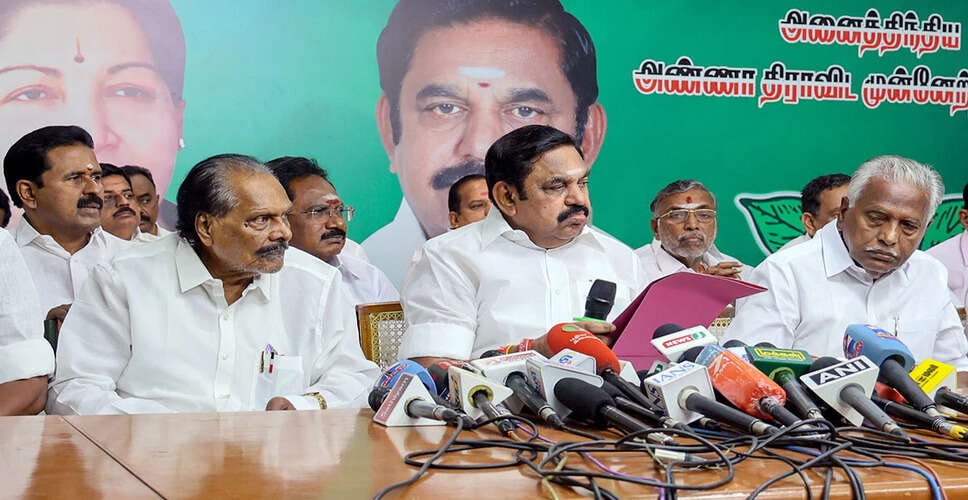
The AIADMK has unveiled its manifesto for the Tamil Nadu assembly elections, filled with appealing promises. Party General Secretary Edappadi K. Palaniswami presented this manifesto, which includes 297 commitments focused on social welfare, inflation relief, and financial support for families.
Key Proposals in the Manifesto
Among the promises made, the party has pledged to provide ₹10,000 to every family. Additionally, women are promised ₹2,000 monthly financial assistance. Other commitments include three free gas cylinders per household annually, free bus travel for both men and women, and the provision of one kilogram of lentils and one liter of cooking oil for ration card holders. Notably, women with rice ration cards are also promised free refrigerators.
Addressing Economic Burdens
The party argues that these initiatives are essential to alleviate the financial burdens on families amid rising inflation. They also claim that there will be a focus on job creation and strengthening the agricultural sector.
Recalling Past Initiatives
The AIADMK has reminded voters of past initiatives from former Chief Minister Jayalalithaa, who introduced free items like fans, mixers, and grinders. The current strategy appears to be an expansion of that model.
Concerns Over Sustainability
However, a critical question arises: do such free schemes genuinely promote development? Recent examples indicate that the opposite effect can occur. States like Himachal Pradesh and Karnataka are experiencing the financial strain of these free offerings on their government budgets.
Financial Strain in Himachal Pradesh and Karnataka
In Himachal Pradesh, the government is forced to make significant cuts in spending due to rising debt and fiscal pressure. Reports indicate difficulties in paying representatives and maintaining essential services. Similarly, in Karnataka, discussions about a lack of funding for development projects are emerging, as a substantial portion of resources is being allocated to free schemes.
The Long-Term Consequences of Excessive Spending
Economic experts warn that when governments spend beyond their means, they must resort to borrowing, leading to an ever-increasing state debt that burdens future generations. Consequently, vital development projects in areas such as infrastructure, education, health, and industrial investment are neglected.
The Risk for Tamil Nadu
Tamil Nadu faces a similar risk. While making attractive promises to win elections is easy, implementing them requires substantial resources. Without increasing sustainable income sources, the state's financial stability could be compromised.
The Balance Between Immediate Relief and Long-Term Growth
Political parties often argue that these schemes are essential for social justice and the welfare of the poor. While it is undeniable that assistance should reach those in need, the challenge lies in maintaining balance. If politics becomes solely focused on distributing freebies, the pace of development is likely to slow.
Upcoming Elections in Tamil Nadu
The upcoming elections in Tamil Nadu are scheduled for April 23, with counting set for May 4. The AIADMK has also finalized a seat-sharing formula with the National Democratic Alliance, planning to contest 178 seats while allocating shares to other allied parties.
The Challenge Ahead
It is evident that free offerings have become a crucial tool in electoral politics. However, experiences from Himachal Pradesh and Karnataka suggest that this model may not be sustainable in the long run. Tamil Nadu now faces the challenge of striking the right balance between immediate benefits and long-term development. If this balance is disrupted, electoral success may come at the cost of genuine progress.