
The Ideological Battle of Early Indian Democracy: Nehru vs. Ambedkar

The Secular Vision of Nehru
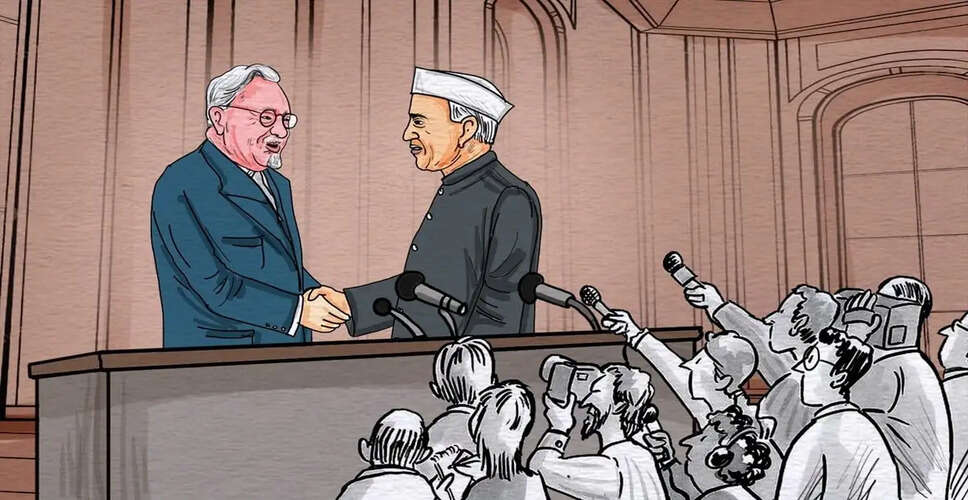
In the formative years of Indian democracy, a significant ideological conflict emerged that shaped the nation's social framework. This discussion revolves around Jawaharlal Nehru's secular vision, which ironically positioned him against his own allies. On one side stood Nehru, advocating for modernization through the Hindu Code Bill, while on the other was Dr. Rajendra Prasad, the first President of India, who argued for a 'Uniform Civil Code' applicable to all, rather than just Hindu personal laws. Adding to this contention was B.R. Ambedkar, who, disillusioned by Nehru's retreat on women's rights, resigned from his position as Law Minister. This report delves into the unspoken debates and sharp disagreements that cast doubt on the secular identity of modern India.
Nehru vs. Ambedkar
The narrative of the Hindu Code Bill begins with its two primary advocates, Nehru and Ambedkar, who shared a vision for a modern, progressive India. However, their relationship soured following Ambedkar's resignation as Law Minister, which Nehru accepted without protest. Nehru had entrusted Ambedkar with drafting the bill and expressed his disappointment in a letter to Patel regarding its opposition. The core of the bill sought to replace religious laws with a secular civil code, proposing to outlaw polygamy, grant women rights to property and divorce, amend inheritance laws, and introduce provisions for inter-caste marriages. Despite being presented as a promise of progress and equality, the bill faced fierce opposition. Ultimately, it was divided into four parts to facilitate passage, yet its implementation remained challenging.
Ambedkar's Sharp Letter to Nehru
Reform measures were central to their nation-building agenda, but they risked disrupting the fragile political consensus necessary for other priorities in the decade following India's independence. By February 1951, Ambedkar's frustration with the inaction peaked. He penned a pointed letter to Nehru, criticizing him for failing to effectively counter the opposition to the bill. He warned that if the bill did not pass despite Nehru's assurances, it would be seen as a farcical and cowardly failure for the government. In the same letter, Ambedkar dismissed some proposed amendments as foolish.
Ambedkar Resigns as Law Minister
Months later, Ambedkar's despair culminated in his resignation from the Law Minister position in September 1951 due to the bill's delays. He regarded his work on the bill as equally significant as his contributions to the Constitution. In his resignation letter, he harshly noted that the bill had been effectively shelved after the passage of four sections. He expressed that while he believed Nehru was sincere, he lacked the necessary seriousness and resolve to pass the Hindu Code Bill.
Resistance from Hindu Groups
Before Nehru and Ambedkar could push for the passage of the Hindu Code Bill in Parliament, a resistance movement led by Hindu groups was already underway. Discussions regarding the bill were taking place in the Constituent Assembly established for drafting the Constitution as early as March 1949. A group named the All India Hindu Anti-Code Bill Committee was formed to challenge the proposed legislation. Historian Ramachandra Guha, in his book 'India After Gandhi', describes how religious figures and conservative lawyers held numerous meetings across the country, portraying themselves as warriors in a religious crusade. They argued that the government had no right to interfere with Hindu laws based on religious scriptures. Guha notes that the Rashtriya Swayamsevak Sangh (RSS) exerted significant influence behind this movement, organizing a public meeting in Delhi's Ram Leela Maidan on December 11, 1949, where speakers condemned the bill, with one calling it a 'nuclear bomb on Hindu society'. On December 12, 1949, when discussions on the bill resumed, around 500 protesters gathered outside Parliament.
Debate Between Rajendra Babu and Nehru on the Hindu Code Bill
On September 14, 1951, Rajendra Prasad wrote to Nehru opposing the Hindu Code Bill, which was intended solely for Hindus. He questioned why provisions beneficial to many should only apply to one community, leaving others deprived of its advantages. He stated that he would assess the bill on its merits before granting approval. Nehru promptly responded, acknowledging that Prasad's concern about evaluating the bill on its merits was serious and could lead to a conflict between the President and the government. He asserted that the President had no authority to oppose a bill passed by Parliament. On September 18, Prasad wrote again, outlining the powers granted to the President under the Constitution and expressing his desire to avoid a conflict. The matter eventually reached a resolution after consulting the Attorney General.