
The Evolving Role of Brahmins in Tamil Nadu Politics
The political dynamics in Tamil Nadu have shifted dramatically, with major parties not fielding Brahmin candidates in recent elections. This change reflects a deeper transformation in power structures, where Brahmins now influence from behind the scenes rather than on the electoral stage. The historical context, including the Non-Brahmin Manifesto and the Dravidian movement, has reshaped political identities. As new centers of power emerge, the absence of Brahmin candidates raises questions about their role in contemporary politics. This article delves into these changes and their implications for the future of Tamil Nadu's political landscape.
| Apr 9, 2026, 13:24 IST
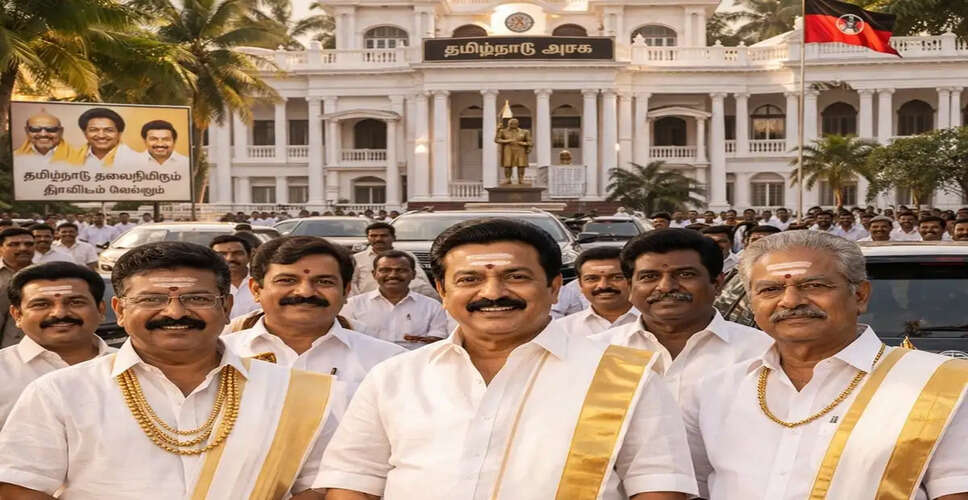

Political Dynamics in Tamil Nadu
As the political climate heats up in Tamil Nadu, a striking revelation has emerged that has stirred significant debate. Major political parties in the state, including DMK, AIADMK, Congress, and even the BJP, have not fielded a single Brahmin candidate this election cycle. This is not merely a strategic decision; it reflects a profound shift in the political and social landscape that has redefined power dynamics in Tamil Nadu over the past century.
This narrative is not about the absence of the Brahmin community from power but rather about their changing role. Brahmins continue to hold significant positions in bureaucracy, policy-making, and influential networks within Tamil Nadu. The difference now is that they are less visible on the electoral stage, opting instead to influence from behind the scenes. They have transitioned from being public figures to becoming integral parts of the system.
To understand this transformation, one must delve into history. The Non-Brahmin Manifesto of 1916 marked the beginning of this shift. At that time, Brahmins were a minority, yet they dominated education, government jobs, and administration. Their proficiency in English was a key asset that brought them close to power. This imbalance gradually morphed into discontent, leading to a robust political identity for non-Brahmins.
The Dravidian movement played a crucial role in solidifying this identity. It was not merely a protest but a construction of an alternative power structure. By addressing social inequality, linguistic pride, and demands for equality, it fostered a political environment that transformed the state's landscape. Consequently, Brahmins became symbols of inequality rather than just a community.
By the 1950s, this shift became increasingly evident. Leadership within the Congress party transitioned from Brahmins to non-Brahmins. In 1954, under K. Kamaraj's leadership, there was not a single Brahmin minister in Madras state. By the 1970s, both the ruling and opposition parties were dominated by non-Brahmin politics. This was not just about winning elections; it was about determining who held legitimate power.
What is happening today is a continuation of this long process. Interestingly, the BJP, often viewed as a Brahmin-friendly party, has also refrained from nominating any Brahmin candidates. This raises the question: why? The answer is straightforward yet uncomfortable. Brahmin leadership within the party seeks to maintain influence without taking electoral risks, aiming to hold onto power while avoiding political gambles.
Conversely, smaller and newer parties are attempting to break this inertia. Some have fielded Brahmin candidates, particularly in areas where their influence remains strong. However, larger parties prefer to steer clear of such risks.
Jayalalithaa stands out as an exception in this narrative. Despite being a Brahmin, she never leveraged her ethnic identity for political gain, instead fostering a broad, inclusive leadership. However, she too did not attempt to re-establish Brahmin politics, as the political landscape of Tamil Nadu had already undergone a complete transformation.
Today, new centers of power have emerged in Tamil Nadu politics. Communities like the Thevar and Gounder have gained prominence within the AIADMK, while other strong social groups dominate the DMK. This indicates that caste has not disappeared; rather, the face of power has changed. Tamil Nadu's politics is no longer a Brahmin versus non-Brahmin scenario but a competition among various backward and influential communities. Thus, the absence of Brahmin candidates is not surprising but rather a recognized political reality.
The real question is not why Brahmins are not contesting elections, but why they feel no need to do so. When power can be wielded from behind the scenes, why take the risk of stepping into the limelight?
Ultimately, Tamil Nadu has once again demonstrated that its politics is driven not by symbols but by the realities on the ground. In this reality, power is now more secure and influential behind the scenes than on the public stage. This is the most compelling and uncomfortable truth of the entire narrative.