
Tensions Rise Over US-Iran Ceasefire Amid Conflicting Claims
Ceasefire Strained
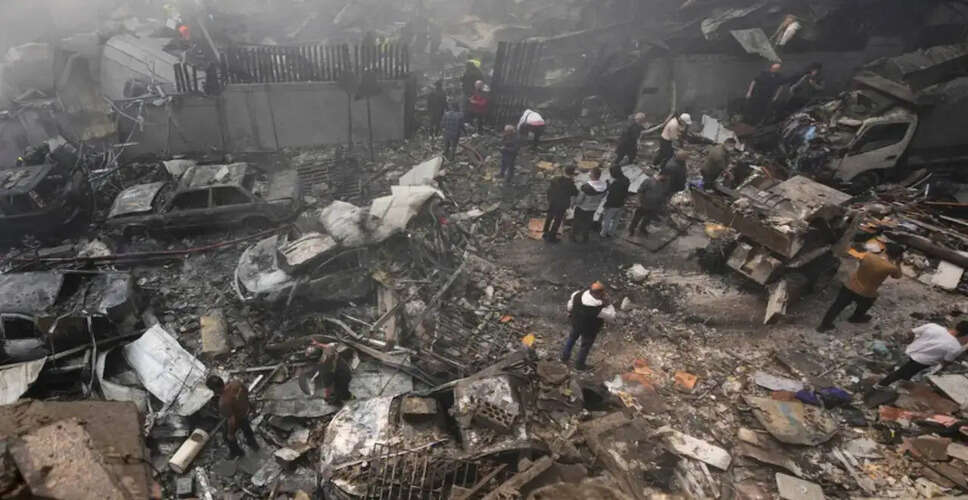
The fragile ceasefire between the United States and Iran showed signs of strain on Wednesday, as officials from both nations clashed over a key issue: whether the truce was intended to include Lebanon. Central to the confusion is a 10-point framework that former President Donald Trump claimed had been agreed upon. Initial reports suggested that the plan called for a cessation of Israeli military actions in southern Lebanon. However, White House representatives have since dismissed that interpretation, asserting that no such commitment was made. This disagreement has quickly become a major point of contention in what was already a precarious two-week pause in hostilities. Iranian officials, including Foreign Minister Abbas Araghchi, have accused the U.S. of not honoring its commitments. Araghchi stated that the U.S. must choose between upholding the ceasefire or allowing the conflict to escalate through Israel. Pakistan, which played a role in brokering the agreement, has claimed that the deal did encompass Lebanon — a statement publicly contested by White House press secretary Karoline Leavitt. This divergence in accounts has left the terms of the agreement ambiguous, even as violence persisted. Israeli forces conducted strikes in Lebanon on Wednesday, highlighting the ongoing uncertainty.
Ceasefire Under Pressure
A Ceasefire Under Pressure
The confusion arises as both parties consider the implications of allowing the ceasefire to collapse. The announcement of the truce had an immediate stabilizing effect on global oil and financial markets, which could complicate any renewed hostilities for Trump. For Iran, already facing economic challenges, further escalation could exacerbate existing issues. Nevertheless, tensions remain elevated. Gulf nations reported Iranian missile and drone strikes earlier in the day, and Iranian state media indicated that an oil refinery on Lavan Island had been targeted by what it referred to as 'enemies.'
Strait of Hormuz in Limbo
Strait of Hormuz in Limbo
There is also uncertainty regarding the status of the Strait of Hormuz, a crucial shipping lane through which approximately one-fifth of the world's oil supply flows. Trump had insisted that Iran reopen the strait as part of the ceasefire agreement. However, Iranian state media reported that it had been 'fully closed,' advising vessels to coordinate with its navy to avoid potential dangers. A ship-tracking company noted that no oil tankers had traversed the waterway since the truce commenced. Adding to the confusion, JD Vance mentioned that multiple versions of a 10-point proposal had circulated, leading to misunderstandings about what had actually been agreed upon.
Vance remarked, 'The first 10-point proposal was something that was submitted, and we think, frankly, was probably written by ChatGPT… that immediately went in the garbage.' He described a second version, developed through discussions among U.S., Pakistani, and Iranian officials, as the basis for Trump's announcement. He noted that a third version circulating online was 'even more maximalist.' Vance asserted that the United States had never indicated that Lebanon would be part of the ceasefire. 'I think the Iranians thought that the ceasefire included Lebanon, and it just didn't,' he stated. 'We never made that promise.' He added that any restraint shown by Israel in Lebanon would be a matter of 'good faith,' not a condition of the agreement. 'If Iran wants to let this negotiation fall apart in a conflict where they were getting hammered over Lebanon — which has nothing to do with them — that's ultimately their choice,' Vance concluded.