
Tensions Rise Again in the Strait of Hormuz: Iran Closes Waterway Amid US Blockade
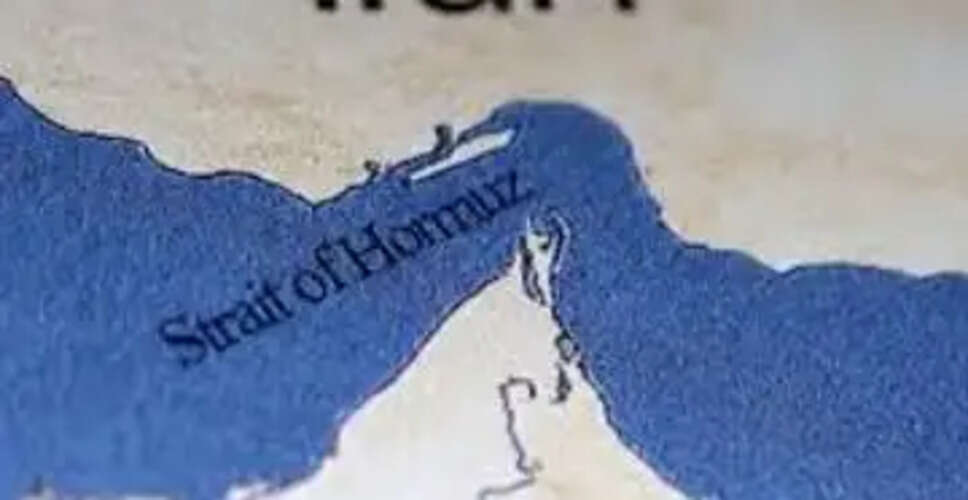

Escalation in the Strait of Hormuz
Cairo: The situation in the Strait of Hormuz intensified on Saturday as Iran retracted its earlier decision to reopen this vital maritime route, resorting to firing upon vessels attempting to navigate through it. This action comes in response to the United States' ongoing blockade of Iranian ports.
According to Iran's Revolutionary Guard navy, the strait will remain closed until the US lifts its blockade. They issued a stern warning stating that any vessel attempting to approach the Strait of Hormuz would be viewed as collaborating with adversaries and would be targeted.
The renewed hostilities in the strait, which typically sees about 20% of the world's oil transit, could exacerbate the global energy crisis and escalate tensions as the conflict enters its eighth week.
A fragile ceasefire is set to expire by Wednesday, with Iran indicating it has received new proposals from the US, while Pakistani mediators are working to facilitate another round of direct talks.
Earlier, Iran's military command declared that control over the Strait of Hormuz had reverted to its previous state, under strict military oversight.
Reports from the UK Maritime Trade Operations center indicated that Revolutionary Guard gunboats fired upon a tanker, and an unidentified projectile struck a container ship, causing damage. India's foreign ministry has summoned Iran's ambassador regarding the serious incident involving two Indian-flagged merchant vessels, especially after Iran had previously allowed several ships bound for India to pass.
For Iran, the closure of the strait—enforced after the US and Israel initiated military actions on February 28 during negotiations concerning Tehran's nuclear program—serves as a potent leverage point, threatening the global economy and inflicting political pressure on President Trump. Conversely, the US blockade aims to maintain pressure on Iran's already struggling economy.
Iran's new supreme leader, Ayatollah Mojtaba Khamenei, made bold statements on Saturday, asserting that the navy is prepared to deliver significant defeats to its adversaries. He has not been publicly seen since assuming leadership following his father's death during Israel's initial strikes.
Reopening and Immediate Closure
Just a day after Iran announced the strait's reopening to commercial traffic following a 10-day truce between Israel and the Iranian-backed Hezbollah group in Lebanon, the situation took a turn. The reopening had led to a drop in oil prices.
However, President Trump reiterated that the US blockade of Iran's ports would remain intact until a deal is reached with Tehran. This blockade was implemented after historic talks in Pakistan ended without a resolution.
Since the blockade commenced on Monday, US forces have dispatched 23 ships back to the region, according to US Central Command. Trump's remarks have sparked significant backlash.
"Americans are jeopardizing the international community and the global economy with these miscalculations," Iranian Deputy Foreign Minister Saeed Khatibzadeh stated, warning that the US is endangering the entire ceasefire agreement.
Iran's Supreme National Security Council labeled the blockade a breach of the ceasefire and declared that Iran would not permit any conditional reopening of the strait. This council has recently acted as Iran's primary decision-making body.
Given that most supplies to US military bases in the Gulf region transit through the strait, the council emphasized that Iran intends to maintain oversight and control over maritime traffic until the conflict concludes, which includes designated routes, fee payments, and transit certificates.
The Revolutionary Guard Navy later reiterated that no vessels should attempt to transit the strait.
Pakistan's Role in Negotiations
The renewed tensions in the strait coincided with Pakistani Foreign Minister Ishaq Dar's announcement that Pakistan is striving to mediate differences between the US and Iran. Pakistan is anticipated to host a second round of negotiations early next week.
Iran's Supreme National Security Council confirmed that new proposals from the US were presented during a visit by Pakistan's army chief and are currently under review.
However, Khatibzadeh expressed that Iran is not prepared for another round of direct talks, citing the US's unyielding stance.
He also stated that Iran would not relinquish its stockpile of 970 pounds (440 kilograms) of enriched uranium to the US, dismissing the notion as unrealistic. Khatibzadeh did not comment on other proposals regarding the enriched uranium, merely stating that Iran is willing to address any concerns.
President Trump remarked on Saturday that Iran "got a little cute" but noted that "very good" discussions were ongoing, promising more information by the end of the day. He added, "They can’t blackmail us."
Trump also mentioned that the US would enter Iran to "retrieve all the nuclear dust," referring to the enriched uranium believed to be buried beneath nuclear sites that were severely damaged by US military strikes last year.
Casualties in Lebanon
In a related incident, French President Emmanuel Macron announced that a French soldier was killed and three others injured during an attack on UN peacekeepers in southern Lebanon. Macron stated on social media that all indications point to Hezbollah being responsible for the attack, a claim echoed by the UNIFIL peacekeeping force.
Hezbollah has denied any involvement.
Pakistan's foreign minister noted that the conflict between Israel and Hezbollah has been a significant hurdle in US-Iran negotiations, and the declaration of a ceasefire in Lebanon is viewed as a positive step towards reaching an agreement with Iran.
It remains uncertain how committed Hezbollah will be to a truce it did not negotiate, especially with Israeli forces still occupying parts of southern Lebanon.
In Beirut, displaced families have begun returning to southern Lebanon and the capital's southern suburbs, despite official warnings to wait until the ceasefire's stability is confirmed.
The ongoing conflict has resulted in at least 3,000 fatalities in Iran, over 2,290 in Lebanon, 23 in Israel, and more than a dozen in Gulf Arab nations.