
Tamil Nadu's 2026 Elections: A Potential Shift in Political Dynamics
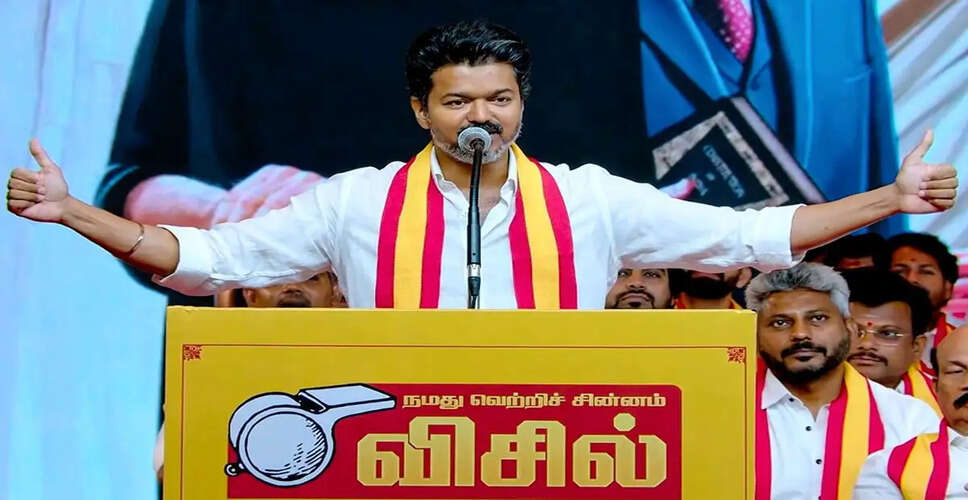

A New Era in Tamil Nadu Politics
The upcoming 2026 assembly elections in Tamil Nadu are poised to signal a significant transformation in the state's political landscape. The Tamilga Vetria Kazhagam, led by actor-turned-politician Vijay, has emerged as a formidable force, challenging the long-standing dominance of Dravidian parties. Recent exit polls have stirred both excitement and uncertainty regarding this new political entity.
According to a leading survey agency, Vijay's party could secure between 98 to 120 seats in its inaugural election. If these predictions hold true, it would mark a historic surge in Tamil Nadu's political arena. The survey also estimates that the DMK alliance may win between 92 to 110 seats, while the National Democratic Alliance could be limited to 22 to 32 seats. Furthermore, the AIADMK alliance is projected to garner around 23% of the vote share, whereas Vijay's party might achieve approximately 35%, matching the ruling party's support.
Vijay's Popularity Among Voters
In terms of preferred candidates for the chief minister position, Vijay appears to be leading the pack. Nearly 37% of respondents identified him as their first choice, while the current chief minister, M.K. Stalin, received 35% support. Although the margin is narrow, it indicates a growing desire for change among the electorate.
Vijay's appeal is particularly pronounced among younger voters. The survey reveals that around 68% of voters aged 18 to 19 support him, with 59% backing him in the 20 to 29 age group, and 45% in the 30 to 39 bracket. This trend suggests a shift away from traditional politics towards new alternatives. His party has also gained traction among students, unemployed youth, urban voters, and marginalized communities.
Diverse Poll Predictions
However, not all surveys present a uniform picture. Some agencies predict that Vijay's party may only secure between 10 to 26 seats, while the DMK alliance could achieve between 120 to 145 seats, potentially returning to power. The AIADMK alliance is estimated to win between 60 to 80 seats. Some surveys indicate a tight race, while one agency has shown the AIADMK in a favorable position. Interestingly, Vijay's party has projected that it could win over 200 seats.
The trend of film stars entering politics is not new in Tamil Nadu. Previous leaders like M.G. Ramachandran and J. Jayalalithaa have successfully transitioned from cinema to governance. If Vijay ascends to power, he would become the third major actor-turned-politician in this lineage. This election is particularly noteworthy as Vijay has opted to contest independently rather than align with a major coalition, a bold move that has helped him establish a distinct identity.
Voter Engagement and Expectations
It's important to note that the Tamil Nadu assembly elections saw over 84% voter turnout on April 23, indicating heightened public engagement. According to exit polls, around 35% of voters cited a desire for change as their primary motivation, with this figure rising to 77% among Vijay's supporters. This suggests a significant portion of the electorate is dissatisfied with the current administration and is seeking new leadership.
Political analysts have drawn comparisons between Vijay and Andhra Pradesh leader N.T. Rama Rao, who achieved remarkable success without the backing of established parties. While Vijay faces different circumstances, his popularity and support among youth position him as a strong contender. There are speculations that if no party secures a clear majority, Vijay could play a pivotal role as a kingmaker. Reports suggest that the AIADMK has already reached out to him for potential collaboration if needed.
Looking Ahead
Ultimately, there is no doubt that the outcome of this election could redefine the political trajectory of Tamil Nadu. All eyes are now on May 4, the date set for vote counting. While exit polls are merely projections and can sometimes be inaccurate, they have undeniably highlighted that Tamil Nadu's political scene is entering a new phase, where a fresh face is challenging the established order.