
Tamil Nadu to Enhance Weather Monitoring with New Doppler Radars
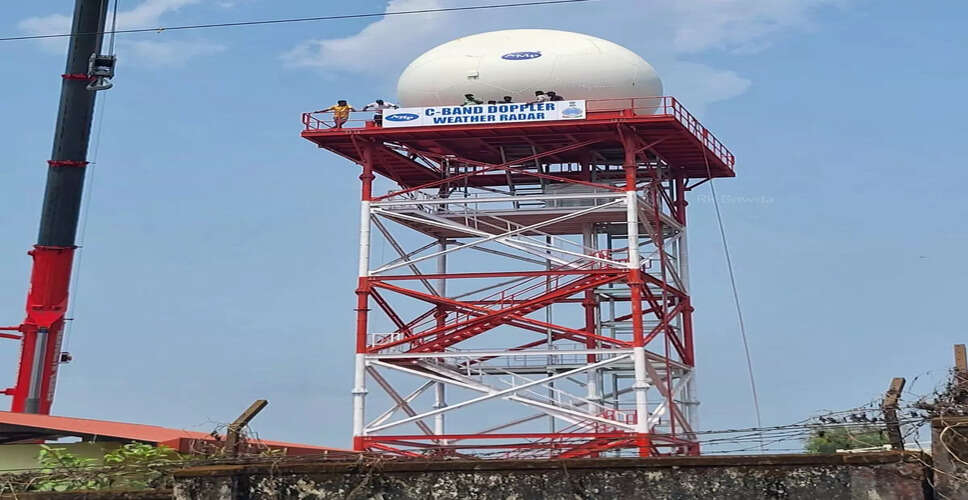
Strengthening Weather Forecasting in Tamil Nadu
Chennai, Dec 29: In a significant advancement for weather forecasting and disaster management, Tamil Nadu is poised to install five new Doppler Weather Radars (DWRs). This initiative aims to improve cyclone tracking, rainfall assessment, and early warning systems throughout the state.
The radars will be strategically placed in Kanyakumari, Tiruchirappalli, Coimbatore, Yercaud, and Ramanathapuram.
Out of the five radars, three will be set up under the Central government's "Mission Mausam" initiative, while the other two will be implemented through a special project by the Tamil Nadu Disaster Risk Reduction Agency.
This expansion is anticipated to greatly enhance weather monitoring capabilities, particularly in areas that currently lack sufficient radar coverage.
Currently, Tamil Nadu is equipped with eight Doppler weather radars, some of which are located within the state and others in adjacent regions.
Among these, Chennai hosts two radars: an older S-band radar at the Chennai Port and an X-band radar at the National Institute of Ocean Technology (NIOT).
Coastal monitoring is facilitated by an S-band radar at Sriharikota, a C-band radar at Kalpakkam, and another S-band radar at Karaikal.
Interior regions are monitored by radars situated in Thiruvananthapuram, Kochi, and Sulur.
However, officials have noted that significant portions of central Tamil Nadu, particularly Tiruchirappalli, and southern districts like Kanyakumari, are still inadequately covered.
These areas are especially susceptible to rainfall from both the southwest and northeast monsoons and are often affected by cyclonic systems originating from the Bay of Bengal.
Officials explained that the choice of new radar locations was influenced by various factors, including the necessity for continuous weather monitoring, increased radar density in coastal and hilly areas, and improved coverage in disaster-prone and densely populated regions.
Additionally, replacing outdated equipment and ensuring redundancy in vulnerable areas were crucial considerations.
With the installation of these five radars, Tamil Nadu's weather surveillance network is expected to be significantly fortified, leading to more accurate forecasts, improved early warning systems, and enhanced responses to cyclones, heavy rainfall, and extreme weather conditions.