
Tamil Nadu CM Opposes Proposed Redistricting for Women's Reservation

Stalin's Strong Opposition to Redistricting
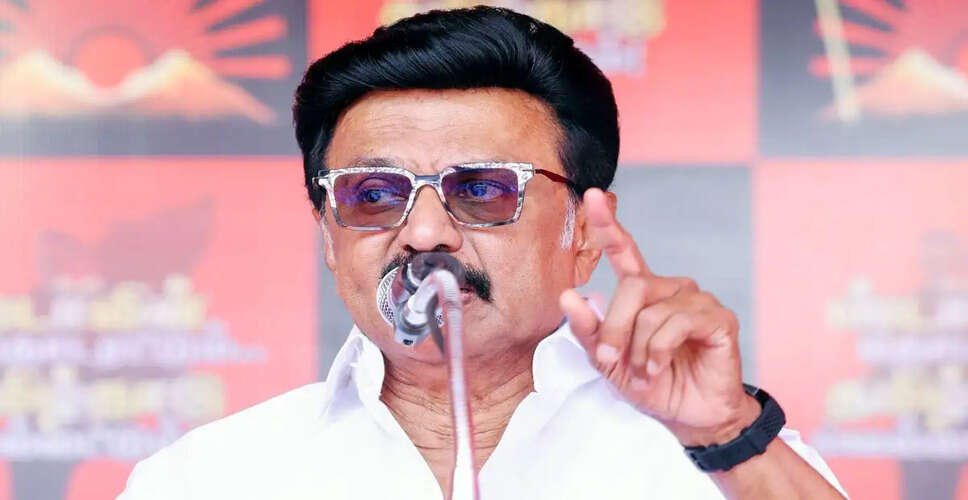
M.K. Stalin, the Chief Minister of Tamil Nadu, has expressed strong disapproval of the proposed redistricting process aimed at implementing 33% reservation for women under the Nari Shakti Vandan Act. He characterized this initiative as a restructuring of power. In a post dated January 31, 2026, Stalin warned that if redistricting is based on the 2011 census, the number of seats allocated to northern states would nearly double, while southern states would retain only about 24% of Lok Sabha seats. He clarified that the Dravida Munnetra Kazhagam (DMK) supports women's reservation but opposes increasing the total number of seats.
Concerns Over Democratic Representation
Stalin stated that this is not a reform but a reorganization of power. He criticized the NDA government led by Prime Minister Narendra Modi for gradually undermining the foundation of Parliament. He noted that a vibrant platform for debate and accountability is being transformed into a hollow ritual, where members struggle to find time to speak or represent their constituents. The proposal to increase seats contradicts the government's own slogan of 'minimum government, maximum governance,' leading to higher expenses and a burden on taxpayers, while diminishing the quality of parliamentary processes.
Violation of Federal Principles
Citing Article 1 of the Constitution, he argued that this approach contradicts the spirit of the Constitution, which describes India as a union of states. Ignoring the voices of states and bypassing meaningful consultation is undemocratic and represents a monopolistic encroachment that undermines India's federal and pluralistic structure. Stalin supported other southern state chief ministers and labeled the redistricting process as punitive for states that have successfully controlled their populations.
Political Maneuvering Ahead of Elections
He expressed further concern that this process would distort representation and tilt the balance of power in favor of BJP-dominated northern states, silencing the voices of southern India. As veteran leader Siddaramaiah pointed out, this is not a fair process; it is a calculated political restructuring. Northern states would receive nearly double the seats, while the southern share would remain stagnant at about 24%. This is tantamount to punishing states like Tamil Nadu, Karnataka, Kerala, and Telangana, which have achieved success in population control. All southern chief ministers, including Siddaramaiah, Pinarayi Vijayan, and Revant Reddy, have rightly warned that this move would distort federalism and concentrate power in certain regions.
Timing of the Amendment Raises Questions
Stalin questioned the timing of the amendment to the Nari Shakti Vandan Act amidst assembly elections in four states and one union territory, labeling it a "political maneuver" for electoral gain. He raised serious doubts about why such a sweeping decision is being made during state elections. This appears to be another political tactic aimed at influencing the electoral atmosphere, similar to attempts to sway women voters ahead of the 2024 parliamentary elections. He emphasized that while they fully support 33% reservation for women, it should be implemented without increasing the number of seats and without penalizing states that are functioning responsibly. If the intention is genuine, there should be no obstacles to immediate implementation within the existing framework.