
Tamil Nadu CM Critiques New CBSE Curriculum as Linguistic Imposition
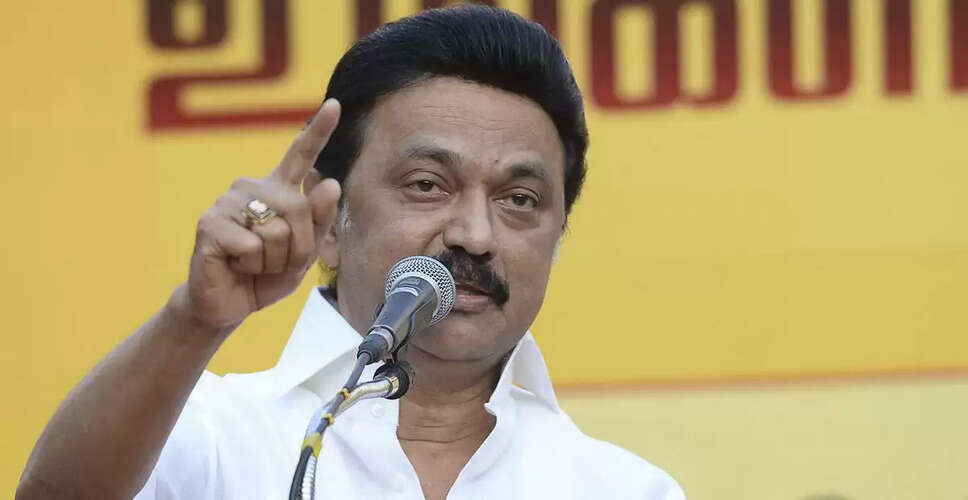
Stalin's Concerns Over CBSE's New Curriculum
On Saturday, MK Stalin, the Chief Minister of Tamil Nadu, expressed serious concerns regarding the new curriculum framework introduced by the Central Board of Secondary Education (CBSE), labeling it a "calculated and alarming effort at linguistic imposition."
The recently announced curriculum, which will take effect in the 2026-’27 academic year, mandates that students in Class 6 learn a third language. According to reports, at least two of these languages must be Indian, with English categorized as a foreign language.
Stalin argued that this requirement would effectively force students in southern states to learn Hindi.
“Where is the reciprocity?” he questioned, pointing out that students in Hindi-speaking regions are not required to learn languages such as Tamil, Telugu, Kannada, Malayalam, or even Bengali and Marathi.
He accused the Union government, led by the Bharatiya Janata Party, of pushing a centralizing agenda that favors Hindi while neglecting India's diverse linguistic heritage.
Stalin claimed that the three-language policy is merely a covert strategy to promote Hindi in non-Hindi speaking areas.
He further noted that while the Centre has not made Tamil a compulsory language in Kendriya Vidyalaya Sangathan schools and has failed to appoint sufficient Tamil teachers, it now seeks to instruct states on promoting Indian languages.
The recently unveiled curriculum framework by the Central Board of Secondary Education, aligned with the National Education Policy 2020, is not an innocent academic reform—it is a calculated and deeply concerning attempt at linguistic imposition that vindicates our long-standing… pic.twitter.com/9sTZKVV7md
— M.K.Stalin - தமிழ்நாட்டை தலைகுனிய விடமாட்டேன் (@mkstalin) April 4, 2026
In response, Union Education Minister Dharmendra Pradhan dismissed Stalin's claims of Hindi imposition as a "tired attempt to cover up political failures."
He stated, "By misrepresenting a flexible policy as 'compulsory Hindi', you are not defending Tamil; you are creating barriers that deny our youth the opportunity to become multilingual global leaders," in a social media post.
Pradhan argued that portraying multilingualism as a threat is misguided. He emphasized that learning additional languages does not weaken Tamil; rather, it enriches the language and empowers its speakers.
The education minister also contended that Stalin's concerns about reciprocity overlook the realities on the ground, asserting that under Prime Minister Narendra Modi, Tamil has been recognized as a national treasure.
Hon’ble Chief Minister of Tamil Nadu, Thiru @mkstalin ji, your narrative of “imposition” is a tired attempt to mask political failures. The National Education Policy 2020 is, in fact, a manifesto for linguistic liberation. It prioritises the mother tongue so every Tamil child can… https://t.co/DhDP5ECM4e
— Dharmendra Pradhan (@dpradhanbjp) April 4, 2026
Stalin, however, maintained that it is disingenuous to claim that there is no imposition of Hindi.
“What third Indian language is actually being implemented in schools across Uttar Pradesh, Madhya Pradesh, Rajasthan, and Gujarat?” he questioned. “How many PM SHRI Schools genuinely offer South Indian languages such as Tamil, Kannada, Malayalam, Telugu, and languages like Bengali, Odia, and Marathi in northern India?”