
Supreme Court's Key Remarks on Protests at Jantar Mantar
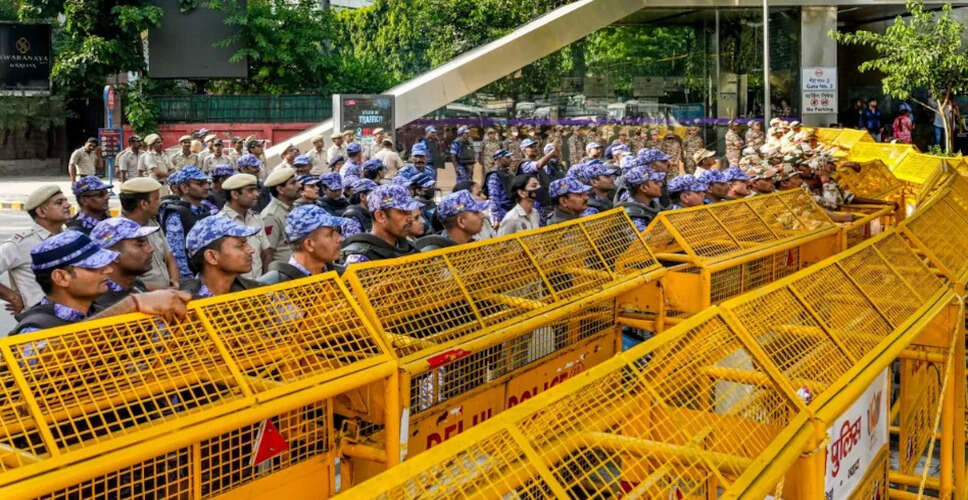

Supreme Court Addresses Protest Rights
During a recent hearing on November 3, the Supreme Court made significant observations regarding protests and the use of public spaces. Chief Justice of India (CJI) D.Y. Chandrachud emphasized that no single group should be allowed to occupy a protest site indefinitely. He clarified that while every citizen and organization has the right to demonstrate in support of their demands, the prolonged presence of one group should not infringe upon the rights of others.
'Everyone Has the Right to Protest, But Not to Permanently Occupy Spaces'
The bench led by CJI Chandrachud stated that designated protest areas should be accessible to various groups for limited durations. No organization should have the authority to monopolize a location, preventing others from voicing their concerns.
The court raised a critical question: if one group remains at a protest site indefinitely, where will others go to express their views? Citing examples of farmers, laborers, trade unions, and the homeless, the court affirmed that everyone deserves a platform to be heard. Thus, the use of protest sites must be balanced and organized.
Concerns for Daily Wage Earners
The Supreme Court also highlighted the impact of protests on the livelihoods of ordinary citizens. CJI Chandrachud remarked that daily wage workers and small business owners should not suffer losses due to protests. The court noted that while the Constitution grants the right to protest, it also protects the rights of individuals to conduct business and earn a living.
The bench stressed the importance of maintaining a balance between these two rights. If a protest disrupts someone's means of livelihood, that concern is equally significant.
Reference to CJP's Protest
During the proceedings, Solicitor General Tushar Mehta mentioned the protest by the Cockroach People's Party (CJP). He informed the court that the party was granted permission for a one-day protest at Jantar Mantar in July, but the demonstrators allegedly remained for 17 days. He also noted that there was an attempt to march towards Parliament without permission afterward.
In response, the court questioned the conditions surrounding the use of protest sites and permissions granted. The circumstances surrounding the CJP-related protests were also discussed.
Discussion on Ram Leela Maidan
Senior advocate N. Hariharan brought up Ram Leela Maidan as a designated protest location. He questioned where people could express their views if there are difficulties at sites like Jantar Mantar and Ram Leela Maidan.
The court also considered the need for alternative locations to provide adequate facilities for protesters while maintaining public order.
Surveillance and Privacy During Protests
The issue of CCTV surveillance during protests and the right to privacy was also raised. Advocate Prashant Bhushan questioned the legal basis for monitoring individuals protesting in public spaces.
In response, the Solicitor General stated that surveillance was conducted via CCTV cameras. CJI Chandrachud commented that the expectation of privacy for individuals in public spaces may vary. However, the legal basis for such surveillance was also a point of concern for the court.
Key Takeaway from the Proceedings
The Supreme Court's remarks convey a crucial message: while the right to protest is vital in a democracy, public spaces cannot be permanently occupied by any single group. It is essential to balance the rights of protesters, local businesses, laborers, and ordinary citizens.
These comments come at a time when there is ongoing debate regarding protest permissions at Jantar Mantar, the site's condition, and the movement associated with the CJP. The court has not dismissed the right to protest but has emphasized the need to maintain public order and consider the interests of other citizens.