
Supreme Court's Authority on Superstitious Practices: A Landmark Discussion
Supreme Court's Jurisdiction on Religious Practices
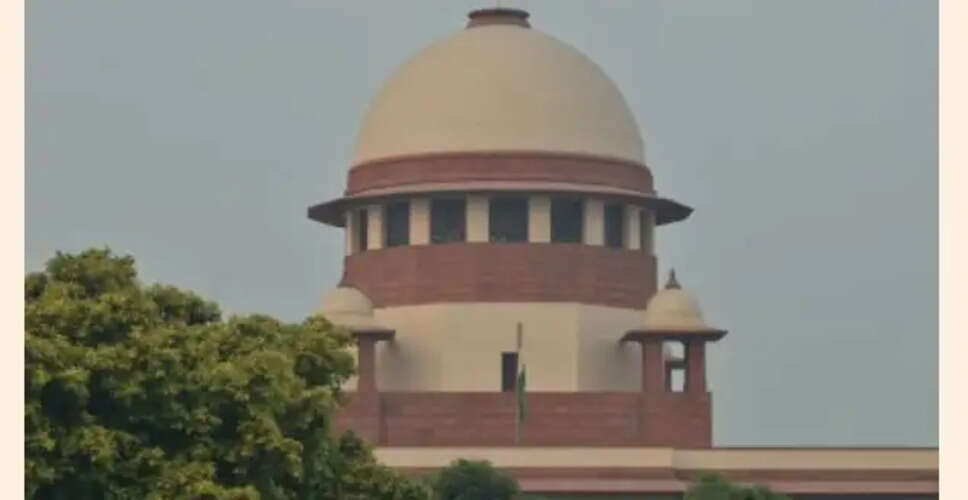
New Delhi: On Wednesday, the Supreme Court asserted its authority to determine what constitutes a superstitious practice within a religion.
This statement was made in response to the government's claim that a secular court lacks the expertise to make such determinations, as judges are primarily trained in law, not religious matters.
A nine-judge constitutional bench, led by Chief Justice Surya Kant, is currently reviewing petitions concerning gender discrimination in religious sites, including the Sabarimala temple in Kerala, and the broader implications of religious freedom across various faiths.
Solicitor General Tushar Mehta, representing the government, questioned how the court could define a superstitious practice.
"Even if a practice is deemed superstitious, it is not the court's role to label it as such. According to Article 25(2)(b) of the Constitution, it is the legislature's responsibility to enact reform laws," he stated.
Mehta further explained that the legislature has the authority to identify superstitious practices and implement necessary reforms, citing existing laws aimed at preventing black magic and similar practices.
In response, Justice Amanullah remarked that the assertion was overly simplistic, emphasizing that the court indeed has the jurisdiction to classify practices as superstitious.
"What follows from that determination is a matter for the legislature. However, it cannot be said that the legislature's decisions are the final authority in court," he noted.
Mehta reiterated that a secular court should not label a religious practice as mere superstition due to a lack of scholarly expertise.
"Your Lordships are experts in law, not in religious matters," he added.
He also pointed out the diversity of beliefs in society, stating that what may be considered religious in one region, like Nagaland, could be viewed as superstition in another.
Justice Bagchi raised a pertinent question about whether witchcraft, if part of a religious practice, should be classified as superstition.
"If the court is approached under Article 32 regarding a religious practice of witchcraft, and the legislature has not acted, can the court not invoke the 'doctrine of unoccupied field' to prohibit such practices, considering health, morality, and public order?" Justice Bagchi queried.
Mehta responded that judicial review could be warranted under the principles of health, morality, and public order, rather than solely on the basis of superstition.
Justice Nagarathna suggested that when defining essential religious practices, the court should consider the philosophy of the respective religion.
"You cannot impose the views of one religion onto another to determine what is essential. The court's approach should reflect the philosophy of that religion, while still considering health, morality, and public order," she stated.
The proceedings are ongoing.
In September 2018, a five-judge bench had ruled 4:1 to lift the ban on women aged 10 to 50 from entering the Sabarimala Ayyappa temple, declaring the longstanding Hindu practice unconstitutional.
Subsequently, on November 14, 2019, another five-judge bench, led by then Chief Justice Ranjan Gogoi, referred the issue of gender discrimination in places of worship to a larger bench, framing broad questions about religious freedom that require factual context.