
Supreme Court Urges Continued Inquiry into CJP Protest Violence

Supreme Court Directs High-Powered Panel to Continue Investigation
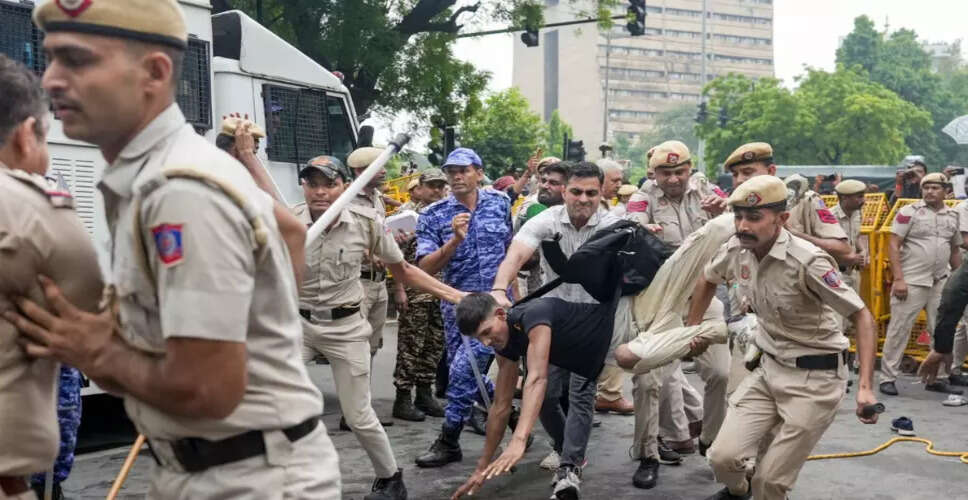
Delhi Police detain protesters attempting to push through security barricades in a bid to reach Jantar Mantar to join the CJP's march on July 20. (Photo: PTI)
New Delhi, Nov 5: On Thursday, the Supreme Court instructed a high-powered committee investigating alleged violence and police misconduct during protests led by the Cockroach Janta Party (CJP) at Jantar Mantar to continue its fact-finding mission, despite receiving minimal complaints from affected individuals.
A bench comprising Chief Justice Surya Kant and Justice Joymalya Bagchi reviewed the committee's action report submitted on October 31, noting the committee's attempts to gather complaints.
The High-Powered Enquiry Committee (HPEC), chaired by former Supreme Court judge Justice R Subhash Reddy, had established a dedicated online portal and published notices in 149 newspapers nationwide on October 17, inviting affected individuals to submit their grievances either online, in person, or via registered mail.
However, only one individual presented themselves to the committee on that occasion, providing an affidavit, while a few police officers also attended.
The report indicated a lack of response, prompting the committee to reiterate its call for complaints on October 21. Despite these efforts, the committee received very few submissions through the portal and none via email, as noted by the bench in its ruling.
The court instructed the committee to proceed with its investigation based on the existing materials rather than waiting indefinitely for complaints.
Senior advocate Gopal Sankaranarayanan, representing some petitioners, contested the committee's claims, stating that the petitioners had submitted a representation prior to the portal's launch and another afterward, which were acknowledged for future consideration.
Senior advocate Vrinda Grover suggested that evidence already presented to the Supreme Court, including video footage allegedly depicting police misconduct, should be forwarded to the committee, rather than requiring each affected individual to approach it separately.
Solicitor General Tushar Mehta, representing the Centre and Delhi Police, opposed this view, arguing that the petitioners might lack firsthand knowledge of the incidents and that victims should come forward themselves.
Grover pointed out that no FIRs had been filed regarding the alleged violence and police misconduct.
Sankaranarayanan also highlighted that despite a previous Supreme Court ruling clarifying that the committee's formation would not hinder departmental actions against officers found guilty of misconduct, no such actions had been initiated.
Justice Bagchi clarified that the court did not intend to prevent police authorities from taking action against personnel who committed violations.
“Our statement was that the committee's formation should not be interpreted as a barrier for police authorities or their superiors to act against personnel found to have committed transgressions,” he stated.
Chief Justice Surya Kant encouraged petitioners to motivate those affected to approach the committee and share their experiences.
The Supreme Court had mandated the establishment of the HPEC in August while addressing a series of petitions alleging police misconduct against student protesters during the CJP-led agitation. The petitions also included claims of violence against police personnel.
The march towards Parliament on July 20 saw confrontations between protesters and security forces, who employed batons and tear gas to disperse crowds attempting to advance towards Parliament.
The protest commenced at Jantar Mantar on June 20 and concluded on July 25 after the resignation of Pradhan and the government's acceptance of the CJP's other demands.