
Supreme Court Upholds Voter List Revision Process, Clarifies Citizenship Status
In a pivotal ruling, the Supreme Court of India clarified that the removal of names from voter lists does not equate to the loss of citizenship. The court upheld the Election Commission's authority to conduct Special Intensive Revision (SIR) as a constitutional necessity for ensuring free and fair elections. The ruling emphasized that the SIR process is valid and within the commission's jurisdiction, countering claims that it exceeded legal powers. The court also highlighted the importance of updating voter lists as part of the electoral process, reinforcing the commission's constitutional obligations. This decision comes amidst challenges to the SIR process, affirming the commission's role in maintaining the integrity of the electoral system.
| May 27, 2026, 11:48 IST
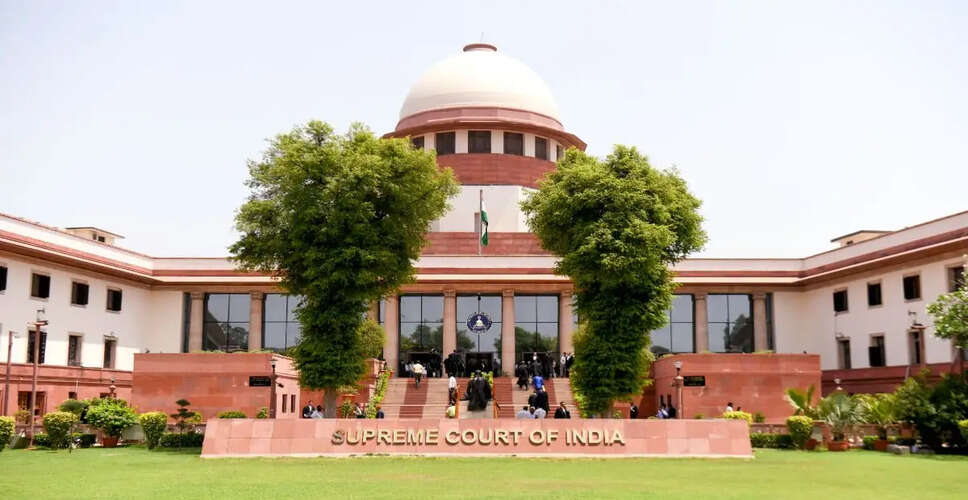

Supreme Court's Landmark Ruling
The Supreme Court delivered a significant ruling on Wednesday (May 27, 2026), clarifying that the removal of a name from the voter list does not equate to the loss of citizenship. The bench, led by Chief Justice (CJI) Suryakant and Justice Joymalya Bagchi, upheld the validity of the Election Commission of India's (ECI) 'Special Intensive Revision' (SIR). The court emphasized that the decision to conduct SIR is a constitutional necessity aimed at ensuring free and fair elections, falling well within the jurisdiction of the election commission.
Court's Observations
The bench remarked that it cannot be claimed that the election commission acted beyond its legal powers by implementing SIR. In the judgment delivered by CJI Suryakant, it was stated, "When the law permits a special amendment at any time based on recorded reasons and in any manner deemed appropriate by the election commission, this contentious process cannot be invalidated merely because it does not align with every aspect of the standard procedures intended for regular amendments. In our considered opinion, this disputed SIR does not replace the 'Representation of the People Act' and its rules; rather, it brings to life the constitutional mandate under Article 324 within the precise legal boundaries set by Section 21(3). Therefore, it cannot be said that the commission has exceeded its legal authority."
What the Court Decided
The bench ruled that the election commission possesses the power to conduct SIR under Article 324 of the Constitution, which should be read in conjunction with the 'Representation of the People Act, 1950' and its associated rules.
The court determined that the SIR process cannot be declared 'ultra vires' (beyond legal authority) simply because it deviates from the standard procedure for amending voter lists.
The apex court affirmed SIR as a valid and constitutional process, stating, "This procedure is legally valid."
Furthermore, the court noted that it is incorrect to assert that the election commission acted outside its jurisdiction by ordering SIR.
The court concluded that updating the voter list is an integral part of conducting free and fair elections; it is a constitutional obligation of the commission.
SIR Process Legality
The court stated that the election commission has the authority to amend voter lists under Section 16 of the 'Representation of the People Act, 1950'. The bench remarked, "The entire process of adding or removing names from the voter lists falls within the scope of judicial review." The Supreme Court indicated that if existing documents raise doubts about an individual's citizenship, the election commission may take action to remove their name from the voter lists.
The court asserted that there were no flaws in the SIR process, as individuals were given multiple opportunities to add information, make corrections, and file objections or appeals.
The Supreme Court further clarified that if voters are asked to submit their documents or information during the SIR process, it does not imply that they are being denied recognition as citizens.
The court stated that the provisions outlined in the SIR rules are reasonable. It noted, "Issuing notices, making information public, conducting personal inquiries in cases of doubt, and granting the right to appeal—these measures collectively fulfill the requirement of fairness." Notably, the SIR process was completed in Bihar as part of the initial phase of this exercise.
Claims in the Petitions
Several petitions challenging the SIR of voter lists claimed that the election commission lacked the authority to undertake such a large-scale exercise under Article 326 of the Constitution, the 'Representation of the People Act, 1950', or related rules.
The Supreme Court commenced the final hearing on this matter on August 12 last year, stating that the inclusion or removal of names from the voter lists falls within the constitutional jurisdiction of the election commission.
Under the SIR exercise, the election commission released data indicating that approximately 6.5 million names were removed from the draft voter lists. According to the SIR notification, voters whose names were not included in the 2002 or 2003 voter lists were required to establish their connection with individuals listed in those lists.