
Supreme Court Upholds Right to Protest Amid CJP Demonstrations in Delhi
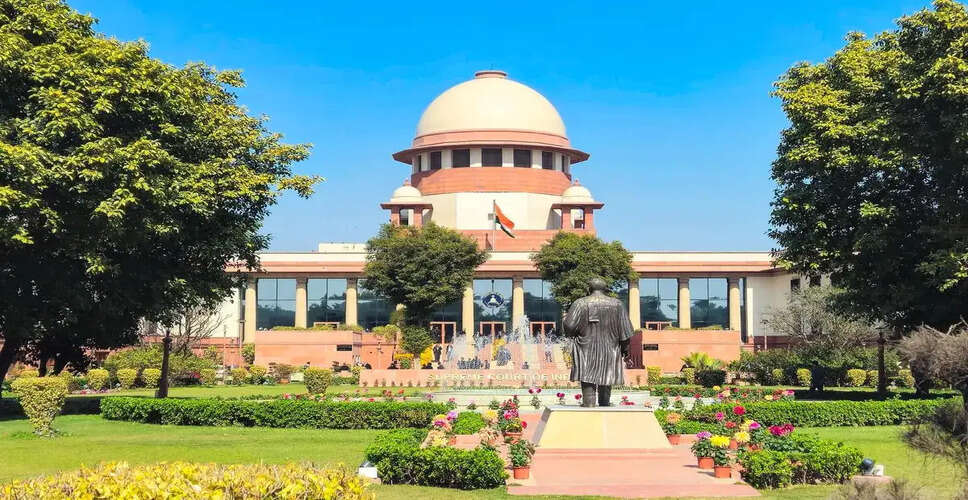

Supreme Court's Directive on Peaceful Protests
New Delhi: In response to a protest organized by the Citizens for Justice and Peace (CJP) in Delhi, the Supreme Court emphasized that individuals gathering peacefully should not face unlawful detention. The court instructed the government to ensure the normal operation of the Delhi Metro and to maintain uninterrupted internet services, provided that law and order is upheld.
During a special session, Justices Joymalya Bagchi and V Mohana addressed a plea regarding contempt proceedings for an alleged breach of the court's directive, which aimed to prevent a total ban on metro and train services in Delhi due to the CJP protest.
The CJP, along with various student organizations, initiated the protest against Chief Election Commissioner Gyanesh Kumar, citing concerns over irregularities within the Election Commission.
The government had previously disrupted a planned mass gathering at Jantar Mantar, resulting in the detention of over 7,000 protesters, including CJP leader Abhijit Dipke, several opposition figures, and YouTuber Dhruv Rathee.
The bench urged Solicitor General Tushar Mehta to ensure that the Delhi Metro operates on its regular schedule and that internet services remain unaffected, contingent on maintaining law and order.
The court also mandated that legal professionals, journalists, and others should not face obstacles while performing their duties.
The court clarified that internet access must remain uninterrupted, while still acknowledging the powers granted under the Information Technology Act.
The bench stated that illegal detentions should not occur except through lawful procedures, particularly concerning gatherings beyond the areas where section 163 of the Bharatiya Nagarik Suraksha Sanhita (BNSS) is enforced.
It ordered the removal of a notice board outside the Supreme Court premises that indicated the enforcement of section 163, which restricts assemblies of five or more individuals.
The court was informed that such a notice board had been erected in the vicinity of the Supreme Court.
The bench directed the relevant authorities to dismantle this board to ensure that citizens and lawyers can access justice.
During the proceedings, senior advocate Kapil Sibal, representing Rashtriya Janata Dal (RJD) MP Manoj Jha, reported that police were detaining individuals from trains and anyone outside a four-kilometer radius of Jantar Mantar, where prohibitory orders were in effect.
He noted that despite the court's order on October 9, 45 metro stations were closed to passengers.
Senior advocate Menaka Guruswamy highlighted that approximately 45 detention centers had been established in the city, with around 7,000 individuals, including opposition leaders, detained.
She argued that metro stations, such as GTB Nagar and Vishwavidyalaya, were entirely inaccessible to the public, indicating a deliberate violation of the court's order.
Senior advocate Shadan Farasat, who was detained during the protests, described the situation as oppressive, emphasizing the citizens' right to protest.
He expressed concern that the atmosphere resembled a police state, urging the restoration of the right to peaceful protest in the capital.
Senior advocate Gopal Sankaranarayanan informed the court that several senior advocates had also been detained and that peaceful demonstrators faced violence.
He insisted that free movement should be reinstated, all barricades removed, and metro services restored.
Mehta stated that entry and exit were restricted at only 45 out of 303 metro stations on October 10, representing merely 15% of the entire network.
He argued that petitions seeking the release of detainees were no longer relevant, as most had already been freed.
As the hearing began on Sunday, the Supreme Court indicated it would hear all lawyers regarding a plea for contempt proceedings against authorities for allegedly violating the court's directives.
The court was also considering a habeas corpus petition filed by Guruswamy concerning the detention of political leaders.
Additionally, the court is reviewing a plea from Jha alleging excessive force used by the Delhi Police during protests against the CEC and the EC.
The RJD MP accused the police of illegal detentions, abductions, house arrests of unarmed protesters, and harassment of women demonstrators.
The contempt petition, submitted by advocate Shailendra Mani Tripathi, named Union Home Secretary Govind Mohan, Delhi Police Commissioner Anurag Kumar, and Delhi Metro Rail Corporation Chairperson D Thara as respondents.
The petition referenced the Supreme Court's October 9 order, which addressed the closure of 57 metro stations and train cancellations in light of the protest.
During a hearing on Friday, a bench led by Chief Justice of India Surya Kant directed the government to ensure that there was no total prohibition on metro and train movements into Delhi on October 10 due to the protest, stating that operations could not be entirely halted.
While law enforcement has the authority to manage unruly behavior, the court emphasized that citizens should not be subjected to undue harassment.
The Delhi Metro had closed 45 stations from 9 PM Friday until 6 PM Saturday for security reasons, as per an advisory.
In its October 9 ruling, the court noted that the notifications appeared excessive, imposing a complete ban on essential public transport. The solicitor general agreed to encourage authorities to reconsider such prohibitions.
The court clarified that while there should be no outright ban on metro train movements, a reasonable decision should be made to allow metro and rail services to operate in a regulated manner.
It stressed that such decisions should be widely communicated to avoid further inconvenience.
The court also requested that a traffic advisory be published in newspapers and online platforms to facilitate smooth vehicle movement and prevent public hardship during travel within the city.