
Supreme Court Upholds ECI's Decision on Counting Supervisors Ahead of West Bengal Elections
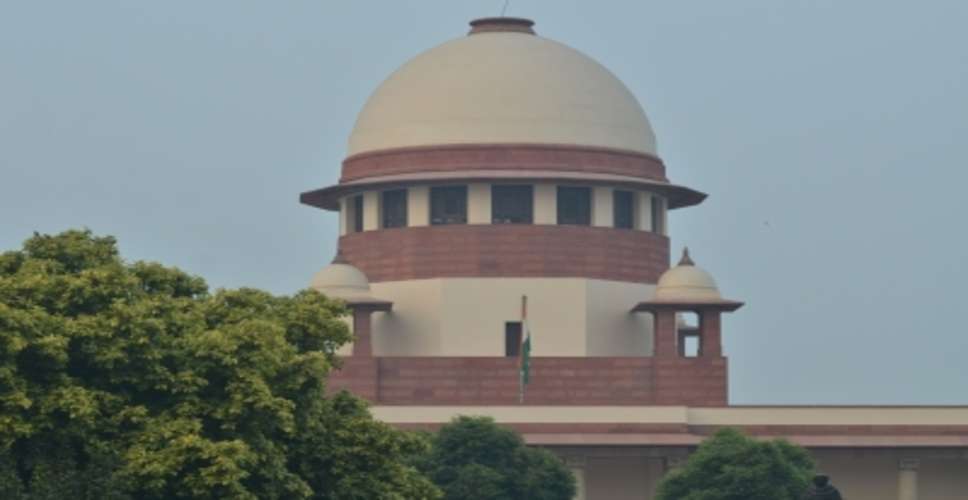

Supreme Court's Ruling on Election Commission's Authority
New Delhi: In a special session held on Saturday, just before the May 4 vote counting for the West Bengal Assembly elections, the Supreme Court decided not to intervene in the Election Commission of India’s (ECI) choice to appoint employees from the Central government and Central Public Sector Undertakings (PSUs) as counting supervisors and assistants. However, the court emphasized that the ECI must adhere to its own guidelines regarding state government nominees.
A bench comprising Justices P.S. Narasimha and Joymalya Bagchi reviewed a petition from the All India Trinamool Congress, which contested a Calcutta High Court ruling that dismissed its challenge against the ECI's framework for deploying counting personnel.
The apex court concluded the Special Leave Petition (SLP) without further directives, acknowledging the assurance provided by senior advocate Dama Naidu, representing the ECI.
Justice Narasimha's bench stated, "No additional orders are required in the SLP. We acknowledge Mr. Naidu's statement that the ECI's circular will be followed in both letter and spirit."
Naidu confirmed that the counting on May 4 would occur with the presence of the state government nominee, as outlined in the ECI's circular.
He assured the court, "The state government nominee will be present, and this will be adhered to even prior to this situation."
Kapil Sibal, representing the Trinamool Congress, argued that the ECI's decision to primarily utilize Central employees for counting supervision undermined the state administration and contradicted Article 324 of the Constitution, as well as the ECI's own circular.
Sibal pointed out, "This circular was issued to the DEO, and we learned about it on April 29. They claim to have concerns about potential issues at every booth. There is one Central government nominee, and now they want another. The circular states that a state government nominee is necessary, yet they fail to appoint one."
Justice Bagchi responded by noting that the ECI has the discretion to appoint either Central or State government officials for counting roles.
He remarked, "The option exists for the counting supervisor and assistant to be from either the Central or state government. Therefore, we cannot conclude that the notification violates regulations."
Justice Narasimha also questioned the basis of the Trinamool's concerns, highlighting that counting would occur in the presence of counting agents from all candidates and various officials, including micro-observers.
He stated, "What is this concept of proportionate representation? All of them are government employees."
When Sibal insisted on strict compliance with the circular, the Supreme Court reiterated that adherence to the ECI's framework was a sufficient safeguard.
The bench instructed, "Ensure that the provisions in the circular are followed."
The case reached the Supreme Court after the Trinamool Congress sought urgent intervention against the Calcutta High Court's refusal to annul the ECI's deployment order.
The Calcutta High Court had affirmed the ECI's authority, stating that the regulatory framework does not prohibit the appointment of Central personnel and that this decision falls within the ECI's supervisory powers.
The single-judge bench, led by Justice Krishna Rao, stated, "It is the prerogative of the ECI to appoint counting supervisors and assistants from either the state or Central government. We find no illegality in appointing counting supervisors and assistants from Central government or PSU employees instead of state employees."
The judge further noted that Clause 15.7.9 of the Returning Officers' handbook allows for the appointment of counting supervisors and assistants from either Central or state government officials or equivalent undertakings.
Addressing the Trinamool Congress's main argument that Central government employees, being under the control of the BJP-led Union government, could favor the principal opposition party in the state, the Calcutta High Court ruled that such concerns were unfounded.
It stated that micro-observers, typically sourced from Central government or PSU employees, would also be present at every counting table, alongside candidates' counting agents and other officials, ensuring adequate checks and balances.