
Supreme Court Transfers High-Profile Religious Disputes to Special Lok Adalat
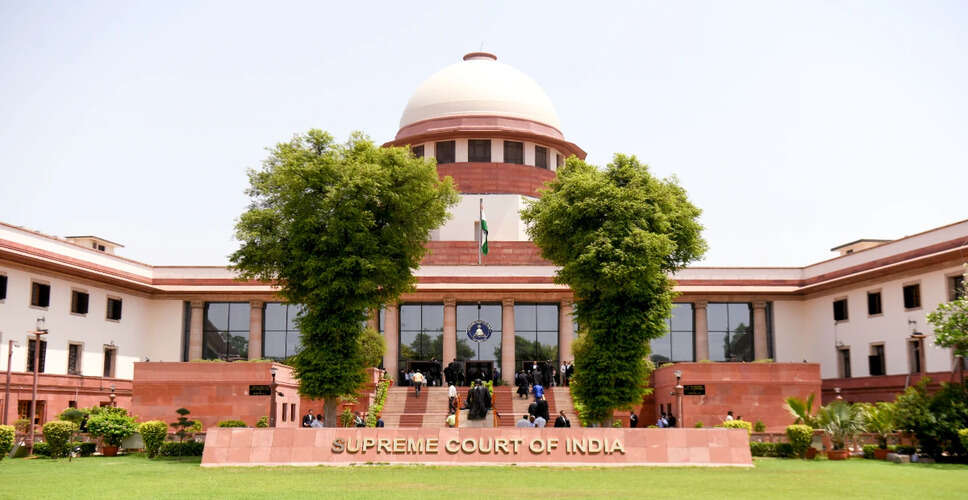

Significant Legal Development in India
A pivotal moment has emerged in India's legal landscape as the Supreme Court has decided to transfer three of the country's most sensitive and high-profile religious disputes to a Special Lok Adalat. These cases include the Gyanvapi Mosque in Varanasi, the Krishna Janmabhoomi-Shahi Idgah dispute in Mathura, and the Jama Masjid controversy in Sambhal. The court's unprecedented move aims to resolve these complex issues through amicable dialogue and mutual reconciliation rather than prolonged legal battles.
This reconciliation process, termed the "Samadhan Samaroh," is scheduled to take place from August 21 to 23, focusing on finding solutions through discussions instead of lengthy court proceedings.
Initiatives for Reconciliation Before Lok Adalat
As part of this initiative, the Supreme Court has issued notices to both Hindu and Muslim parties involved in these three cases.
Additionally, efforts for reconciliation have already begun prior to the Lok Adalat; mediation attempts in lower courts have been ongoing since April 21.
According to the schedule, a pre-reconciliation hearing for the Gyanvapi case will take place in Varanasi on July 14, ahead of the Lok Adalat proceedings.
Background on the Disputes
Gyanvapi Mosque Case
The Gyanvapi dispute centers around claims made by Hindu petitioners that the Gyanvapi Mosque in Varanasi was constructed by demolishing the original Kashi Vishwanath Temple during the Mughal era.
Numerous petitions have been filed seeking the right to worship at certain locations within the mosque complex and questioning the applicability of the 'Places of Worship (Special Provisions) Act, 1991,' which maintains the religious character of places of worship as it was on August 15, 1947.
The Anjuman Intezamia Masjid Committee, representing the Muslim side, has opposed these claims, asserting that the mosque is protected under the 1991 Act and that the petitions lack legal merit. The dispute is currently being heard in various courts, addressing issues such as survey results, worship rights, and the validity of the lawsuits.
Krishna Janmabhoomi-Shahi Idgah Dispute
This dispute pertains to the Shahi Idgah Mosque in Mathura, which is alleged to have been built on the site of Lord Krishna's birthplace by order of Mughal ruler Aurangzeb. The Hindu side claims that there are indications that a temple once existed at this location, making it a site of significant importance for Hindus.
Several lawsuits have been filed demanding the removal of the mosque or the return of the land, which the Hindu side asserts was originally the site of the Shri Krishna Janmabhoomi Temple. The Shahi Idgah Mosque Committee has contested these claims, arguing that the lawsuits are not legally valid and citing the 'Places of Worship (Special Provisions) Act, 1991' in their defense.
Sambhal Jama Masjid Controversy
The Sambhal Jama Masjid controversy arose when a civil court ordered a survey of the Mughal-era Jama Masjid. This order was issued in response to a petition claiming that the site originally housed the Harihar Temple. The survey led to violence in Sambhal last November, resulting in several fatalities and injuries.
Currently, the disputes related to Gyanvapi, Mathura, and Sambhal are pending in the Supreme Court, which is examining broader legal issues associated with these cases, including the application and interpretation of the 'Places of Worship (Special Provisions) Act, 1991.'