
Supreme Court to Hear Petitions on Pellet Gun Injuries During Student Protests

Supreme Court Agrees to Hear Petitions
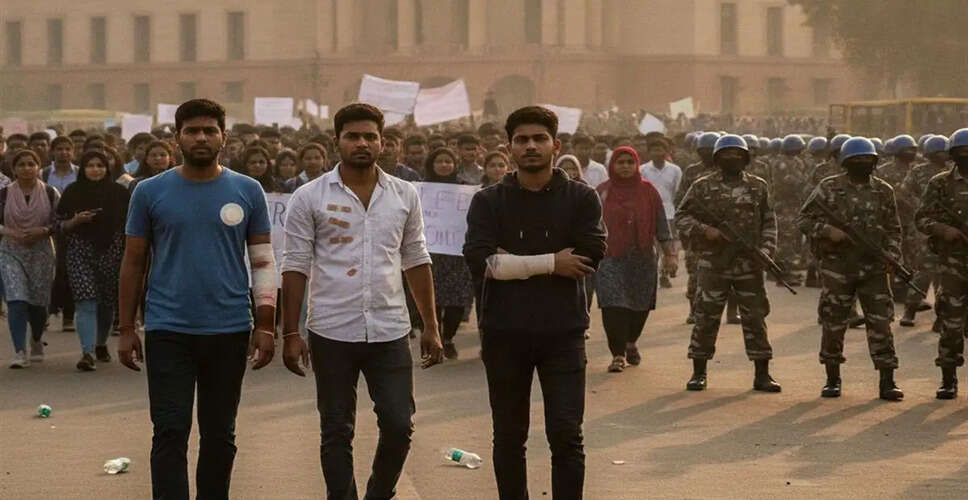
New Delhi, July 28 - The Supreme Court has agreed to hear petitions filed by a former IPS officer and two others, claiming they were injured by pellets fired from a pellet gun during student protests led by the 'Cockroach People's Party' (CAZPA) in Delhi. The case was presented before a bench headed by Chief Justice of India (CJI) D.Y. Chandrachud. The bench stated that it would hear this matter along with other petitions related to the protests on August 3.
Details of the Petition
Through advocate Vrinda Grover, former IPS officer Yashovardhan Azad, Prashant Kumar, and Sheikh Irshad Mansuri have requested the court to issue directives to halt or ban the use of pellets fired from 'pump-action rifles' or 'projectile action guns' (PAG) by law enforcement agencies to disperse crowds. The petition mentions that 25-year-old artist Prashant Kumar participated as a peaceful protester in the 'March to Parliament' on July 20. It claims he was injured by pellets during the Rapid Action Force (RAF) firing without any provocation or aggression on his part.
Injuries Reported During Protests
According to the petition, 26-year-old Sheikh Irshad Mansuri was present in Connaught Place for passport and visa-related work on the same day. He also claims to have been hit by pellets during the RAF firing without any provocation. The petition states, 'On July 20, 2026, during the 'March to Parliament' organized by CAZPA against the leak of question papers affecting the credibility of higher education in India, the Delhi Police sought assistance from the Central Reserve Police Force (CRPF) RAF for crowd management.'
Allegations Against Police Actions
The petitioners observed that around 4 to 4:30 PM that day, police and RAF personnel continuously fired tear gas, charged with batons, and pushed protesters towards the inner circle of Connaught Place in New Delhi.
Hearing on Junaid Malik's Petition
The Supreme Court also agreed to hear the petition of Junaid Malik, who provided food to protesters and alleged illegal detention, threats, and forced actions against him and his family members. Junaid claims he was detained by Delhi police officers after receiving a rabies vaccine around midnight on July 24 while returning from Ram Manohar Lohia (RML) Hospital. He alleges he was kept in a police vehicle for about five to six hours, where he was threatened and interrogated.
Concerns Over Police Conduct
Junaid further alleges that his mobile phone was forcibly opened and searched, with officials repeatedly questioning him about the source of funds for providing food to protesters. His lawyer, Prashant Bhushan, informed the bench that Junaid was 'blindfolded and taken to Mussoorie.'
Escalation of Protests
On July 20, clashes occurred between protesters and security forces during the CAZPA-led 'March to Parliament.' Security forces resorted to baton charges and tear gas to disperse the crowd heading towards Parliament. Subsequently, the protests spread to several other states. Protesters were demanding the resignation of then Union Education Minister Dharmendra Pradhan over the NEET question paper leak. The movement concluded after the minister's resignation and the government's agreement to provide compensation to the families of candidates who allegedly committed suicide over the NEET controversy, as well as the withdrawal of all FIRs against the protesters.