
Supreme Court to Form Committee to Investigate Police Actions During Protest

Investigation into Police Conduct During 'Sansad Chalo' Protest
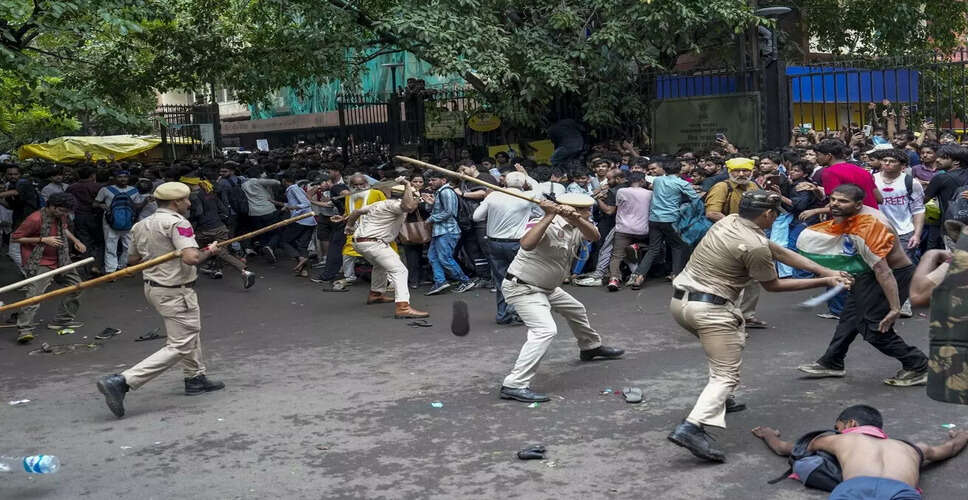
File image of Security personnel resorting to lathi-charge during 'Sansad Chalo' protest in New Delhi, on July 20. (Photo:PTI)
New Delhi, Aug 18: On Tuesday, the Supreme Court announced plans to establish a high-powered committee that will include retired judges, a former Director General of Police, a past CBI director, and other experts to investigate claims of police misconduct against student demonstrators during the 'Sansad Chalo' march in Delhi.
A bench led by Chief Justice Surya Kant, along with Justices Joymalya Bagchi and V Mohana, indicated that the committee's formation order would be issued on Wednesday, following input from involved parties regarding additional members for the panel.
The court also mandated that authorities provide video evidence and CCTV footage related to the incidents of violence that occurred during the Parliament march on July 20 for the committee's review.
This committee will also look into the grievances of female protesters who reportedly faced police aggression during the march in Delhi and its vicinity.
The bench requested Solicitor General Tushar Mehta to provide information about the FIRs filed against the student protesters, suggesting that the court might consider using its powers under Article 142 of the Constitution to dismiss these cases.
“The lives of students are at risk. We must take this into account. They have a future to consider. Their right to protest is protected under Article 19,” the bench remarked to a lawyer who opposed the idea of dismissing the cases without an apology from the students.
Mehta noted that police had identified over 2,800 individuals labeled as “anti-social elements” who had previously committed serious offenses and were implicated in the violence during the protest on July 20.
On August 3, the Supreme Court clarified that the term “criminal antecedents” in its previous ruling regarding the release of student protesters applied solely to those involved in serious crimes. It stated that states could dismiss or withdraw FIRs against other students in accordance with legal provisions.
This clarification followed the Centre's assertion that it was committed to not pursuing FIRs against students involved in protests related to the alleged NEET examination paper leak, including the July 20 march, as long as they did not have criminal backgrounds.
The apex court had previously emphasized that police violence or a “lathi charge” cannot be justified simply due to protests, reaffirming that the right to peaceful demonstration is “completely guaranteed.”
The 'Sansad Chalo' march, led by the Cockroach Janta Party (CJP) on July 20 in Delhi, resulted in confrontations between protesters and law enforcement, who employed batons and tear gas to disperse crowds attempting to approach Parliament.
Earlier that day, the Supreme Court requested responses from the Centre and state governments regarding a public interest litigation (PIL) that sought orders to seize the movable and immovable assets of offenders and their families allegedly involved in examination question-paper leak incidents.
A bench consisting of Justices PS Narasimha and Alok Aradhe issued notices to the Union of India and the states concerning the plea filed by advocate Ashwini Kumar Upadhyay. The Supreme Court has scheduled the next hearing for September 25.