
Supreme Court Rules on Caste and Religious Conversion in Tamil Nadu

Supreme Court's Decision on Religious Conversion and Caste
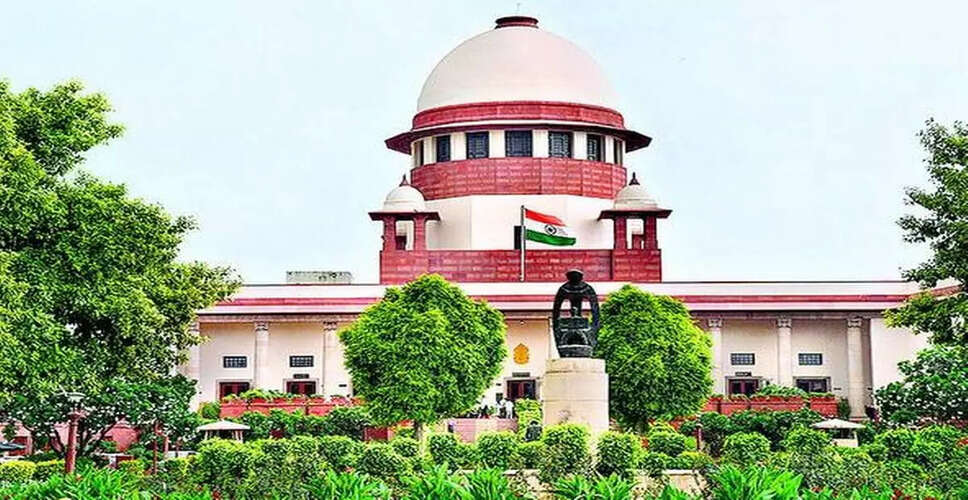
File image of the Supreme Court of India. (Photo: X)
New Delhi, Oct 15: On Thursday, the Supreme Court ruled that the social disadvantages linked to an individual's original caste and religious identity do not automatically transfer to a different religious community after conversion.
A bench comprising Justices Prashant Kumar Mishra and Shree Chandrashekhar dismissed a special leave petition from the Tamil Nadu government, which contested a ruling from the Madras High Court. This ruling had prohibited individuals converting to Islam from claiming reservations under the Backward Class (Muslim) category based solely on their conversion.
The apex court upheld the High Court's decision, finding no valid reason to overturn the judgment that invalidated a Tamil Nadu government order allowing certain converts to be classified as Backward Class Muslims for reservation purposes.
This case originated from a petition by Sameer Ahamed N., who converted to Islam from Hinduism in 2015.
After his conversion, he sought a community certificate to identify as a Muslim Lebbai, but his request was denied by the revenue authorities.
The Madras High Court supported this rejection and deemed Government Order No. 31, issued on March 9, 2024, unconstitutional.
This order had allowed individuals from Backward Classes (BC), Most Backward Classes (MBC), Denotified Communities, and Scheduled Castes to be classified as Backward Class Muslims for reservation purposes.
The High Court deemed the order arbitrary, as it attempted to merge individuals from different reservation categories, such as Scheduled Castes and Backward Classes, into the same Backward Class Muslim category.
It also stated that merely converting to Islam does not automatically confer membership in a recognized Backward Class Muslim community.
This ruling from the Supreme Court follows a previous decision regarding Scheduled Caste status after conversion to Christianity, where the court ruled that individuals adopting religions outside Hinduism, Sikhism, or Buddhism lose their Scheduled Caste status under the Constitution (Scheduled Castes) Order, 1950.
In that March 24 ruling, the court found that conversion to a non-Hindu religion results in the immediate and total loss of Scheduled Caste status, subsequently dismissing a review petition that sought to challenge this verdict.
In the Tamil Nadu case, the Supreme Court had reserved its decision on August 7, with the state government's appeal arguing that the High Court's ruling raised significant questions regarding the extent of judicial intervention in executive policies established based on expert statutory commission recommendations.