
Supreme Court Rules in Favor of CRPF Constable Denied Employment After Vision Loss
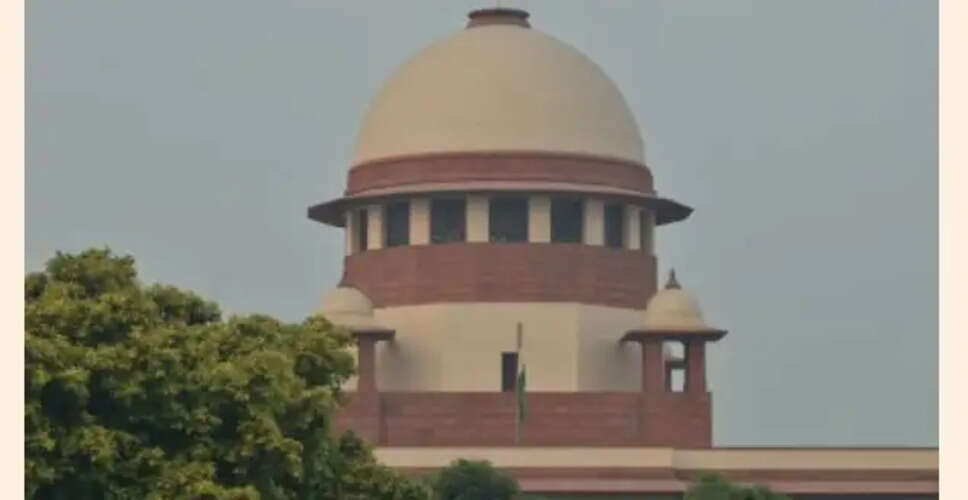

Supreme Court's Landmark Decision
New Delhi: On Monday, the Supreme Court upheld a ruling from the Himachal Pradesh High Court that determined the Central Reserve Police Force (CRPF) had unlawfully invalidated a constable after he lost his sight while on duty. The court emphasized that the authorities had a legal obligation to accommodate him rather than terminate his employment.
A bench comprising Justices Dipankar Datta and A.G. Masih dismissed an appeal from the Union government and the CRPF, while also adjusting the compensation awarded by the High Court to the constable, Bali Ram, to a total of Rs 1.25 crore, which includes back wages, interest, and legal expenses.
The Supreme Court found that Bali Ram, who served as a driver for the CRPF, developed a visual impairment during his service in 1996 and was declared medically unfit in 1998, violating Section 47 of the Persons with Disabilities (Equal Opportunities, Protection of Rights and Full Participation) Act, 1995.
Justice Datta's bench stated, "The duty imposed by the PwD Act is mandatory, not discretionary. The law does not permit the authorities to fulfill their obligations at their convenience. They were required to provide a position for the respondent rather than waiting for him to request one."
The ruling noted that after the constable's eye condition worsened, he was deemed permanently unfit for both driving and combat duties by the Medical Board, leading to his medical invalidation on March 11, 1998.
The Supreme Court rejected the Centre's argument that the CRPF was exempt from Section 47 of the PwD Act due to a 2002 notification, clarifying that such an exemption could only apply prospectively and could not legitimize actions that had already been deemed illegal.
The bench expressed confusion over the CRPF's disregard for the statutory requirements, stating, "It is perplexing that the CRPF failed to act promptly. As a state instrumentality, it should have been fully aware of the PwD Act's provisions and the protections afforded to the respondent under Section 47."
The court criticized the CRPF for not providing an alternative position, stating that they failed in their duty as a responsible employer and rendered a welfare provision ineffective.
Highlighting that the respondent had been out of work for nearly thirty years and faced significant financial difficulties despite winning his case in the Himachal Pradesh High Court in 2008, the Supreme Court noted that reinstatement was no longer practical due to his age.
The court remarked, "The respondent's unemployment is entirely due to the appellants' actions. Therefore, he is entitled to full back wages, and the appellants must face the repercussions of their inaction."
While confirming that the respondent's medical invalidation was unlawful, the Supreme Court modified the relief from the High Court and ordered the Union government and the CRPF to pay him Rs 1.25 crore within eight weeks. Additionally, it instructed the Himachal Pradesh State Legal Services Authority or the District Legal Services Authority in Kangra to assist the visually impaired respondent in managing part of the compensation and addressing his future medical needs.