
Supreme Court Probes DGP Appointments: What’s at Stake for Jharkhand?
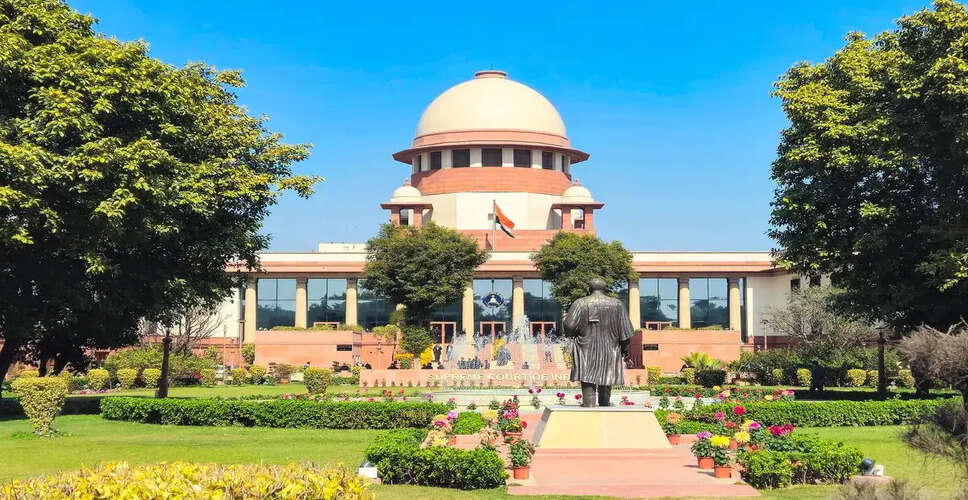

Supreme Court's Inquiry into DGP Appointments
New Delhi: The Supreme Court has expanded its investigation into the appointment processes for Directors General of Police (DGPs), requesting the central government to summarize the legislative or executive frameworks each state employs for selecting police chiefs.
A bench led by Chief Justice Surya Kant, along with Justices Joymalya Bagchi and V Mohana, has directed the Jharkhand government and its DGP, Tadasha Mishra, who was appointed just before her retirement, to respond to a challenge from the Centre regarding her promotion by November 16.
The Chief Justice acknowledged the arguments presented by senior advocate Raju Ramachandran, who is serving as an amicus curiae, stating that the Union should be able to provide a summary of the existing frameworks for DGP appointments across states.
Ramachandran urged the court to require both the Centre and the states to reveal whether they have enacted laws or established rules governing DGP appointments, and whether these regulations are being followed.
He highlighted that some states have created rules akin to those of Jharkhand while still claiming adherence to the Supreme Court's directives in the Prakash Singh case.
Specifically, he mentioned Uttar Pradesh and Punjab as states with similar provisions.
A thorough evaluation of the legal and executive frameworks across states is essential for the court to address the matter comprehensively, rather than examining individual state rules in isolation.
The bench indicated that states would need to submit their responses.
The court noted that relevant provisions could be in the form of statutes, regulations, or executive orders, but their legal implications would be subject to judicial review.
The bench requested the amicus curiae to prepare a detailed note for the record and instructed the Registry to accept and distribute copies to the attorneys involved.
Additionally, the current DGP of Jharkhand has been given until November 16, 2026, to file a counter-affidavit.
Solicitor General Tushar Mehta, representing the Centre, emphasized that the Jharkhand matter should be prioritized, as the state's rules appear to violate the Supreme Court's guidelines regarding the DGP appointment process.
On October 8, the bench raised concerns about the legitimacy of the Jharkhand government's rules for appointing its police chief.
In that session, the bench remarked that the relevant provision seemed to contradict the legal standards established in the Prakash Singh ruling.
It further noted that if the rule were to be invalidated, the appointment of the current DGP could also be annulled.
Senior advocate Kapil Sibal, representing Jharkhand, informed the court that he had consulted with the chief secretary and that the state would review the situation and submit an appropriate application or affidavit.
The Centre has contested the Jharkhand government's Selection and Appointment of Director General and Inspector General of Police, Jharkhand (Head of the Police Force) Regulation, 2025, which was notified on January 8, 2025.
Initially, the regulation established a nomination committee for selecting the DGP, including a panel of three to five officers and a minimum residual service requirement of six months.
The Centre claims that the Jharkhand government later amended the regulation on December 29, 2025, appointing Tadasha Mishra as DGP on December 30, just before her retirement.
According to the Centre, this appointment allowed an officer nearing retirement to secure a two-year term, which contradicts the Supreme Court's prescribed procedures.
The Centre's petition, filed on July 16, also questions the prior appointment of Anurag Kumar Gupta as Jharkhand DGP on February 2, 2025, when he reportedly had only about three months of service left.
The Supreme Court's pivotal 2006 ruling in Prakash Singh vs Union of India established safeguards to ensure transparency, merit, and stability in the selection of state police chiefs.
It mandated that DGPs be chosen by state governments from among the three senior-most eligible officers recommended by the UPSC, based on their service length, exemplary records, and experience.
The ruling also required a minimum tenure of two years for appointed DGPs, regardless of their retirement dates.