
Supreme Court Justice Advocates for Improved Coordination Among Judges
Justice Abhay S. Oka has raised concerns about the coordination among judges in the Supreme Court, labeling it as a 'Chief Justice-centric court.' He advocates for structural changes to better represent the diverse regions of the country. Highlighting the significant backlog of cases in lower courts, he calls for a shift in focus to ensure justice is served efficiently. Oka also reflects on his career, emphasizing the need for introspection as the Supreme Court celebrates its 75th anniversary. His remarks during a farewell event have sparked discussions on the future of the judiciary in India.
| May 24, 2025, 11:44 IST
Call for Change in Supreme Court Structure
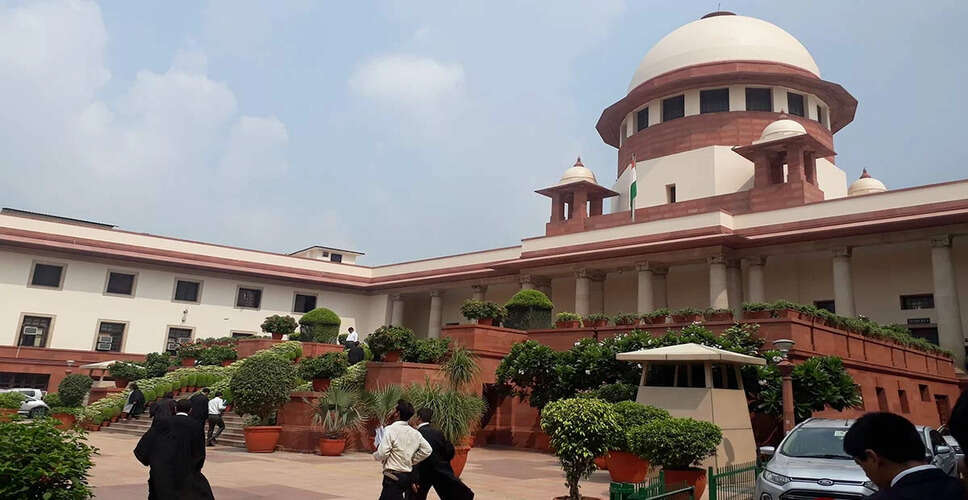
Is there effective coordination among all judges in the Supreme Court? This question arises as Justice Abhay S. Oka referred to the Supreme Court as a 'Chief Justice-centric court' on Friday, advocating for changes in its structure given the presence of 34 judges from various regions of the country. During an event organized by the Supreme Court Bar Association (SCBA), Justice Oka pointed out that both the Supreme Court and High Courts have neglected lower and district courts, which are the backbone of the judiciary. He highlighted the significant backlog of cases in lower courts, with some pending for as long as 30 years.
In his farewell address, Justice Oka remarked, 'High Courts operate in a more democratic manner compared to the Supreme Court, as they have an administrative committee of five judges that makes key decisions. Over the past few years, I have observed that the apex court is primarily focused on the Chief Justice, and I believe we need to change this perception.' He emphasized that the Supreme Court comprises 34 judges from diverse regions, indicating the necessity to shift away from a Chief Justice-centric image.
Related Reading: Why Should the Public Bear the Unwanted Burden of Corruption?
Earlier on the same day, Justice Oka stated that the Supreme Court is capable of upholding constitutional freedoms, which was the vision of the framers of the Constitution. Responding to praises from lawyers, bar leaders, Chief Justice B.R. Gavai, and Justice A.G. Masih, he expressed, 'I must admit that after listening to what has been said in the last hour and 20 minutes, I am left speechless. Perhaps today is the first and last day of my professional life when I did not interrupt anyone speaking, as I was unable to do so. I have witnessed so much love and affection from bar members that I am truly at a loss for words.'
During the SCBA ceremony, Justice Oka also mentioned that manual intervention in listing selected cases should be minimized. He noted, 'People complain about why some cases are listed the next day while others remain pending for days. Until we significantly reduce manual intervention, we cannot improve our listing process. We have artificial intelligence (AI) technology and other software that can assist in rationally listing cases.' Justice Oka stated that throughout his career spanning over two decades, he has never delivered a dissenting judgment.
He added, 'Throughout my tenure, I have never issued a dissenting judgment, nor have my colleagues. An exception occurred just two days ago.' The judge clarified that he would not give interviews immediately after retirement and would need some time before speaking to the press. Justice Oka stated, 'I have decided that while I am in office, it is not possible for me to speak with the media. I will never do that. I need two to three months. The reason is that if I speak to the media today, my mind will be filled with emotions, and I might say something I shouldn't.'
In a separate message to the bar, Justice Oka noted that on January 28, the court marked its 75th anniversary. Instead of celebrating, he emphasized the need for introspection. He remarked, 'The citizens of this country had high expectations from this court. While no one can deny the contributions of this court, my personal view is that the Supreme Court has not fulfilled the hopes of the citizens of India.'