
Supreme Court Intervenes in Wing Commander Nikita Pandey's Case, Addressing Women's Challenges in IAF
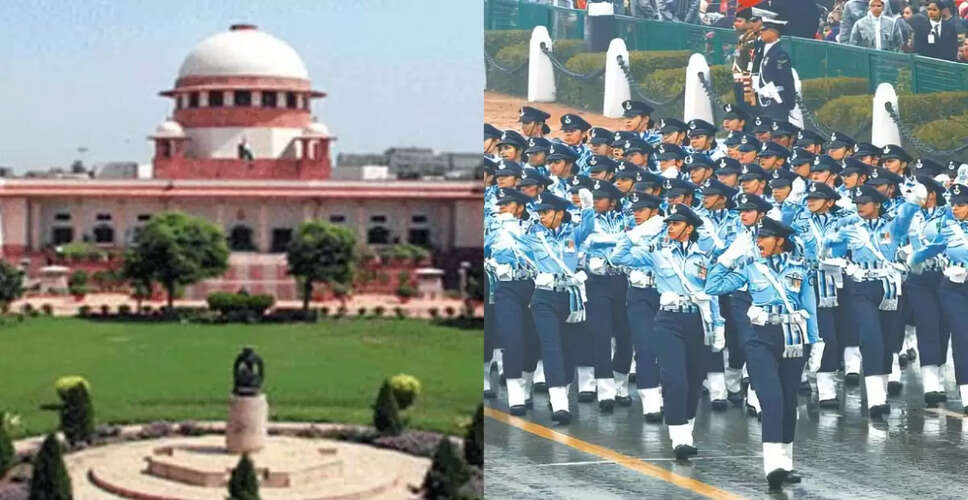
Supreme Court's Intervention in IAF Women's Commission Case
In a significant move for female officers in the Indian Air Force (IAF), the Supreme Court has intervened in the case concerning Wing Commander Nikita Pandey. On Thursday, the court instructed the Centre and the IAF to halt her impending release from service, emphasizing the need to tackle the challenges faced by Short Service Commission (SSC) officers regarding their long-term career prospects in the military.
Wing Commander Nikita Pandey, a distinguished officer known for her expertise as a fighter controller during critical operations such as Operation Balakot and Operation Sindoor, approached the Supreme Court after being denied a permanent commission. She argues that the 2019 policy change adversely affected her career despite her commendable service of over 13.5 years and her position as the second-ranked expert air fighter controller in the nation.
During the proceedings, Senior Advocate Menaka Guruswamy, representing Pandey, highlighted the urgency of her situation, as she was required to conclude her service within a month due to the denial of the permanent commission. The argument pointed out the inequality faced by women officers, who have been part of the IAF since 1992 but primarily enter through SSC, unlike their male counterparts who have access to both SSC and permanent commission options.
The Supreme Court bench, led by Justices Surya Kant and N Kotiswar Singh, voiced strong concerns during the hearing. They commended the IAF as 'one of the best organizations globally' and questioned how career uncertainty could be advantageous for such a professional entity. Justice Surya Kant remarked, 'That sense of uncertainty may not be good for the Armed Forces,' suggesting that if the IAF recruits a specific number of SSC officers, it should be able to retain them in permanent roles if they meet the necessary criteria. He also noted that the 'steep pyramidal structure' cited by the IAF, which leads to officer exits after 14 years to maintain youth within the force, should be balanced with opportunities for deserving candidates.
Aishwarya Bhati, the Additional Solicitor General representing the Centre and the IAF, stated that while they support capable officers continuing their service, Pandey was deemed 'unfit' by the selection board. She also informed the court that a second selection board would review her case and that Pandey had approached the apex court directly without prior representation.
The Supreme Court has temporarily stayed Pandey's release from service until further notice and has scheduled the next hearing for August 6. While granting this interim relief, the court clarified that it would not establish any equity in her favor, leaving all arguments open for detailed discussion.
This case highlights the persistent challenges women officers face in achieving equal career advancement within the armed forces, despite earlier Supreme Court rulings supporting permanent commissions for women. Wing Commander Nikita Pandey's fight for a permanent commission could potentially lead to policy reforms and create a more transparent and equitable pathway for dedicated officers in the Indian Air Force.