
Supreme Court Highlights Urgent Need to Tackle Air Pollution in Delhi-NCR
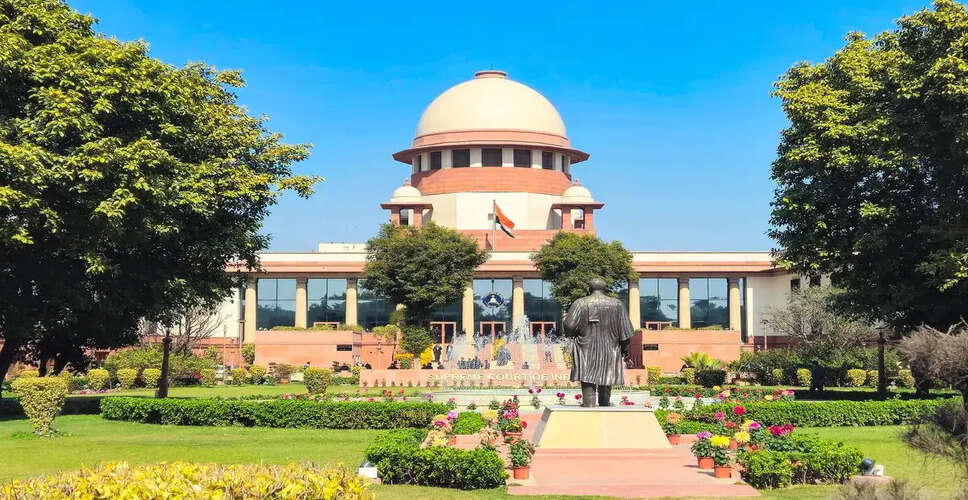

Supreme Court's Stance on Air Quality Crisis
New Delhi: On Friday, the Supreme Court identified vehicle emissions as a significant factor contributing to air pollution in the Delhi-NCR region, emphasizing the necessity for immediate, medium, and long-term strategies to address the escalating air quality index.
During a suo motu hearing focused on the regulatory measures related to air pollution, a bench led by Chief Justice of India Surya Kant, alongside Justices Joymalya Bagchi and V Mohana, expressed alarm over the 'bumper-to-bumper' traffic prevalent in the area.
"We often discuss and propose solutions, yet the air quality index has already reached alarming levels, nearing 400," remarked the Chief Justice.
The bench pointed out the overwhelming number of vehicles on roads linking Delhi with surrounding areas such as Ghaziabad, Greater Noida, Gurugram, and Faridabad.
"Observe the roads in Delhi and those connecting to the NCR. The sheer volume of vehicles is a major issue," the Chief Justice stated.
The bench noted that the underprivileged are the most affected, as they are the ones on the roads, and the festive season is crucial for their livelihoods.
Regarding stubble burning, the bench highlighted the importance of educating farmers on utilizing machinery instead of resorting to open burning.
In response to a request for either closing schools or implementing hybrid learning for all students when the AQI exceeds a certain threshold, the bench indicated it would rely on expert advice.
Additional Solicitor General Aishwarya Bhati, representing the Centre and other authorities, discussed the regulatory framework addressing five key sectors: industrial emissions, vehicular pollution, construction dust, road dust, and stubble burning.
She informed the bench about various measures already in place, including restrictions on specific vehicles, geo-tagging of pollution under control (PUC) certificates, and actions against visibly polluting vehicles based on complaints received through apps and social media.
Bhati noted that stubble burning was responsible for 14 percent of Delhi's pollution as of Thursday.
The bench stated it would issue orders and revisit the plea on November 16, after the court reconvenes following the Diwali break.
A thick layer of smog enveloped the national capital on Friday, with air quality sharply declining and nearing the 'severe' category, as the overall AQI reached 391.
Among the 59 monitoring stations in the city, 30 reported 'severe' air quality at 9 am, while the others fell into the 'very poor' category.
Rohini recorded the worst AQI at 475, followed closely by IIT Delhi at 472, according to official data.