
Supreme Court Grants Abhishek Banerjee Permission for Medical Travel Abroad

Supreme Court Decision on Travel Request
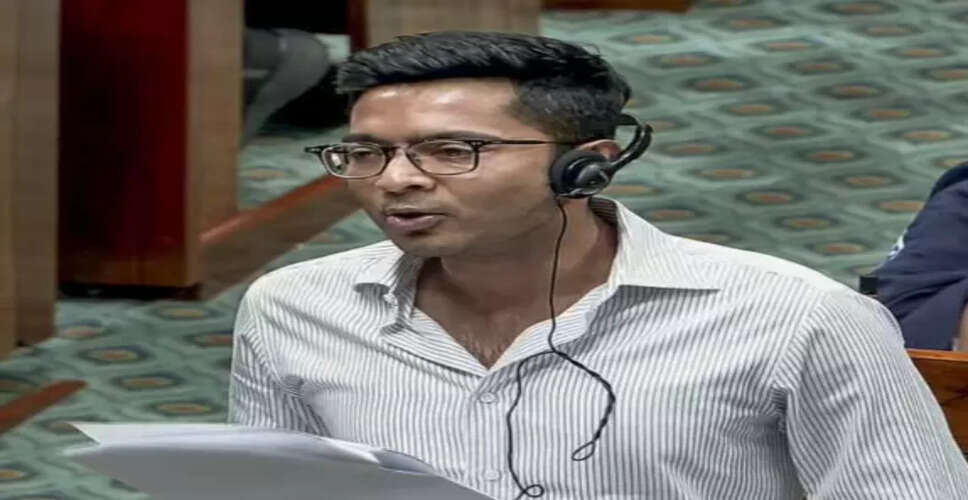
File image of TMC general secretary and Lok Sabha member Abhijit Banerjee(Photo: IANS)
New Delhi, Aug 10: The Supreme Court has permitted Abhishek Banerjee, general secretary of the Trinamool Congress and Lok Sabha member, to travel abroad for three weeks for eye treatment, overturning the Calcutta High Court's earlier decision that denied him this opportunity.
A bench led by Chief Justice of India Surya Kant, along with Justices Joymalya Bagchi and V. Mohana, granted Banerjee's appeal with specific conditions. He is required to travel using his diplomatic passport and must provide his travel itinerary and accommodation details to the investigating authorities.
The Chief Justice expressed reluctance to consider the West Bengal government's objections regarding Banerjee's travel, emphasizing that every individual has the right to seek medical treatment abroad.
During the proceedings, Additional Solicitor General S.V. Raju, representing the West Bengal government, opposed the request, citing multiple cases against Banerjee and concerns that he might not return if allowed to travel.
Raju acknowledged that the state had no issue with Banerjee receiving medical care overseas but insisted that a medical evaluation should first confirm the necessity of such treatment.
He argued that Banerjee's refusal to appear before a medical board set up by the Calcutta High Court should lead to a negative inference regarding his claims.
In contrast, senior advocate Gopal Sankaranarayanan, representing Banerjee, stated that his client only possessed a diplomatic passport linked to Operation Sindoor outreach, assuring that the relevant embassies would monitor his travel.
Sankaranarayanan also highlighted that Banerjee, being a Lok Sabha member and the general secretary of a national party with family ties in India, had no intention of fleeing.
After considering the arguments, the Supreme Court instructed Banerjee to provide comprehensive details about his travel plans, including his accommodation, the medical professionals or facilities he intends to visit, the duration of his stay, and flight information.
The bench noted that the information provided by Banerjee could be utilized by the investigating agencies but would remain confidential.
Banerjee had approached the Supreme Court following the Calcutta High Court's rejection of his request on August 5 to travel abroad for eye treatment.
The High Court denied the request after Banerjee's legal team informed that he would not attend a medical evaluation at the state-run S.S.K.M. Medical College and Hospital in Kolkata to assess his eye condition.
Previously, on August 3, the Supreme Court had addressed Banerjee's plea challenging the High Court's refusal to allow immediate travel, urging the High Court to expedite its decision.
This case is linked to allegations against Banerjee for making inflammatory remarks during the campaign for the 2026 West Bengal Assembly elections.
The travel restrictions were initially imposed as a condition of interim protection from arrest.
Banerjee first sought permission from the Calcutta High Court on June 23 to travel abroad for seven days for eye treatment, citing a decade-long medical history following a serious eye injury from a road accident in October 2016.
The accident occurred while he was returning to Kolkata from a political event in Murshidabad district, leading to subsequent treatments in both India and abroad.