
Supreme Court Expresses Concern Over Judicial Corruption Section in Textbooks
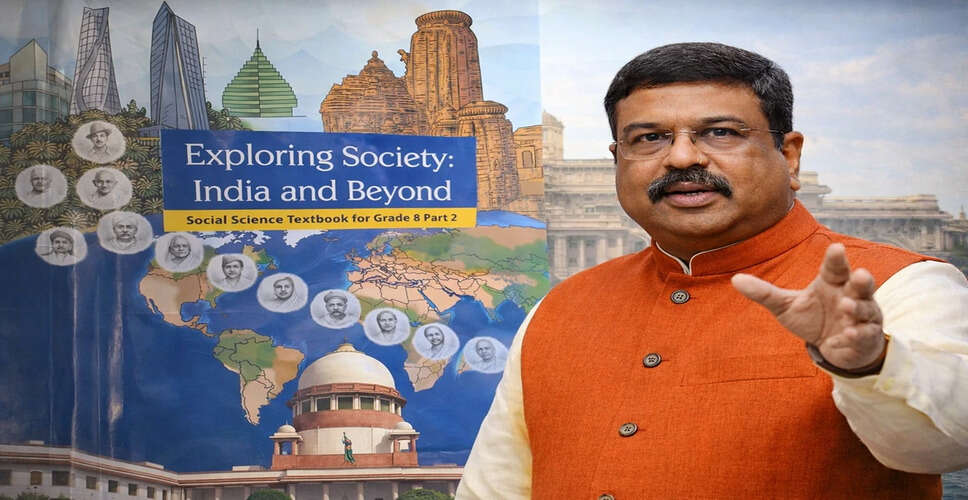
Judiciary Under Scrutiny
The current state of the judiciary is alarming, raising serious concerns. With the book already available in the market and on social media, retracting it later seems ineffective. If educators and students are taught that the judiciary is corrupt, it could lead to confusion and misinformation in society. Chief Justice of India, D.Y. Chandrachud, expressed his displeasure in a packed courtroom regarding the inclusion of a section on judicial corruption in a Class 8 textbook.
Court's Reaction to the Controversy
On February 26, the Supreme Court took suo motu cognizance of the issue, with Chief Justice Chandrachud visibly upset. During the proceedings, Solicitor General Tushar Mehta represented the government and offered an unconditional apology for the NCERT's oversight, but this did not appease the Chief Justice. He remarked that this appears to be a deliberate attempt to tarnish the judiciary's reputation, likening it to a direct attack on the institution.
Concerns Over Educational Impact
The Chief Justice questioned the effectiveness of retracting the publication when it is already accessible to the public. He emphasized that teaching students about judicial corruption could mislead society. He also expressed frustration towards the UGC, demanding clarity on whether NCERT was instructed to publish such a book after an article appeared in the Indian Express on February 24, 2026.
Court's Directive for Transparency
The court ordered that the minutes from meetings discussing the chapter be presented at the next hearing. It noted that the chapter referenced complaints against judges in a manner suggesting no action had been taken. The bench pointed out that comments from former Chief Justices were presented out of context, implying that the current Chief Justice acknowledged the existence of corruption.
Long-Term Effects on Society
The court highlighted that the book's impact would extend beyond students to their parents, the broader community, and even future generations. It criticized the absence of acknowledgment regarding the judiciary's historical contributions to strengthening democratic frameworks, stating, 'This silence is particularly objectionable, especially since this court has reprimanded numerous high officials for corrupt practices and misuse of public funds.'
Courtroom Developments
Solicitor General Tushar Mehta confirmed that NCERT has apologized for the error in the book. In response, Chief Justice Chandrachud noted that the NCERT's press release lacked any expression of regret. He recalled that when he sought information from the Supreme Court's Secretary General regarding news reports, NCERT had defended the chapter. The Solicitor General assured that those responsible would not be associated with NCERT or any ministry in the future, but the Chief Justice deemed this response insufficient.
Education Minister's Response
Following the Supreme Court's stern stance on the Class 8 textbook, Union Education Minister Dharmendra Pradhan expressed regret. He stated that action would be taken against those involved with NCERT, ensuring such a situation does not recur. The committee responsible for the chapter on 'Judicial Corruption' will face consequences. He mentioned that as soon as the issue came to light, efforts were made to withdraw the books. The education secretary has been tasked with identifying who included this irresponsible chapter, and NCERT is also investigating to pinpoint the responsible parties and processes to prevent future errors.