
Supreme Court Dismisses Petition Against PM Modi's Chadar Offering at Ajmer Sharif Dargah
Supreme Court's Ruling on Chadar Offering
On Monday, the Supreme Court dismissed a petition aimed at preventing Prime Minister Narendra Modi from presenting a chadar at the Ajmer Sharif Dargah. The court's decision was reported by a legal news outlet.
The bench, comprising Chief Justice Surya Kant and Justice Joymalya Bagchi, stated that the issue had become moot since the offering had already occurred in December.
They further noted that this matter was not suitable for judicial review, according to the legal news source.
Nonetheless, the court emphasized that its ruling would not affect an ongoing civil case, which asserts that the shrine of the 13th-century Sufi saint Khwaja Moinuddin Chishti was constructed over a Hindu temple.
The petition against the annual offering was filed by Vishnu Gupta, the leader of Hindu Sena, in January 2025. He argued that the act would lend 'political legitimacy' to what he claims is a disputed site.
In his initial lawsuit, Gupta requested that the Ajmer Sharif Dargah be recognized as Bhagwan Shri Sankatmochan Mahadev Virajman temple. He also sought the removal of the dargah committee and requested a survey of the site by the Archaeological Survey of India.
Gupta contended that the architectural design at the main entrance resembles that of a Hindu temple, indicating that the location was originally a place of worship for Hindus.
Since 2014, Prime Minister Modi has traditionally sent a chadar to the shrine each year for the Urs, a ceremony commemorating the death anniversary of the Sufi mystic. This tradition has been upheld by previous prime ministers as well.
Gupta claimed that this practice, which began with former Prime Minister Jawaharlal Nehru in 1947, has continued without any legal or constitutional foundation.
The writ petition was filed before Modi's customary offering in January 2025.
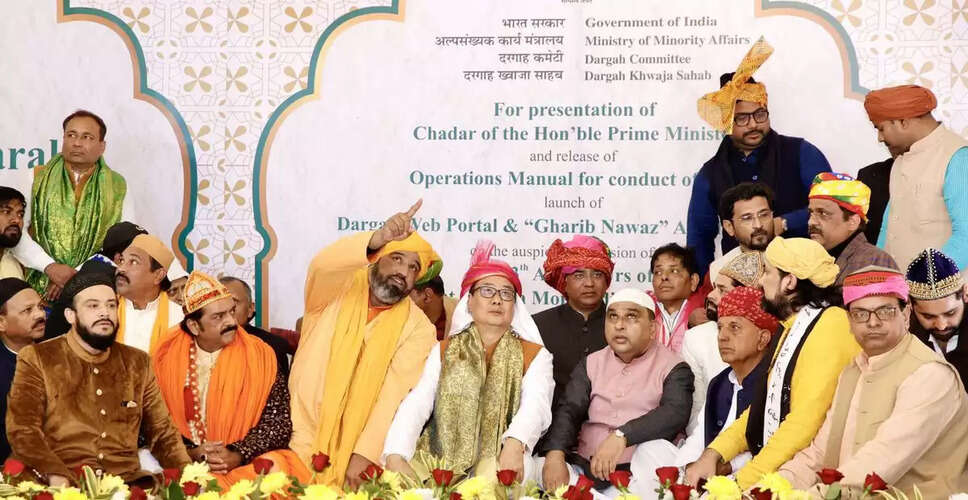
Additionally, a subsequent offering was made by Union Minister for Minority Affairs Kiren Rijiju on December 22 on behalf of Modi.
On the auspicious occasion of the 814th Urs of Khwaja Garib Nawaz, I had the privilege of visiting the revered Dargah Sharif, Ajmer & offering the sacred chadar at the holy shrine.
— Kiren Rijiju (@KirenRijiju) December 22, 2025
I prayed for the peace, harmony & well-being of all. Khwaja Sahib’s timeless message of love,… pic.twitter.com/nT94vxCEsM
In December 2024, the Supreme Court prohibited trial courts from issuing orders, including survey directives, in ongoing lawsuits regarding the religious status of places of worship.
It also declared that no new lawsuits could be filed in any court nationwide until further notice while it reviews several petitions challenging the constitutional validity of the 1991 Places of Worship Special Provisions Act.
This Act prevents any alterations to the religious character of a place of worship as it existed on August 15, 1947.
Currently, there are at least 18 lawsuits pending in courts across the country concerning 10 mosques and shrines, including the Gyanvapi mosque in Varanasi, the Shahi Eidgah mosque in Mathura, and the Atala Mosque in Jaunpur. Hindu plaintiffs in these cases assert that these structures were erected after the demolition of ancient Hindu temples.